


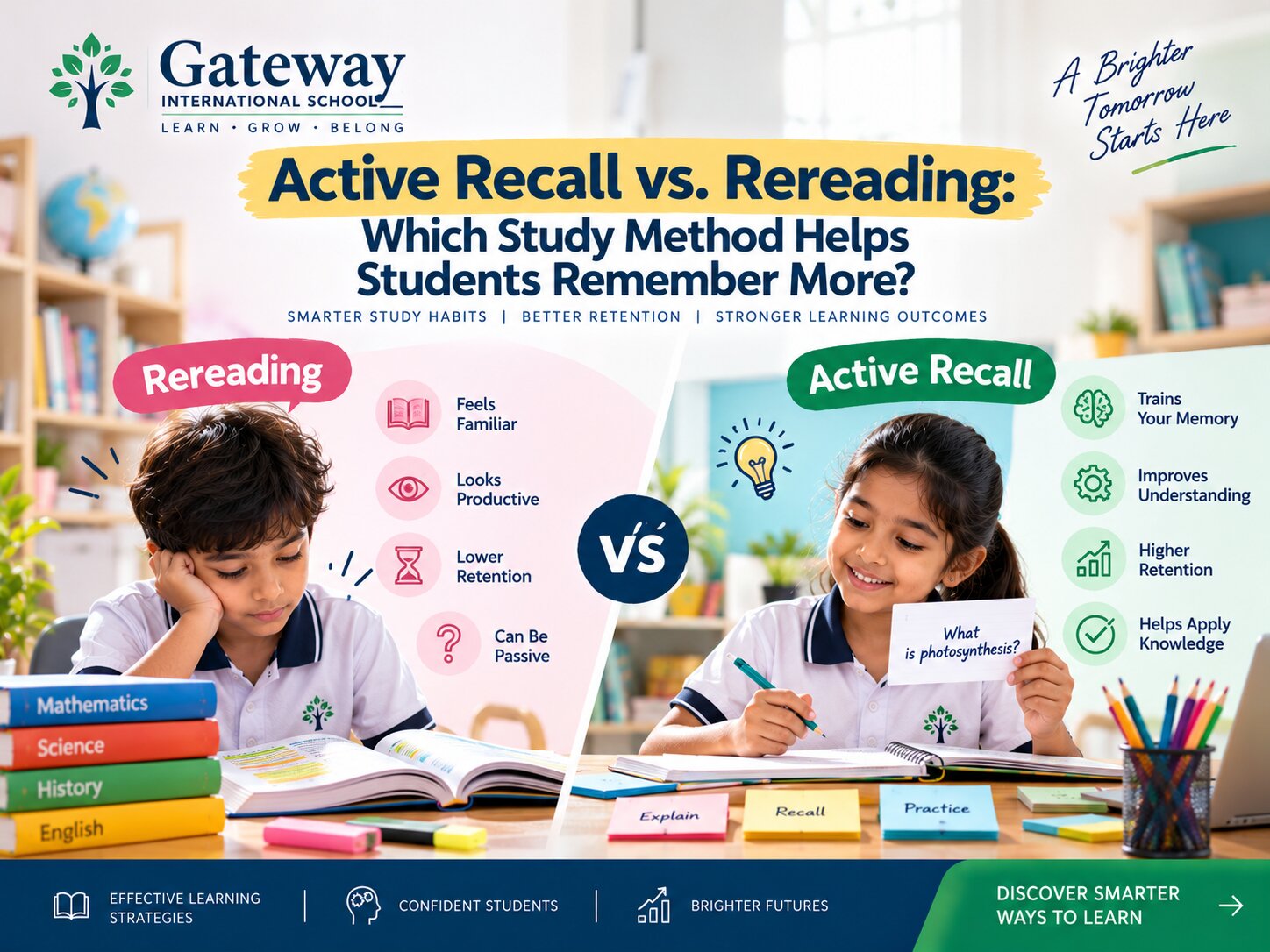
Active Recall vs. Rereading: Which Study Method Helps Students Remember More?
Have you ever noticed your child spending hours reading a textbook, highlighting important sentences, and reviewing notes, only to struggle to remember the same information during an exam?
Many students believe that repeatedly reading their notes is the best way to prepare for examinations. While rereading can help students become familiar with a topic, it does not always mean they can recall or apply what they have learned.
An alternative approach is active recall, a study technique that encourages students to retrieve information from memory rather than simply review it.
So, which method works better: active recall or rereading? In this guide, we explore how both techniques work, their benefits, practical examples, and how students can combine them to improve learning outcomes.
What Is Rereading?
Rereading is the process of reviewing information by reading textbooks, class notes, study guides, or previously completed materials more than once.
It is one of the most common study methods because it feels familiar and is easy to practise.
For example, a student preparing for a science examination might read a chapter about the human digestive system three times, highlighting the important terms and definitions.
Benefits of Rereading
Rereading can be useful when students are encountering a topic for the first time or need to refresh their understanding.
Its benefits include:
- Building familiarity: Repeated exposure helps students become more comfortable with new terminology and concepts.
- Clarifying difficult topics: Reviewing an explanation can help students understand information they initially found confusing.
- Supporting initial learning: Students can use textbooks and notes to establish a foundation before practising recall.
- Identifying important information: Reviewing a chapter can help students recognise key concepts, definitions, and examples.
Limitations of Rereading
Although rereading has a role in learning, relying on it alone can create a false sense of confidence.
When students read the same information repeatedly, the material may begin to look familiar. However, familiarity does not necessarily mean they can reproduce the information without looking at their notes.
Students may also spend too much time reviewing material they already recognise instead of identifying concepts they have not fully understood.
The key takeaway: Rereading is useful for learning and clarification, but it should not be the only strategy students use to prepare for examinations.
What Is Active Recall?
Active recall is a learning technique in which students deliberately try to retrieve information from memory without immediately looking at the answer.
Instead of reading a paragraph repeatedly, students close their books and attempt to explain the main ideas, answer questions, solve problems, or write down what they remember.
For example, after studying the human digestive system, a student might close the textbook and answer these questions:
- What are the main organs involved in digestion?
- What role does the stomach play?
- Where does most nutrient absorption take place?
- Can I explain the journey of food through the digestive system?
The student then checks the answers against their notes and corrects any mistakes.
Benefits of Active Recall
Active recall encourages students to practise the same skill they need during examinations: retrieving information independently.
Its benefits include:
- Strengthening memory: Retrieving information helps reinforce learning and makes it easier to access later.
- Identifying knowledge gaps: Students discover which concepts they remember and which need further study.
- Improving exam preparation: Practice questions help students become more comfortable answering without relying on notes.
- Encouraging independent learning: Students learn to assess their understanding instead of assuming they know a topic because it looks familiar.
- Supporting long-term retention: When combined with spaced practice, active recall can help students retain information over longer periods.
Limitations of Active Recall
Active recall works best when students have first developed a reasonable understanding of the material.
If a student attempts to recall a topic they have never understood, they may repeatedly practise incorrect answers or become frustrated.
It is also important to check answers and correct mistakes. Simply attempting to remember something without feedback may leave misunderstandings unresolved.
The key takeaway: Active recall is particularly valuable for strengthening memory, assessing understanding, and preparing to use knowledge independently.
Active Recall vs. Rereading: What Is the Difference?
| Feature | Rereading | Active recall |
|---|---|---|
| Main activity | Reviewing information | Retrieving information from memory |
| Study approach | Reading notes or textbooks again | Answering questions without looking at notes |
| Identifying knowledge gaps | May be less obvious | Makes gaps easier to recognise |
| Initial learning | Helpful for understanding new material | Most useful after initial exposure to the material |
| Exam preparation | Builds familiarity with content | Practises independent retrieval |
| Long-term retention | Can help, especially when used purposefully | Often more effective when combined with spaced practice |
| Examples | Reviewing a chapter or highlighted notes | Flashcards, practice tests, closed-book summaries |
Research on learning techniques, including a widely cited review by Dunlosky and colleagues, identifies practice testing and distributed practice as particularly effective approaches. Retrieval practice has also been shown to improve long-term retention compared with repeated study in many experimental settings.
The best approach is not necessarily to eliminate rereading. Instead, students can use rereading to understand a topic and active recall to check and strengthen what they have learned.
Why Does Active Recall Help Students Remember More?
Active recall supports learning through several important processes.
1. It Encourages Retrieval Practice
Remembering information requires the brain to retrieve it rather than simply recognise it.
When students answer questions without looking at their notes, they practise accessing stored knowledge. Repeating this process over time can improve their ability to recall the information later.
2. It Makes Learning Gaps Visible
A textbook may appear easy to understand when the answers are already in front of the student.
But when the book is closed, students may discover that they cannot explain a concept or remember an important detail.
This is useful feedback. It shows students where they should focus their next study session.
3. It Encourages Deeper Engagement
Answering questions requires students to think about what they know and how different concepts connect.
For example, instead of memorising the definition of photosynthesis, a student could explain why plants need sunlight and predict what might happen if a plant receives very little light.
These questions encourage students to move beyond memorising definitions towards understanding and applying ideas.
4. It Works Well with Spaced Practice
Spacing study sessions over several days can improve long-term retention compared with completing all revision in one sitting.
Students can combine active recall with a simple schedule: practise a topic on the day it is learned, revisit it the next day, review it several days later, and test themselves again after a week.
The exact schedule can vary according to the subject, difficulty, and time available before an examination.
How to Use Active Recall: A Practical Study Example
Imagine your child is preparing for a biology test on photosynthesis.
Here is a simple five-step method to try.
Step 1: Read to Understand
Spend 10–15 minutes reading the relevant textbook section or reviewing classroom notes. Focus on understanding the main concepts rather than memorising every sentence.
Step 2: Close the Book
Put the textbook and notes aside. This removes the immediate source of answers and encourages independent retrieval.
Step 3: Write Down What You Remember
Ask your child to explain photosynthesis in their own words, list the materials plants need, and describe the role of sunlight.
They could write a short summary, draw a labelled diagram from memory, or explain the process aloud.
Step 4: Check the Answers
Open the textbook and compare the explanation with the correct information. Identify missing details, inaccurate statements, or concepts that need further clarification.
Step 5: Repeat After a Gap
Return to the topic the following day and try the questions again without looking at the answers first.
Revisit the material over the following days or weeks, depending on when the information will be needed.
This process combines understanding, retrieval, feedback, and spaced practice.
Five Active Recall Techniques Students Can Try
1. Flashcards
Write a question on one side of a card and its answer on the other.
For example:
Question: What is the function of red blood cells?
Answer: They transport oxygen around the body using haemoglobin.
Students should attempt to answer before turning the card over. Digital flashcard tools can also help organise questions for repeated practice.
2. The Blank Page Method
After studying a topic, take a blank sheet of paper and write everything you can remember.
Organise the information into headings, diagrams, formulas, or key points. Then compare your work with the textbook to identify gaps.
This method is especially useful for subjects that require students to connect several related concepts.
3. Practice Questions and Quizzes
Answer questions from textbooks, worksheets, revision guides, or previous examination papers.
Begin with basic questions to check understanding and progress to more challenging questions that require reasoning or application.
Students should review both incorrect answers and correct answers they guessed.
4. Teach Someone Else
Ask your child to explain a concept as if teaching a friend, sibling, or parent.
For example, they might explain how fractions work using a pizza diagram or describe the causes of a historical event.
Teaching encourages students to organise their knowledge and identify areas they cannot yet explain clearly.
5. Draw Diagrams from Memory
Students can recreate labelled diagrams, timelines, flowcharts, or concept maps without looking at the original.
This technique can be particularly helpful for biology, geography, history, and other subjects involving connected processes or relationships.
After completing the diagram, students should check the details against reliable study materials.
How Parents Can Help Children Use Active Recall at Home
Parents do not need to become subject experts to support effective study habits. A few simple changes can help children practise retrieval without adding unnecessary pressure.
Ask questions instead of immediately giving answers. When your child finishes studying, ask them to explain the main idea in their own words.
Encourage short study sessions. Ten or fifteen minutes of focused retrieval practice can be a useful starting point, depending on the child’s age and the task.
Make mistakes part of learning. If your child forgets an answer, encourage them to review it and try again rather than treating the mistake as a failure.
Use questions suited to the child’s age. Younger students may benefit from simple oral questions and picture cards, while older students can practise written answers, complex problems, and examination questions.
Focus on understanding rather than speed. Give your child enough time to think, retrieve information, and explain their reasoning.
Celebrate progress. Recognise improvements in understanding, consistency, and independent study habits rather than focusing only on examination marks.
The aim is to help children become confident, independent learners who understand how to assess their own progress.
Common Active Recall Mistakes to Avoid
Active recall is most effective when students use it thoughtfully. Avoid these common mistakes:
- Testing before understanding: Read and clarify the material before attempting demanding recall questions.
- Skipping feedback: Always check answers and correct misunderstandings.
- Only practising easy questions: Include questions that require explanation, reasoning, and application.
- Studying everything in one sitting: Revisit important topics over multiple sessions.
- Memorising without understanding: Encourage students to explain why an answer is correct, not just repeat a definition.
- Ignoring difficult topics: Spend additional time on concepts that remain unclear instead of repeatedly testing only familiar material.
A balanced study routine combines reading, explanation, practice, feedback, and revision over time.
Frequently Asked Questions
1. Is active recall better than rereading?
For long-term retention, active recall is often more effective than repeated rereading alone. However, rereading remains useful for understanding unfamiliar topics, clarifying difficult concepts, and correcting mistakes.
2. How long should students practise active recall?
The ideal duration depends on the student’s age, the difficulty of the material, and their concentration. Students can begin with short sessions of 10–15 minutes and adjust according to their needs.
3. Is active recall suitable for all subjects?
Active recall can be used across most subjects. Students can retrieve vocabulary in languages, formulas in mathematics, processes in science, dates and causes in history, and arguments in literature. Practical subjects may also require demonstrations and hands-on practice.
4. Can students use active recall for mathematics?
Yes. Students can recall formulas, explain mathematical rules, solve problems without referring to worked examples, and check their solutions afterwards. Understanding the reasoning behind a formula is more useful than memorising it alone.
5. What is the difference between active recall and spaced repetition?
Active recall is the process of retrieving information from memory. Spaced repetition involves revisiting information at intervals over time. Combining both techniques can help students strengthen learning and improve long-term retention.
6. Should students stop highlighting and making notes?
No. Highlighting and note-taking can help students organise information and identify important ideas. However, these activities should support active learning rather than replace independent practice and retrieval.
Conclusion: Study Smarter, Not Just Longer
Effective learning is not simply about the number of hours a student spends with a textbook. It is also about how actively they engage with information, test their understanding, and revisit concepts over time.
Rereading helps students become familiar with information and clarify difficult topics. Active recall encourages them to retrieve that information independently, identify gaps, and strengthen their ability to remember it later.
By combining both methods with spaced practice, constructive feedback, and regular problem-solving, students can build more effective study habits.
At Gateway Schools, learning goes beyond memorising information. Encouraging curiosity, independent thinking, and meaningful engagement with concepts helps students develop the skills they need for continued academic growth.
Parents can support this journey by encouraging children to ask questions, explain what they learn, practise independently, and view mistakes as opportunities to improve.
The goal is not merely to study more, but to develop learning strategies that help students understand, remember, and apply knowledge with confidence.