

How CBSE Prepares Students for Competitive Exams
How CBSE Prepares Students for Competitive Exams
For many families in India, competitive examinations are a major milestone on the road to higher education. Whether your child dreams of engineering, medicine, law, design or a top central university, entrance exams such as JEE, NEET and CUET play a significant role in shaping their options.
That’s one of the reasons so many parents choose the Central Board of Secondary Education (CBSE). Its curriculum closely aligns with the syllabus of most national entrance exams, giving students a strong foundation from the classroom itself.
In this guide, we explain how CBSE prepares students for competitive exams, where additional preparation helps, and how parents can support their children through this important phase.
Why CBSE Aligns So Well with Competitive Exams
The biggest advantage of CBSE is its close connection to the NCERT curriculum. NCERT textbooks form the backbone of CBSE teaching, and they’re also the primary reference for the syllabus of several major national entrance examinations.
This means that when a CBSE student studies physics, chemistry, biology or mathematics in Classes 11 and 12, they’re covering much of the same ground they’ll need for their entrance exams. Instead of juggling two completely different syllabi, students can build their board and entrance preparation together.
Key Competitive Exams and How CBSE Connects to Them
JEE (Joint Entrance Examination)
JEE is the gateway to engineering programmes at NITs, IIITs, IITs and many other institutions. The syllabus for JEE Main draws heavily on Class 11 and 12 physics, chemistry and mathematics, the same subjects CBSE students study in depth. CBSE’s structured approach to mathematics and science helps students build the conceptual clarity JEE demands.
Board performance also matters. Admission to the IITs, NITs and other top institutions includes eligibility criteria linked to Class 12 board results, so strong board marks remain important alongside entrance scores.
NEET (National Eligibility cum Entrance Test)
NEET is the entrance exam for medical programmes across India. Its syllabus is closely based on NCERT physics, chemistry and biology from Classes 11 and 12. Many NEET questions, particularly in biology, are drawn directly from concepts in NCERT textbooks, which gives CBSE students a natural advantage when they study their textbooks thoroughly.
CUET (Common University Entrance Test)
CUET is used for undergraduate admissions to central universities and many other participating institutions. Its domain-specific tests are based on the Class 12 syllabus, making CBSE preparation directly relevant across science, commerce and humanities.
Other Exams
CBSE also provides a solid base for exams such as CLAT for law, NDA for defence careers, design and architecture entrance exams, and various national and international Olympiads, particularly through its focus on mathematics, reasoning, English and general awareness.
How CBSE Builds the Skills Competitive Exams Demand
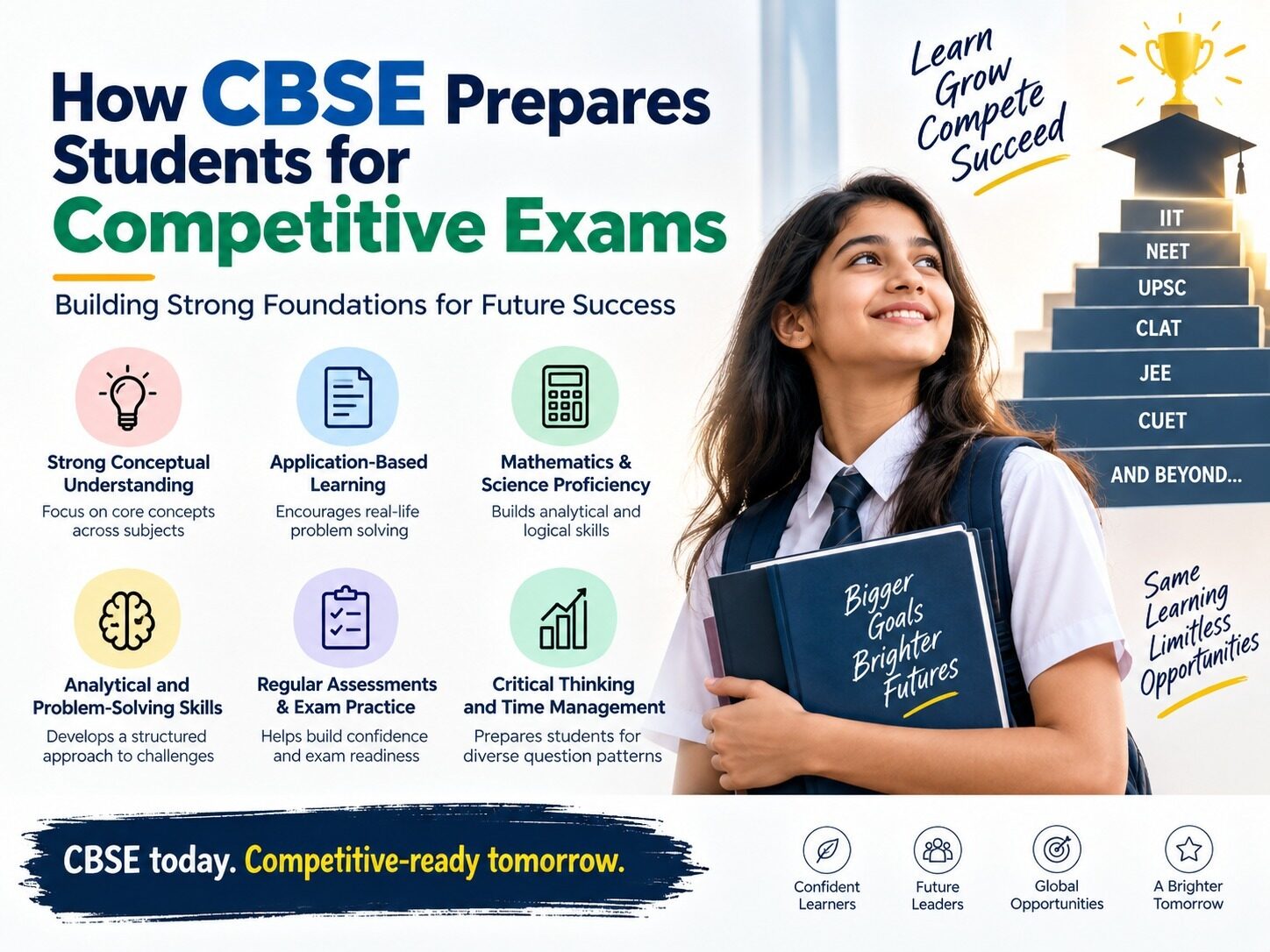
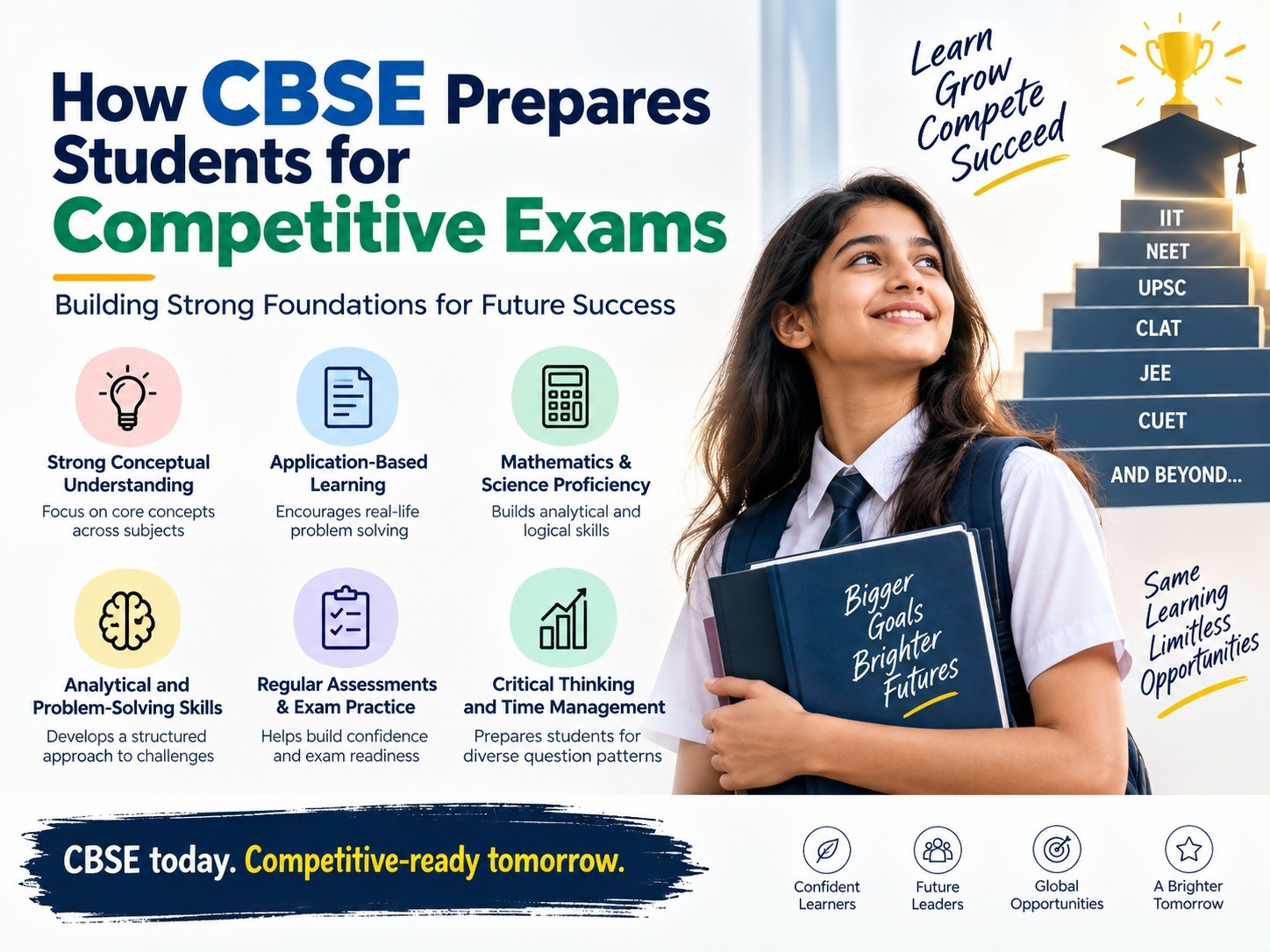
1. Strong Conceptual Foundations
Competitive exams test understanding, not just recall. CBSE’s step-by-step progression, where concepts introduced in middle school are developed further in Classes 9 and 10 and then deepened in Classes 11 and 12, helps students build knowledge systematically.
2. Emphasis on Science and Mathematics
CBSE places strong emphasis on mathematics and science from the early years. Regular practice, problem-solving and numerical work help students develop the speed and accuracy competitive exams require.
3. Competency-Based Learning
In line with the National Education Policy (NEP) 2020, CBSE has been increasing its focus on competency-based questions that test application, analysis and real-world problem-solving. This shift closely mirrors the style of questions students face in entrance exams.
4. Practical and Lab Work
Laboratory experiments in physics, chemistry and biology help students understand theory in action. This hands-on understanding makes it easier to tackle application-based questions in exams like NEET and JEE.
5. Regular Assessments
Periodic tests, internal assessments and pre-board examinations help students get used to exam conditions, manage time and learn from their mistakes, skills that transfer directly to competitive exam preparation.
6. Early Stream Choice
In Class 11, CBSE students choose a stream (science, commerce or humanities) and specific subject combinations. This lets students focus on the subjects most relevant to their chosen entrance exams.
Where Extra Preparation Helps
While CBSE offers an excellent foundation, it’s worth being realistic. Top competitive exams, especially JEE Advanced, test concepts at a greater depth and difficulty than board examinations. Students aiming for the most competitive institutions usually benefit from:
- Advanced problem-solving practice beyond textbook exercises
- Regular mock tests under timed, exam-like conditions
- Previous years’ question papers to understand patterns and difficulty levels
- Time management strategies for long, high-pressure exams
- Consistent revision across both Class 11 and Class 12 topics
The key is balance. Students who master their NCERT textbooks and CBSE curriculum first build a strong base, which makes any additional preparation far more effective.
When Should Students Start Preparing?
Classes 6 to 8: Build curiosity and fundamentals. Focus on strong reading, reasoning and number skills. Olympiads and quizzes can make learning fun and challenging at this stage.
Classes 9 and 10: Strengthen core concepts. These years lay the foundation for Class 11 and 12 topics. A clear grasp of mathematics and science now makes senior-school learning much easier.
Classes 11 and 12: Focused preparation. This is when board and entrance preparation come together. Consistent study, regular practice and a sensible routine make the biggest difference.
Starting too early with intense coaching can lead to burnout. A gradual, well-paced approach usually produces better results and happier learners.
How Parents Can Support Their Child
- Encourage understanding over memorisation. Ask your child to explain concepts in their own words.
- Help them build a realistic timetable. Balance school, self-study, rest and recreation.
- Prioritise health and sleep. Physical and mental wellbeing are essential for sustained performance.
- Keep communication open. Talk about goals, pressures and progress without adding stress.
- Celebrate effort, not just results. Consistent effort builds the resilience students need for competitive exams.
- Stay in touch with teachers. Regular conversations with teachers help you understand where your child needs support.
Is CBSE the Right Choice for Your Child?
CBSE is often a strong fit for students who:
- Are aiming for engineering, medicine or other fields with national entrance exams
- Plan to pursue higher education in India
- Benefit from a structured, well-defined curriculum
- Want board and entrance preparation to reinforce each other
That said, every child is different. If your family is considering international higher education or prefers a more flexible subject structure, curricula such as Cambridge IGCSE or IB may also be worth exploring.
CBSE Education at Gateway Group of International Schools
The Gateway Group of International Schools offers CBSE education across three campuses in Chennai: Padur, Neelankarai and Mahabalipuram. For two decades, Gateway has helped students build strong academic foundations while developing the confidence, curiosity and character they need beyond the classroom.
Strong academic foundations. Gateway’s CBSE campuses focus on conceptual clarity in mathematics, science and languages, laying the groundwork students need for board examinations and national entrance exams.
Experiential learning. Hands-on, inquiry-driven teaching helps students understand how concepts apply in real life, which supports the application-based thinking competitive exams demand.
Holistic development. Sports, arts, cultural celebrations and leadership opportunities help students grow into well-rounded individuals who can manage pressure with confidence.
Choice within one group. Families can also explore Cambridge IGCSE at Sholinganallur and the IB programme at Padur, all within the Gateway family.
Wide transport coverage. School buses serve neighbourhoods across South Chennai along the ECR and OMR corridors.
Frequently Asked Questions
Is CBSE good for JEE and NEET preparation?
Yes. The CBSE curriculum is based on NCERT textbooks, which form the core of the JEE Main and NEET syllabi. Students still benefit from additional practice and mock tests for the most competitive exams.
Are NCERT textbooks enough for NEET?
NCERT textbooks are essential for NEET, especially for biology. Most students combine thorough NCERT study with practice questions and mock tests.
Do board marks matter for competitive exams?
Yes. Admission to institutions such as the IITs and NITs includes eligibility criteria linked to Class 12 board results, so board performance remains important.
When should my child start preparing for competitive exams?
Focused preparation usually begins in Class 11, but strong fundamentals built in Classes 6 to 10 make that preparation much easier.
Can IGCSE or IB students also appear for JEE and NEET?
Yes, provided they meet the subject and eligibility requirements for each exam. However, CBSE’s syllabus aligns most directly with these exams.
Build a Strong Foundation for Your Child’s Future
CBSE gives students a clear, structured path that connects classroom learning directly to India’s major competitive examinations. With strong fundamentals, consistent practice and the right support at home and school, your child can approach these exams with confidence.
Admissions for 2027–28 are open at Gateway’s CBSE campuses in Padur, Neelankarai and Mahabalipuram. Apply online, explore our admissions page, call 044-2449 3333, or email admission@gatewaytheschool.in to schedule a campus visit.