


Apply for Admission

Category: IB

Inquiry-Based Learning

Inquiry-Based Learning: A Guide to Spark Student Curiosity

Inquiry-Based Learning

Inquiry-based learning activities to spark curiosity in the classroom

Just as learning must go on for a life-time, we must also remain curious about things that spark interest. Especially as students in the early stages of life when learning happens in the classrooms. Books cannot be the only source of information, they need to be supplemented with questions that help relate the information with the world around. This is the basis of inquiry based learning – a student-centric approach to learning encouraged with questions, ideas to be explored and answers to be discovered. These avenues allow learners to be active, personal and engaging. 

Read on to know more about this widely accepted inquiry-based learning methodology.

What is Inquiry-based Learning?

The recent years have seen a departure from the traditional learning methods to one of active student participation in the process.They are encouraged to ask questions, seek the answers themselves if needed all in an attempt to understand and retain the information better. This is the inquiry-based learning strategy that is accepted world-wide, across all curricula. The teachers are no longer mere ‘knowledge-givers’ but guides on the discovery journey for the students. As a marked departure from before, the teaching methods are now structured to invite queries, mentor self-study and expect unique answers that are the measure of comprehension.  

Types of Inquiry-based Learning

You have probably come across the notion of ‘every child learns at their own pace and method’. No one solution is the best fit for all students just as no pace of learning is the best. Each is unique and best for that child. Based on this, this learning process has been classified into four key types:

  • Confirmation inquiry is where students verify a principle through an activity where the outcome is known.
  • Structured inquiry is one where the teacher provides the question and procedure, but students investigate the outcome.
  • Guided inquiry allows the students to figure out the answer to the question posed by the teacher
  • Open inquiry is the process where students formulate their own questions, design investigations and draw conclusions.

Each of these types allow for a level of independence of thought that is perfect for curating the subject matter based on age groups or even levels of comprehension of the students. 

Read More: Benefits of STEAM-Based Extracurricular Activities in Schools

The why behind Inquiry-based Learning theory

Renowned thinkers like John Dewey and Jerome Bruner laid the foundation for inquiry-based learning, where students are allowed to learn by ‘doing’ and ‘thinking critically’ rather than by blank memorisation of the subject matter. It was deemed that they retain the information better and longer with this freedom.

Benefits of Inquiry-based Learning

  • Helps promote curiosity and engagement
  • Allows students to develop critical thinking and problem-solving attributes
  • Builds communication and collaboration skills
  • Encourages creativity and independent thinking
  • Connects learning to the world beyond the classroom

Read More: What is Universal Design for Learning and Why It Matters

Final thoughts on integrating this learning freedom

Are you ready to spark the inquiry mindset in your students? Start with one activity. Watch their interest levels skyrocket and confidence soar. That is proof enough of having found the perfect method to make lessons interesting and engaging for them. 

As teachers, we always need to empower our students to become thinkers, questioners and solution seekers. How else will they make changes in the world and right the wrongs? Remember to give them the freedom to ask, explore and learn. This is your contribution to a better world beyond.
 

Universal Design for Learning

What is Universal Design for Learning and Why It Matters

Universal Design for Learning

What is Universal Design for Learning (UDL) and why it matters in modern education

In a world that is gradually learning to be inclusive of varied abilities, learning styles and backgrounds, the education system worldwide is moving towards diverse classrooms where the traditional one-size-fits-all teaching methodology is no longer deemed effective.This paradigm shift has evolved into the Universal Design for Learning (UDL) – a truly unique blend of teaching and learning environments where these diversities are addressed.  

Understanding Universal Design for Learning (UDL)

The world of architecture has used the principles of universal design to create spaces accessible to all people, for long. As the education ecosystem continues to evolve to address the lacunae in the traditional classroom, this simple and yet effective architectural concept found its way into how learning can happen. 

Universal Design for Learning (UDL) education provides a roadmap for developing teaching goals, methods and materials that accepts the differences in learning speed, aptitude or even interest of individual students. It allows for a more proactive approach to the curriculum design, keeping in mind the diversity from the very onset.

The core UDL principles

The ‘multiple means’ approach to learning within the UDL framework is based on the principles of reducing learning barriers and optimising opportunities for all students. Rooted in research in cognitive neuroscience, these UDL principles help structure a practical approach to creating a far more diverse and inclusive learning environment for all students.

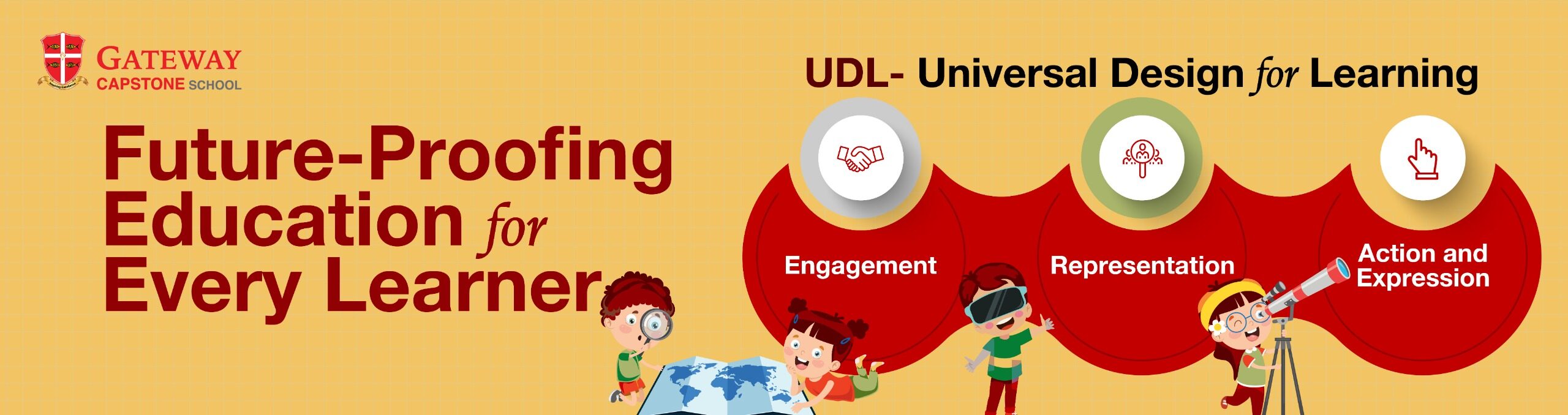
  • Multiple means of engagement
    “Why do we learn” is the basis of this principle where understanding the core difference in how learners learn, what helps engage and motivate them. UDL education allows for varying ways to spark interest in the topic with sustained effort and self-regulation. E.g. Game-based learning is a truly genius way to teach a generation of learners that has grown up on ‘gaming’ as a hobby. The UDL framework also allows for choice in assignments, based on the aptitude or learning levels of each student, thereby allowing for the teacher to assess no matter what. 
  • Multiple means of representation
    When talking of “What you are learning”, it has been proven that learners process information differently. The UDL principles of the learning experience recommend presenting the content in multiple formats for ease of comprehension – text, audio, video, charts and interactive simulations. All these contribute to the wide range of visual, auditory and kinesthetic learner profiles. 
  • Multiple means of action and expression
    “How we learn” was never before addressed in the way that the UDL curriculum has. This core principle of UDL based learning helps to assess students over a wide range of assessment possibilities. No longer dependent on written tests alone, this has allowed teachers to include oral presentations, visual representation of their knowledge or even with digital storytelling. These roadmaps, albeit leading to the final assessment of learning, have freed the students from the stress of the inability to communicate in any one route. 

Read More: IB Assessment Strategies: Going Beyond Traditional Testing

Why does UDL matter in the future of education frameworks?

  • It is inclusive
    The UDL education framework is not merely as a corrective measure for challenges faced in traditional education, but a concerted effort to integrate accessibility and flexibility of learning modes into the mainstream learning process. It was always meant to accommodate different learning styles, support all learners, be they gifted or with special abilities.
  • Promotes equity
    The UDL framework is structured in a way that no student is left behind. Rigidity in the traditional learning environment did not take into account that every student has their unique learning needs, strengths and challenges. This is the lacuna that UDL strives to address.
  • Supports differentiated instruction
    If lesson planning is deeply entrenched in the futuristic approach to education that UDL provides, the teachers have the liberty to explore instruction methods that help address all differences. Each student is allowed to feel the one-on-one handholding that the method allows them to benefit from, with appropriate challenges that help their learning curve.
  • Encourages lifelong learning skills
    Self-motivated learners who have the ability to assess their own learning needs, find the resources required and apply strategies are nurtured within this framework. To encourage the need for lifelong learning, the UDL curriculum allows for essential skills that need to become a part of the student’s mindset to navigate in a rapidly changing world.
  • Enhances teacher effectiveness
    Every teacher aims to be engaging in the classroom, with increased student satisfaction in the learning process. It has been proven that the UDL framework not only encourages reflective teaching best practices but also leaves room for continuous evaluation and improvement based on student feedback and performance.

Read More: Empowering Future Leaders: The Role of Leadership Skills in the IB Curriculum

Implementing UDL in the classroom

Begin your UDL framework adoption in small steps. Make practical and yet intentional changes in how you approach the curriculum, one lesson at a time:

  • You need to be sure of the learning goals and make sure that they are flexible enough to allow for more than one way to reach
  • Give the students the choice of tasks or topics that interest them and yet go into contributing to the overall lesson plan.
  • Traditional textbooks become a uni-dimensional learning tool in an age of emerging technologies on offer. Use them to the best of your ability – videos, podcasts, infographics, hands-on activities. Anything and everything that helps the child learn is a win-win scenario.
  • Help your students organise how they learn with graphic organisers, guided notes and other support structures. It goes a long way to instill confidence in their own learning.

Challenges and considerations

Any new method of learning and teaching comes with its share of challenges and the Universal Design for Learning has its share of them as well. Teachers need to reorient their time-tested methodologies, may need professional development support and time to redesign lessons. While these are not overwhelming in their own right, the long-term benefits of the process far outweigh the initial settling-in time if viewed as an investment for the future.

In conclusion –  UDL is a future-ready approach to education

At Gateway Capstone School, we strongly believe that as classrooms evolve into diverse nodes of culture and learning, it is necessary to be flexible, inclusive, and adopt varying teaching strategies to engage with the students. With the research-backed practical solution such as Universal Design for Learning, we are focused on improving outcomes for all students and making for an enjoyable learning experience for everyone. 

In essence, UDL is not just a teaching strategy; it’s a mindset shift—one that sees diversity not as a challenge to be managed, but as an opportunity to be embraced.

IB-Assessment-Strategies

IB Assessment Strategies: Going Beyond Traditional Testing

The International Baccalaureate (IB) assessment strategies transcend conventional testing methods, embracing a holistic approach to evaluating students’ progress, skills, and personal growth. Across the Early Years Programme (EYP), Primary Years Programme (PYP), Middle Years Programme (MYP), and Diploma Programme (DP), IB employs diverse assessment techniques that empower students to become lifelong learners. Let’s delve into the distinctive assessment methods in each of these stages at IB Schools in Chennai.

Assessment for Early Years Programme (EYP) and Primary Years Programme (PYP):

In the EYP and PYP, the focus is on nurturing inquiry, curiosity, and comprehensive development. Assessment is an ongoing process, involving teachers, students, and even parents. It incorporates various techniques:

Observation and Documentation: Teachers closely observe students’ interactions, behavior, and progress. These observations are documented to gain insights into each child’s development.

Portfolios: Portfolios serve as a repository of students’ work, reflections, and accomplishments. They provide a comprehensive view of a student’s growth over time.

Self-Assessment: Encouraging students to assess their own work promotes metacognition and self-awareness. It helps them recognize strengths and areas for improvement.

Teacher-Student Conferences: One-on-one discussions between teachers and students facilitate personalized feedback and goal setting.

Assessment in the EYP and PYP encourages a proactive, reflective, and holistic approach to learning. It supports students in understanding their progress and areas of development.

Assessment for Middle Years Programme (MYP):

The MYP introduces academic rigor while nurturing personal and interpersonal development. MYP assessment is multifaceted and aligns with the IB’s learner profile attributes:

Criterion-Referenced Assessment: Assessment is based on task-specific criteria, focusing on students’ understanding and application of concepts.

eAssessment: This innovative approach combines on-screen examinations with coursework components. It allows students to demonstrate their skills in varied formats.

Projects and Investigations: MYP emphasizes inquiry-based learning. Students engage in personal projects and investigations, developing research, communication, and critical thinking skills.

Collaborative Assessment: Group projects encourage teamwork, communication, and the sharing of diverse perspectives.

Assessment for Diploma Programme (DP):

The DP’s comprehensive assessment aims to prepare students for higher education and beyond. It comprises internal and external assessment methods:

Internal Assessments: These are teacher-assessed assignments, projects, and presentations that encourage in-depth exploration of subjects.

External Assessments: Terminal exams evaluate students’ understanding of the curriculum and their ability to synthesize information.

Comparative Assessment Table:

Assessment Level Assessment Approach Emphasis Techniques
EYP and PYP Ongoing, involving teachers, students, parents Inquiry, reflection, comprehensive growth Observation, portfolios, self-assessment
MYP Criterion-referenced, eAssessment, projects Rigor, inquiry, skill development Exams, projects, teamwork
DP Internal and external assessments College readiness, in-depth exploration Assignments, exams, projects

IB’s assessment strategies reflect its commitment to nurturing well-rounded individuals who excel academically and contribute positively to society. By going beyond traditional testing, IB paves the way for holistic development and lifelong learning.

Gateway IB Continuum School:

At Gateway IB Continuum School, the best IB school in Chennai, assessment strategies align with the IB philosophy. As one of the notable IB schools in Chennai, Gateway focuses on nurturing students’ holistic development through a range of assessment methods. The school’s educators encourage students to think critically, communicate effectively and apply knowledge in real-world contexts. By going beyond traditional testing, Gateway IB Continuum School prepares students for success in a dynamic and interconnected global landscape.

Conclusion:

IB assessment strategies are rooted in the belief that assessment should mirror authentic learning experiences. By prioritizing comprehensive evaluation methods such as internal assessment, extended essay, TOK presentations and CAS reflections, the IB curriculum prepares students to be lifelong learners, global citizens, critical thinkers and communicators. Through an approach that goes beyond traditional testing, IB assessment strategies empower students to excel academically and thrive in an ever-evolving world.

The-Role-of-Leadership-Skills-in-the-IB-Curriculum

Empowering Future Leaders: The Role of Leadership Skills in the IB Curriculum

In a rapidly changing world, the education landscape is evolving to prepare students for the challenges and opportunities that lie ahead. One vital aspect of this evolution is the emphasis on cultivating leadership skills within the International Baccalaureate (IB) curriculum. Beyond academic excellence, the IB curriculum recognizes the significance of nurturing leadership qualities in students. In this article, we probe into the vital role of leadership skills within the IB curriculum and how they shape the leaders of tomorrow.

Leadership Skills in the IB Curriculum:

The IB curriculum is renowned for its holistic approach to education, aiming to develop students into well-rounded individuals with a global perspective. Leadership skills are seamlessly integrated into the curriculum, fostering attributes such as communication, collaboration, critical thinking and empathy.

  1. Approaches to Learning (ATL) Skills:

The IB curriculum emphasizes the development of Approaches to Learning skills. These skills encompass thinking, communication, self management, social and research skills. Such skills not only enhance academic success but also lay the foundation for effective leadership.

  1. Creativity, Activity, Service (CAS) Component:

CAS is a core component of the IB Diploma Programme. It encourages students to engage in creative, physical and service-oriented activities. Through CAS, students learn to lead initiatives, collaborate with peers and make a positive impact in their communities.

  1. Theory of Knowledge (TOK) and Critical Thinking:

TOK encourages students to question assumptions and think critically about the nature of knowledge and the ways in which we acquire, evaluate, and use knowledge. This intellectual inquiry is essential for effective leadership, enabling individuals to analyze complex situations, make informed decisions and inspire others.

  1. Extended Essay and Research Skills:

The Extended Essay is designed to promote independent research and critical thinking skills, and it serves as an opportunity for students to engage in academic inquiry and produce a substantial piece of writing. This cultivates skills such as problem-solving, research methodology and effective communication – all crucial for leadership roles.

Leadership Beyond the Curriculum:

Apart from the structured elements of the curriculum, IB schools often provide additional platforms for students to hone their leadership skills. Student councils, clubs, and extracurricular activities offer opportunities for students to take on leadership roles, organize events and collaborate with peers.

Gateway International School’s Perspective:

Gateway International School, an esteemed IB school in Chennai, places a strong emphasis on nurturing leadership skills. The school believes that leadership is not solely about holding positions of authority, but about influencing positive change. Through innovative teaching methods, real-world projects and mentorship, Gateway International School aims to empower students to become compassionate, responsible and visionary leaders. As one of the prominent IB board schools in Chennai, Gateway IB Continuum School is dedicated to cultivate an educational environment that encourages holistic growth and global awareness.

Preparing Leaders for Tomorrow:

The role of leadership skills in the IB curriculum extends beyond school years. As students graduate and step into the wider world, they carry with them a set of skills that transcend traditional career paths. Whether in academia, business, public service or any other field, these skills enable them to lead with integrity, empathy and a global perspective.

Conclusion:

The IB curriculum’s commitment to nurturing leadership skills equips students with qualities that extend far beyond the classroom. By promoting collaboration, critical thinking and a sense of responsibility, the curriculum lays the groundwork for empowering future leaders who are ready to tackle the challenges of an interconnected and rapidly changing world. Through this holistic approach, the IB curriculum contributes to the development of leaders who can shape a brighter future for themselves and for society at large.

IB-vs-IGCSE

IB vs. IGCSE: Decoding International Curricula in Chennai Schools

In the globalized world of education, choosing the right curriculum for your child is a pivotal decision. Chennai, known for its diverse educational landscape, offers parents the choice between two prominent international curricula: the International Baccalaureate (IB) and the International General Certificate of Secondary Education (IGCSE). Let’s delve into the nuances of these curricula and explore how they shape the educational experience in Chennai.

Understanding IB and IGCSE:

The International Baccalaureate (IB) and the International General Certificate of Secondary Education (IGCSE) are both renowned for their rigorous and holistic approach to education. The IB curriculum is designed to foster critical thinking, creativity, and international-mindedness. On the other hand, the IGCSE curriculum places emphasis on a broad and balanced education that equips students with practical skills and knowledge.

Benefits and Considerations:

IB Advantages:

Holistic Development: The IB curriculum nurtures well-rounded individuals through its emphasis on academic rigor, skill development, community service, and global-mindedness.

Inquiry-Based Learning: IB encourages students to question, research, and think critically, fostering a deeper understanding of subjects.

Global Perspective: With its international focus, IB prepares students to be culturally sensitive and open-minded global citizens.

Well-Rounded Assessment: The diverse assessment methods of IB, including oral presentations and independent research, provide a comprehensive evaluation of a student’s abilities.

IGCSE Advantages:

Subject Specialisation: IGCSE enables students to concentrate on subjects they are passionate about from an early age, preparing them for in-depth academic investigation.

Practical Skills: The IGCSE curriculum equips students with practical skills and knowledge that can be applied to real-world situations.

Preparation for Higher Levels: IGCSE sets a solid foundation for further education, such as AS/A levels, Cambridge Pre-University, or even the IB Diploma.

Comparing IB and IGCSE:

Let’s dig in deeper into the comparison of these two prominent international curricula:

AspectIB BoardIGCSE Board
Origin and AssociationFounded by a consortium of international educatorsForms a part of the renowned Cambridge pathway system
Approach to ContentEmphasises skills and critical thinking, utilising a flexible framework and assessment criteria allowing the exploration of diverse reading materials aligned with the curriculumRequires adherence to prescribed readings for study and assessment
Curriculum DesignEmphasizes a structured educational framework tailored to the needs of MYP and DP, with a flexible curriculum approach informed by guidelines and subject frameworksAdheres to a specific and structured curriculum outlined in accordance with IGCSE guidelines and subject specifications
Subject MasteryEncourages students to achieve mastery in certain subjectsAims to excel in examinations for higher levels of understanding
Learning FocusFosters student-centered learning with a combination of external and internal assessments for each subject, ensuring a comprehensive evaluation of learning outcomesExternally graded certificates hold greater weight than school-assessed qualifications
Flexibility in CurriculumOffers flexibility as a complementary frameworkCulminates in a systematic end-of-program examination for international comparison
Skill DevelopmentConcentrates on holistic skill developmentDriven by syllabus and centered around examinations
Adoption in IndiaApproximately 201 schools in India offer IB curriculumOver 400 schools in India are offering the IGCSE curriculum
Approach to LearningEncourages concept and context-based, inquiry-driven, interdisciplinary learning with a global perspectiveSubject specialisation, practical applications
Assessment MethodsCoursework, oral presentations, written examinations, researchWritten examinations, coursework (varies), subject-specific evaluation
Curriculum FlexibilityOffers a wide range of subjects, encourages exploration through Core elementsProvides subject choices, promotes early specialisation

Chennai’s Educational Landscape:

Chennai’s education scene is dynamic, with numerous schools offering both IB and IGCSE programs. Parents often consider factors such as teaching methodologies, extracurricular activities and the school’s overall ethos while making this critical decision.

Gateway International School (IB) and Gateway The Complete School:

In the heart of Chennai’s educational ecosystem, Gateway IB Continuum School and Gateway The Complete School stand out as institutions offering the best of both worlds. Gateway IB Continuum School follows the IB curriculum, seamlessly transitioning students from the Primary Years Program (PYP) to the Middle Years Program (MYP) and eventually the Diploma Program (DP). On the other hand, Gateway The Complete School, the best IGCSE school in Chennai offers the IGCSE curriculum, ensuring a holistic and comprehensive education.

Both schools prioritize not only academic excellence but also character development and overall growth. By providing a nurturing environment that encourages critical thinking, creativity, and holistic well-being, Gateway IB Continuum School and Gateway The Complete School, renowned IB schools in Chennai, uphold the values of their respective curricula while preparing students for success in an ever-evolving world.

Conclusion:

The choice between IB and IGCSE is a decision that resonates with a student’s learning style, aspirations, and individual strengths. Chennai’s educational institutions, including Gateway IB Continuum School and Gateway The Complete School offer exceptional platforms for students to excel in their chosen curriculum, providing a solid foundation for future endeavors in an increasingly interconnected world.

Approach-to-Write-IB-Extended-Essay

What is the IB Extended Essay and How to Approach its Writing?

In the realm of International Baccalaureate (IB) education, the Extended Essay stands as a testament to a student’s research, analytical, and writing skills. This extensive piece of academic writing, akin to a mini-thesis, offers students the opportunity to explore deep on a subject of personal interest. Let’s explore the nuances of the IB Extended Essay and discover how to approach its writing for a successful outcome.

Understanding the IB Extended Essay:

The IB Extended Essay is a significant component of the IB Diploma Programme. It challenges students to engage in independent research on a chosen topic, exploring it in-depth and demonstrating their ability to formulate a coherent argument. The essay is an opportunity for students to showcase their academic prowess, critical thinking, and intellectual curiosity.

Approaching the Writing Process:

Topic Selection:

Selecting a compelling topic is paramount. It should be of personal interest and have the potential for thorough exploration within the guidelines provided by the IB.

Formulating a Research Question:

A well-crafted research question narrows down the scope of the essay and guides the research process. It should be specific, focused, and open to analysis.

Length of Essay:

The Extended Essay has an upper limit of 4,000 words. This count includes the introduction, body, conclusions, and any quotations. However, elements like the abstract, acknowledgements, table of contents, maps, charts, diagrams, annotated illustrations, tables, reference pages, and appendices are excluded from the word count.

Conducting Research:

Thorough research is the foundation of a successful Extended Essay. Utilize a variety of reputable sources, such as academic journals, books, and primary sources, to gather relevant information.

Structured Outline:

Organize your essay with a clear structure. Include an introduction, body paragraphs, and a conclusion that summarises the key findings and arguments.

Critical Thinking:

Apply critical thinking skills to evaluate sources and present a balanced view. Avoid bias and consider counterarguments to strengthen your analysis.

Drafting and Revision:

Write a draft of your essay based on your research. Review and revise your work multiple times. Pay attention to clarity, coherence and effective use of evidence.

Citations and Referencing:

Properly cite your sources using the required citation style (e.g., MLA, APA, Chicago). Plagiarism is a serious offence, so ensure accurate referencing.

Reflection:

Complete the Reflection session, a mandatory component of the EE. Reflect on your research process, challenges faced, and lessons learned.

Time Commitment:

Dedicate around 40 hours to independent research and writing a quality essay. The process begins with informational sessions and relationship establishment. Submit a research plan, essay proposal by January in the first year. Submit a final draft of at least 2000 words to the supervisor by October of the second year. The final essay is due in November.

By adhering to these steps and understanding the intricacies of the IB Extended Essay, students embark on a rewarding academic journey showcasing skills and fostering appreciation for research and analysis.

Gateway International School’s Approach:

At Gateway International School, a prominent IB Board school in Chennai, the importance of the Extended Essay is emphasized. With guidance from experienced educators, students are supported throughout the EE process. The school encourages students to choose diverse and intriguing topics, fostering a love for learning beyond the classroom. As one of the leading IB schools in Chennai, Gateway International School is dedicated in providing an enriching educational experience that goes beyond textbooks and examinations.

Conclusion:

The IB Extended Essay is not just an academic requirement; it is an opportunity for students to explore their interests deeply and develop essential skills for higher education and beyond. By approaching the EE with enthusiasm, dedication and a systematic strategy, students can navigate the challenges and achieve a well-researched and insightful essay that reflects their academic growth and intellectual curiosity.