

Apply for Admission

Category: IGCSE

ChatGPT Image Sep 23, 2026, 10_28_35 AM

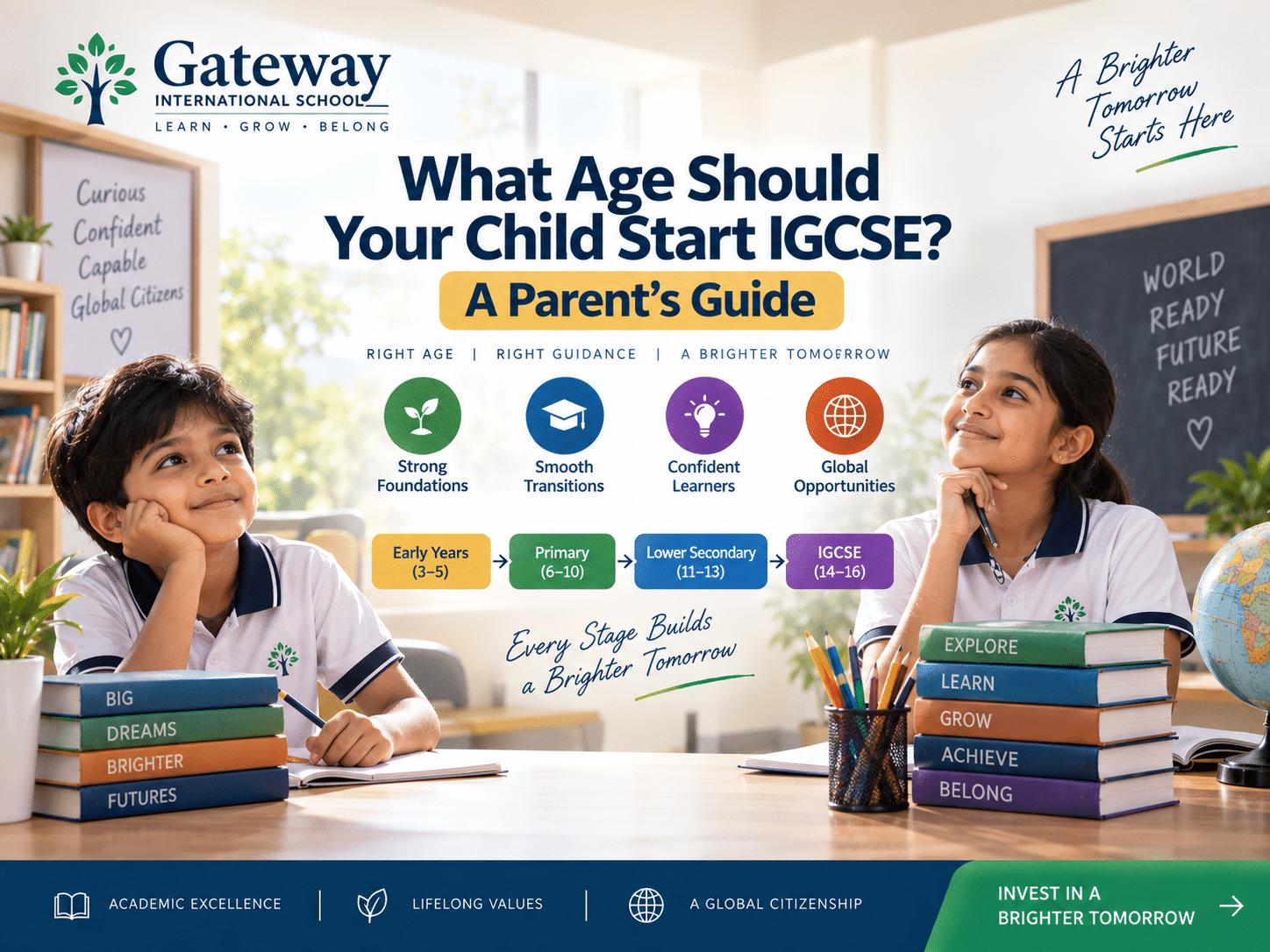
What Age Should Your Child Start IGCSE? A Parent’s Guide
What Age Should Your Child Start IGCSE? A Parent's Guide

“When should my child start IGCSE?” is one of the most common questions parents ask when they begin exploring the Cambridge curriculum. Some families plan from kindergarten, while others consider a switch from CBSE or State Board midway through school. Both paths are possible, but the timing you choose can make a real difference to how smoothly your child settles in and how confidently they approach their exams.

This guide explains the IGCSE age group, how the Cambridge pathway is structured, the best time to join, and what to consider if your child is moving from another board.

What Is the Standard Age for IGCSE?

Cambridge IGCSE is designed for students aged 14 to 16. In Indian schools, this usually corresponds to Grades 9 and 10, which is when students follow the two-year IGCSE course and sit their final Cambridge examinations at the end of Grade 10.

However, IGCSE doesn’t stand alone. It is one stage of a connected Cambridge journey, and students who are familiar with the Cambridge way of learning before Grade 9 tend to find the transition to IGCSE much easier.

The Cambridge Pathway by Age

Here’s how the full Cambridge programme is structured, with approximate ages and the equivalent grades:

Cambridge StageApproximate AgeEquivalent Grades
Cambridge Primary5 to 11 yearsGrades 1 to 5
Cambridge Lower Secondary11 to 14 yearsGrades 6 to 8
Cambridge Upper Secondary (IGCSE)14 to 16 yearsGrades 9 and 10
Cambridge Advanced (AS and A Levels)16 to 19 yearsGrades 11 and 12

Each stage builds on the one before. Cambridge Primary develops strong foundations in English, mathematics and science. Lower Secondary deepens subject knowledge and introduces more independent thinking. By the time students reach IGCSE, they’re expected to analyse, apply and explain concepts, not just recall them.

So, When Is the Best Time to Start?

There isn’t a single “right” age that works for every child, but here is a practical way to think about it.

Starting in the Early Years or Primary (Ages 3 to 11)

This is the smoothest route. Children who begin the Cambridge curriculum early grow up with its inquiry-based, application-focused style of learning. They develop strong English communication, confidence in asking questions and the habit of explaining their reasoning. By the time IGCSE arrives, the format feels completely natural.

Best for: Families who are confident about an international pathway and want complete continuity from kindergarten to Grade 12.

Joining in Lower Secondary (Ages 11 to 14)

Joining in Grade 6, 7 or 8 is an excellent option and a very popular one. Your child has enough time to adjust to the Cambridge teaching style, strengthen any gaps in English or mathematics, and get comfortable with Cambridge-style assessments before the IGCSE course begins.

Best for: Students moving from CBSE, ICSE or State Board who want a well-prepared transition.

Joining at the Start of Grade 9 (Age 14)

Students can join directly at the start of the IGCSE course. Since IGCSE is a two-year programme, Grade 9 is the natural entry point. Children with solid fundamentals and good English skills usually adapt well, though the first few months may involve a learning curve as they get used to a new assessment style.

Best for: Academically confident students who are ready to adapt quickly.

Joining in Grade 10 (Age 15)

This is generally the most difficult time to switch. The IGCSE course is typically taught over two years, so joining in the final year means catching up on a full year of content just before the board examinations. Some schools may allow it depending on the student, but most parents are advised to plan earlier where possible.

Best for: Only in special circumstances, such as relocation, and with careful guidance from the school.

Signs Your Child Is Ready for the IGCSE Programme

Age is only part of the picture. When planning the move, consider whether your child:

  • Reads and writes comfortably in English
  • Enjoys asking “why” and “how” rather than memorising answers
  • Can manage a mix of classwork, projects and independent study
  • Is curious about exploring subjects beyond the textbook
  • Responds well to discussion-based and hands-on learning

If some of these are still developing, joining a little earlier, in Lower Secondary for example, gives your child the time to build these skills before IGCSE begins.

Moving from CBSE or State Board to IGCSE

Many families switch to the Cambridge curriculum from Indian boards, and it’s entirely achievable with the right planning. A few things to keep in mind:

Learning style changes. CBSE and State Board often place greater emphasis on textbook content and recall, while Cambridge assessments focus on application and analysis. Students may need some time to adjust to longer-answer questions and practical, problem-solving formats.

English matters more. Cambridge assessments are written in English and reward clear expression across all subjects, not just English itself.

Subject choice is new. In IGCSE, students choose a combination of subjects. Parents and children should discuss interests and future goals with the school’s IGCSE coordinator before making choices.

Earlier is easier. Switching in Grade 6, 7 or 8 gives your child the most comfortable runway before exam years.

Why Starting at the Right Time Matters

Joining at the right stage helps your child:

  • Build confidence gradually instead of adjusting under exam pressure
  • Develop the critical thinking and writing skills IGCSE rewards
  • Make better-informed subject choices for IGCSE and A Levels
  • Continue smoothly into AS and A Levels and on to university, in India or abroad

Cambridge IGCSE and A Level qualifications are recognised by universities around the world and across India, so a well-timed start sets your child up for a wide range of future options.

Starting IGCSE at Gateway The Complete School, Sholinganallur

Gateway The Complete School (GTCS) is a co-educational Cambridge International School in Sholinganallur, founded in 2006 by educationalist Dr. Anton Cruz. With two decades of Cambridge experience, GTCS offers the complete pathway, making it easy for families to join at whichever stage suits their child best.

Every Cambridge stage under one roof. GTCS offers Cambridge Primary, Cambridge Lower Secondary, Cambridge Upper Secondary (IGCSE) and Cambridge Advanced (AS and A Levels), with admissions from LKG to Grade 12.

Admission assessments suited to each stage:

  • Early Years (LKG and UKG): No entrance exam. Qualified applicants may be invited for a readiness assessment.
  • Grades 1 to 5: An informal assessment in Mathematics and English, along with a personal interview.
  • Grades 6 to 12: A subject-specific entry examination and an interview, with English as a Second Language placement where needed. Students joining the IGCSE or Cambridge Advanced programme meet the relevant coordinator to discuss subject choices and readiness.

Thoughtful grade placement. Placement follows the school’s age guidelines, and the school also considers each child’s social, emotional and physical development to find the right fit.

Support for families relocating. Gateway offers mid-year admissions for students with valid reasons for changing schools.

Proven outcomes. Gateway alumni have gone on to institutions such as VIT, IIIT Hyderabad, SRM Institute of Science and Technology, Symbiosis Law School and universities in the UK and Europe.

Frequently Asked Questions

What is the IGCSE age group?

Cambridge IGCSE is designed for students aged 14 to 16, typically in Grades 9 and 10.

Can my child start IGCSE directly in Grade 9?

Yes. Grade 9 is the natural entry point for the two-year IGCSE course. Students with strong fundamentals in English and mathematics usually adapt well.

Is it too late to switch to IGCSE in Grade 10?

It’s generally difficult because the course runs over two years. Joining by Grade 9, or earlier in Lower Secondary, is strongly recommended.

What is the best age to switch from CBSE to IGCSE?

Grades 6 to 8 (ages 11 to 14) are ideal. This gives your child time to adjust to Cambridge-style learning before the IGCSE years.

Does my child need to take an entrance test to join IGCSE at Gateway?

Students applying for Grades 6 to 12 take a subject-specific entry examination and an interview. Early Years applicants do not take an entrance exam.

Give Your Child the Right Start

The best time to start IGCSE is the time that gives your child enough room to settle in, build confidence and grow into the Cambridge way of learning. For most families, that means joining early, or at the latest by the start of Grade 9.

Admissions for 2027–28 are open at Gateway The Complete School, Sholinganallur. Apply online, visit the IGCSE Sholinganallur admission page, or email admissionsgtcs@gatewaytheschool.in to discuss the right entry stage for your child.

ChatGPT Image Sep 22, 2026, 07_34_26 PM

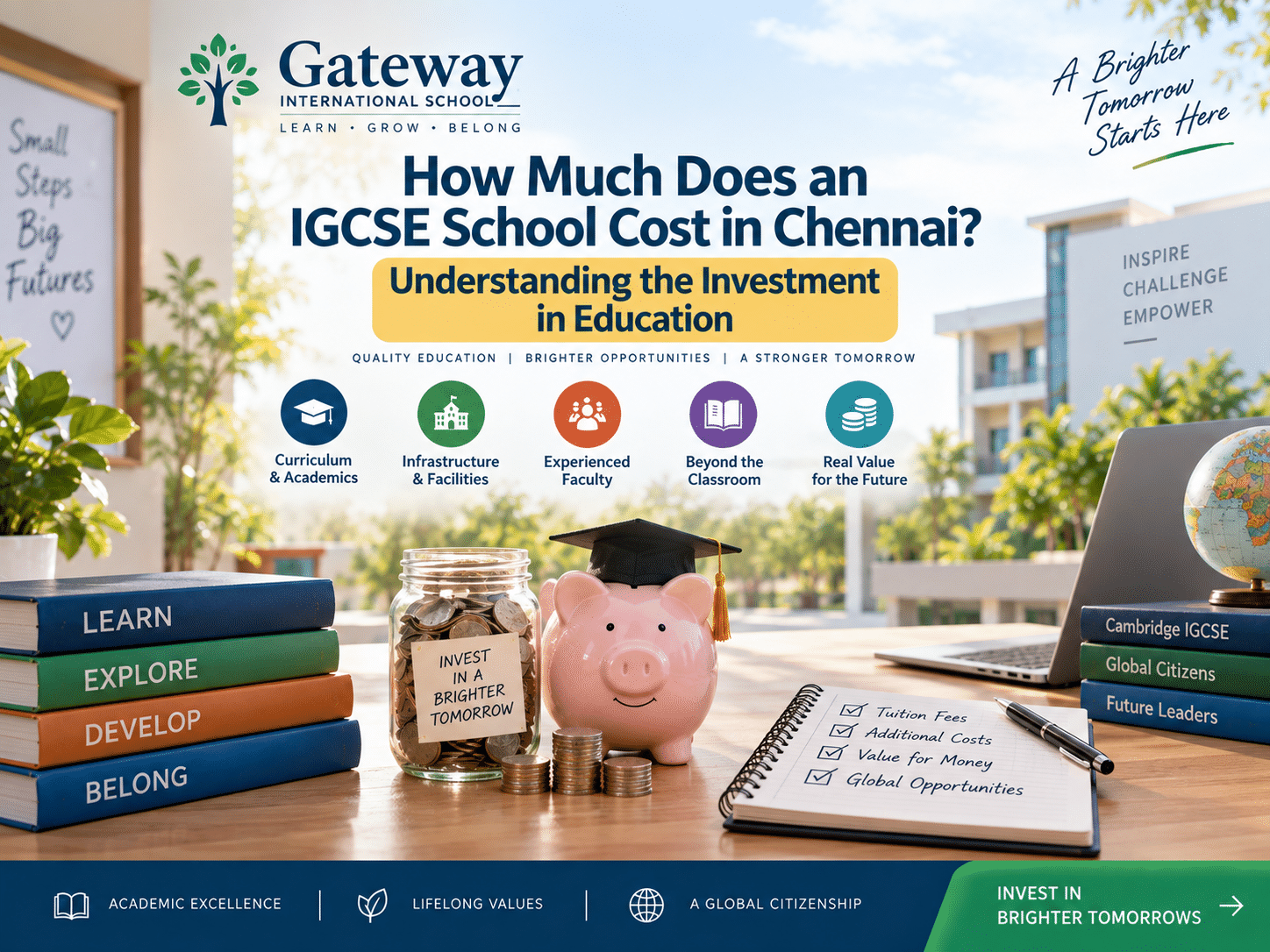
How Much Does an IGCSE School Cost in Chennai? Understanding the Investment in Education

How Much Does an IGCSE School Cost in Chennai? Understanding the Investment in Education

For many families, the decision to choose a Cambridge IGCSE school comes with one very practical question: how much will it cost? It’s a fair question, and one that deserves a clear, honest answer.

The truth is that IGCSE school fees in Chennai vary widely. Two schools offering the same Cambridge curriculum can differ significantly in price, depending on their facilities, class sizes, teacher expertise and the extras included in the fee. This guide breaks down what parents can typically expect to pay, what the fees actually cover, which costs are easy to overlook, and how to judge whether a school offers real value for your investment.

Why IGCSE School Fees Vary So Much

Before looking at numbers, it helps to understand what drives the cost of an IGCSE education.

  • Teacher quality and training. Cambridge programmes need teachers who understand the syllabus, the assessment style and application-based teaching. Schools that invest in experienced, Cambridge-trained faculty generally charge more.
  • Class size. Smaller classes allow more individual attention but mean higher costs per student.
  • Infrastructure. Science and computer labs, libraries, sports facilities, art and music rooms all add to a school’s running costs.
  • Curriculum stages offered. Schools that run the full Cambridge pathway, from Primary through IGCSE to AS and A Levels, need specialist teachers for advanced subjects.
  • Grade level. Fees usually rise as children move into higher grades, particularly in the IGCSE and A Level exam years.
  • Location and campus. Schools in high-demand residential areas such as the OMR and ECR corridors often have higher land and operating costs.

Typical IGCSE School Fee Ranges in Chennai

Fees change every year and differ by grade, so the ranges below are only indicative. Always confirm the current fee structure directly with each school.

Based on publicly available school listings, IGCSE school fees in Chennai generally fall somewhere between roughly ₹5,800 and ₹41,700 per month, with the exact figure depending on facilities, class level and curriculum options. Converted to annual terms, that is approximately ₹70,000 to ₹5,00,000 a year.

At the premium end of the international school market, costs climb considerably. Some well-known international schools charge ₹6–10 lakh a year for secondary and IGCSE/IBDP years, and the most premium schools can run above ₹10 lakh annually for secondary grades.

In broad terms, parents will find three bands:

  • Accessible IGCSE schools: around ₹70,000 to ₹2 lakh per year
  • Mid-range IGCSE schools: around ₹2 lakh to ₹5 lakh per year
  • Premium international schools: ₹6 lakh to ₹10 lakh or more per year

Remember that these figures usually refer to tuition. The total annual cost can be higher once other fees are added.

What Is Usually Included in IGCSE School Fees?

Every school structures its fees differently, so ask for a complete breakdown. Common components include:

  • Admission or registration fee. A one-time payment made when your child joins the school.
  • Tuition fee. The main annual fee covering teaching and day-to-day academics. Many schools collect it annually or in instalments.
  • Annual or development fee. Supports infrastructure, maintenance and campus improvements.
  • Activity fee. Covers sports, clubs, cultural events and co-curricular programmes.
  • Transport fee. Charged separately in most schools and based on distance or route.
  • Books, uniforms and learning materials. Sometimes bundled into the fee, often billed separately.

Costs Parents Often Overlook

When budgeting for an IGCSE education, these are the expenses that sometimes come as a surprise:

Cambridge examination fees. IGCSE, AS and A Level board examinations are conducted by Cambridge International, and exam entry fees are usually charged per subject in addition to regular school fees. The more subjects your child takes, the higher the exam cost.

Checkpoint assessments. Some schools charge separately for Cambridge Primary and Lower Secondary Checkpoint tests.

Field trips and excursions. Educational visits, residential trips and international exchanges may carry separate charges.

Specialist activities. Coaching in particular sports, music instruments or competitions can add extra costs.

Devices and technology. Some schools require students to bring laptops or tablets for coursework.

Asking about these upfront helps you compare schools on a like-for-like basis and avoid unexpected bills later.

IGCSE vs CBSE: Is IGCSE More Expensive?

In most cases, yes. IGCSE schools in Chennai generally charge more than CBSE or State Board schools. There are clear reasons for this: Cambridge teacher training, international examination fees, smaller class sizes, and a wider range of subject options all add to the cost of delivering the programme.

However, cost alone doesn’t tell the full story. The more useful question is what your child gains from that investment and whether it matches your family’s goals.

Understanding the Real Value of an IGCSE Education

School fees are best seen as an investment in your child’s future rather than simply an expense. Here’s what that investment typically delivers.

Global recognition. Cambridge IGCSE and A Level qualifications are accepted by universities in the UK, US, Canada, Australia, Singapore and across India. For families considering higher education abroad, this can simplify applications considerably.

Skills that last. The Cambridge approach rewards understanding and application over memorisation. Students learn to think critically, write clearly and solve unfamiliar problems, skills that remain valuable well into university and working life.

Subject flexibility. Students can choose combinations of subjects that suit their strengths, whether in sciences, commerce, humanities, languages or the arts.

Continuity for mobile families. If your work might take you to another city or country, an internationally recognised curriculum makes the move far smoother for your child.

Future savings. A strong school foundation can reduce reliance on expensive private tuition and coaching in later years.

How to Judge Whether a School Is Worth the Fees

A higher fee doesn’t automatically mean a better education, and a lower fee doesn’t always mean lower quality. When comparing IGCSE schools, look at what you actually receive for the money.

Ask these questions during your school visit:

  1. Is the school an authorised Cambridge International School?
  2. How long has it been teaching the Cambridge curriculum?
  3. Are teachers trained specifically for Cambridge programmes?
  4. What is the average class size?
  5. Which Cambridge stages does the school offer? Can my child continue through to A Levels without changing schools?
  6. What does the fee include, and what is charged separately?
  7. Are there instalment options for paying fees?
  8. How are fees likely to change as my child moves into higher grades?
  9. Where have past students gone for higher education?
  10. What sports, arts and leadership opportunities are included?

A school that answers these clearly and openly is usually one you can trust with your child’s education.

Smart Budgeting Tips for Parents

  • Plan for the full journey. Look at fees across all grades, not just the entry year, since costs typically increase in the IGCSE and A Level years.
  • Include exam fees in your estimate. Budget for Cambridge board exam entries in Grades 10, 11 and 12.
  • Factor in transport. Choosing a school with a bus route near your home can save both money and daily travel time.
  • Avoid switching schools mid-way. Moving between curricula can mean new admission fees, new uniforms and books, and an academic adjustment period. A school offering the complete pathway avoids these repeated costs.
  • Ask about payment schedules. Instalment plans can make annual fees easier to manage.

Gateway The Complete School: A Complete Cambridge Pathway in Sholinganallur

For families looking for a Cambridge education along the OMR corridor, Gateway The Complete School (GTCS) in Sholinganallur offers a complete journey under one roof. Founded in 2006 by educationalist Dr. Anton Cruz, GTCS is a co-educational Cambridge International School with two decades of experience delivering the curriculum.

One pathway, no disruption. GTCS offers Cambridge Primary, Cambridge Lower Secondary, Cambridge Upper Secondary (IGCSE) and Cambridge Advanced (AS and A Levels), with admissions from LKG to Grade 12. Children can move from early years to university readiness without changing boards or schools.

Learning that builds real skills. The school follows a multisensory, experiential approach focused on inquiry, hands-on learning, problem-solving, communication and creativity.

Proven outcomes. Gateway alumni have progressed to institutions including VIT, IIIT Hyderabad, SRM Institute of Science and Technology, Symbiosis Law School and universities in the UK and Europe, with many crediting their IGCSE and A Level years for their confidence and depth of understanding in college.

Wide transport coverage. School buses serve Sholinganallur, Karapakkam, Thoraipakkam, Perungudi, Velachery, Medavakkam, Perumbakkam, Pallikaranai, Semmencherry, Navalur, Padur, Neelankarai and nearby areas.

For the current fee structure for your child’s grade, including any separately charged components, our admissions team will be happy to share complete details.

Frequently Asked Questions

What is the average IGCSE school fee in Chennai?

Fees vary widely by school and grade. Most IGCSE schools in Chennai fall between roughly ₹70,000 and ₹5 lakh per year, while premium international schools can charge considerably more.

Are Cambridge exam fees included in the school fees?

Usually not. IGCSE and A Level board examination fees are typically charged separately, per subject. Confirm this with the school.

Why do fees increase in higher grades?

Higher grades need specialist subject teachers, more lab and practical work, and preparation for board examinations, all of which raise the cost of delivery.

Is IGCSE worth the higher cost compared to CBSE?

It depends on your child’s goals. IGCSE offers global recognition, subject flexibility and an application-based learning style, which many families find valuable, particularly if studying abroad is a possibility.

Can I pay IGCSE school fees in instalments?

Many schools offer instalment options. Ask the admissions office about the payment schedule before enrolling.

Make an Informed Investment in Your Child’s Future

The cost of an IGCSE education in Chennai depends on far more than a single number. By understanding what fees include, planning for extra costs and asking the right questions, you can choose a school that offers genuine value for your family.

Admissions for 2027–28 are open at Gateway The Complete School, Sholinganallur. Apply online, visit the IGCSE Sholinganallur admission page, or email admissionsgtcs@gatewaytheschool.in to request the fee structure and schedule a campus visit.

ChatGPT Image Sep 22, 2026, 07_29_58 PM

Best IGCSE Schools in Sholinganallur: A Parent’s Guide for 2027

Best IGCSE Schools in Sholinganallur: A Parent's Guide for 2027

Sholinganallur has grown into one of Chennai’s busiest residential and IT hubs. With that growth has come a new generation of parents who work with global teams, travel internationally, and want an education for their children that opens doors worldwide. That is why searches for IGCSE schools in Sholinganallur have risen steadily, and why so many families are already planning ahead for the 2027–28 academic year.

Choosing a school is one of the biggest decisions a family makes. This guide explains what the Cambridge IGCSE pathway offers, what separates a good IGCSE school from a great one, and how the admission process works, so you can make a confident, well-informed choice.

What Is the Cambridge IGCSE Curriculum?

The International General Certificate of Secondary Education (IGCSE) is offered by Cambridge International and is designed for learners aged 14 to 16. It is one of the most widely taken international qualifications in the world and is recognised by leading universities and employers across the globe.

In a full Cambridge school, IGCSE is one stage of a connected journey:

  • Cambridge Primary builds strong foundations in English, mathematics and science.
  • Cambridge Lower Secondary develops subject depth and independent thinking, with Checkpoint assessments to track progress.
  • Cambridge Upper Secondary (IGCSE) allows students to choose subjects that match their strengths and interests.
  • Cambridge Advanced (AS and A Levels) prepares learners aged 16 to 19 for university and higher education.

Instead of relying on rote memorisation, the Cambridge approach rewards understanding, application and analysis. Students learn to explain their reasoning, solve unfamiliar problems and write with clarity, skills that serve them well long after the exams are over.

Why Parents in Sholinganallur Are Choosing IGCSE

Families along the OMR corridor are choosing the Cambridge pathway for a few practical reasons.

Global recognition. IGCSE and A Level qualifications are accepted by universities in the UK, US, Canada, Australia, Singapore and beyond, as well as by universities across India. Students who stay in India can still sit for national entrance exams such as JEE and NEET, provided they meet the subject requirements.

Subject flexibility. Students can build a combination of subjects that reflects who they are, whether that leans towards sciences, commerce, humanities, languages or the arts.

Application-based learning. Assessments test how well students can use what they know, which builds critical thinking and confidence.

Mobility. For families who may relocate for work, a Cambridge education makes transitions between schools and countries much smoother.

How to Choose the Best IGCSE School in Sholinganallur

Not every school that offers IGCSE offers the same experience. When you shortlist IGCSE schools in Sholinganallur, look beyond the brochure and ask these questions.

1. Is it an authorised Cambridge International School?

Confirm that the school is registered with Cambridge International and can conduct Cambridge examinations. Ask which stages it offers. A school that runs the full pathway from Primary through A Levels gives your child continuity without switching boards or campuses later.

2. How experienced is the school with the Cambridge curriculum?

A school that has taught Cambridge programmes for many years understands the syllabus, the assessment style and how to guide students through subject choices. Ask about the school’s history and how long it has been delivering IGCSE and A Levels.

3. Who are the teachers?

Teachers make the biggest difference to your child’s learning. Ask about teacher qualifications, Cambridge-specific training and how teachers support students who need extra help or extra challenge.

4. What results and pathways do alumni achieve?

Ask where past students have gone. Strong schools can tell you about alumni placements in reputed universities in India and abroad, across engineering, medicine, law, business and the creative fields.

5. Is the learning holistic?

Academic excellence matters, but so do sport, the arts, leadership opportunities and community service. Look for a school with a full calendar of activities, clubs and events that help children discover their interests.

6. What is the learning environment like?

Visit the campus. Notice whether classrooms feel engaging, whether students seem happy and confident, and whether the school welcomes children from diverse backgrounds. A caring, safe environment is essential for learning.

7. How involved are parents?

The best schools treat parents as partners. Ask how often parent-teacher meetings happen, how progress is reported and how the school communicates day to day.

8. Is transport convenient?

In a fast-growing area like Sholinganallur, commute time matters. Check the school’s bus routes and whether they cover your neighbourhood.

Gateway The Complete School: Cambridge Education in Sholinganallur Since 2006

Gateway The Complete School (GTCS), part of the Gateway Group of International Schools, is a co-educational Cambridge International School in Sholinganallur. Founded in 2006 by educationalist Dr. Anton Cruz, the school has spent two decades shaping young learners through the Cambridge pathway.

A complete Cambridge journey. GTCS offers Cambridge Primary, Cambridge Lower Secondary, Cambridge Upper Secondary (IGCSE) and Cambridge Advanced (AS and A Levels), with admissions open from LKG through to Grade 12. Children can grow within one consistent curriculum and one school community from their early years to university readiness.

Learning that goes beyond textbooks. Under the leadership of Principal Dr. Rajendra B. Deshmukh, GTCS follows a multisensory, experiential approach that encourages hands-on learning, inquiry and creative expression. The focus is on the competencies students need for the future, including problem-solving, communication, creativity, decision-making and resilience.

A culturally diverse community. GTCS welcomes students from different parts of India and the world, creating a genuinely international school environment where children learn to collaborate across cultures.

Holistic development. The school calendar is filled with sports, art competitions, cultural celebrations and leadership opportunities, including student leadership roles such as Head Girl, Head Boy and house captains.

Proven alumni outcomes. Gateway alumni have gone on to study at institutions such as VIT, IIIT Hyderabad, SRM Institute of Science and Technology and Symbiosis Law School, as well as universities in the UK and Europe. Many credit the IGCSE and A Level programme at Gateway for building their depth of understanding, critical thinking and confidence in college.

Wide bus coverage. School transport covers Sholinganallur and surrounding areas including Karapakkam, Thoraipakkam, Perungudi, Velachery, Medavakkam, Perumbakkam, Pallikaranai, Semmencherry, Navalur, Padur and Neelankarai.

IGCSE Admission Sholinganallur: Step-by-Step Process at Gateway

If you are planning IGCSE admission in Sholinganallur for 2027–28, here is how the process works at Gateway The Complete School.

Step 1: Apply online. Complete the online application form and indicate the grade your child is applying for.

Step 2: Application review. The Admissions Officer and Principal review all application materials, including academic records and recommendations from the previous school.

Step 3: Assessment and interview. The assessment depends on your child’s grade:

  • Early Years (LKG and UKG): There is no entrance examination. Qualified applicants may be invited to the school for a readiness assessment.
  • Grades 1 to 5: An informal, subject-specific assessment in Mathematics and English, along with a personal interview.
  • Grades 6 to 12: A subject-specific entry-level examination and an interview. Students entering IGCSE or the Cambridge Advanced programme meet with the relevant coordinator.

Step 4: Grade placement. Placement follows the school’s age guidelines. The school also considers your child’s social, emotional and physical development when deciding the right grade.

Step 5: Submit documents. Keep these ready:

  • Previous year’s final report card with teacher comments, and the current year’s first semester report card
  • Original Transfer Certificate or Leaving Certificate
  • Copy of the birth certificate
  • Four passport-size photographs
  • Address proof
  • Aadhaar card

Gateway also offers mid-year admissions for students with valid reasons for changing schools, which is helpful for families relocating to Chennai during the academic year.

Tips for Parents Planning 2027–28 Admissions

  • Start early. Popular IGCSE schools often have limited seats in key entry grades. Begin your research and campus visits well before the academic year begins.
  • Visit in person. A campus tour tells you far more than a website. Meet teachers, see classrooms and ask questions.
  • Prepare your child gently. For older students, a little revision in Mathematics and English before the entrance assessment can build confidence. For younger children, simply keep the visit relaxed and positive.
  • Think long term. If you expect your child to continue to A Levels, choose a school that offers the full Cambridge pathway so there is no disruption later.

Frequently Asked Questions

Is IGCSE recognised in India?

Yes. Cambridge IGCSE and A Level qualifications are accepted by universities across India as well as internationally.

Can IGCSE students appear for JEE and NEET?

Yes. Students who complete Cambridge A Levels can appear for Indian entrance examinations, provided they meet the subject and eligibility requirements for each exam.

From which grade can my child join Gateway The Complete School?

Admissions are open from LKG to Grade 12.

Is there an entrance test for kindergarten admission?

No. There is no general entrance exam for Early Years. Qualified applicants may be invited for a readiness assessment.

Does Gateway offer school transport around Sholinganallur?

Yes. Bus routes cover Sholinganallur and neighbouring areas along OMR and ECR, including Karapakkam, Thoraipakkam, Perungudi, Velachery, Medavakkam, Perumbakkam and Navalur.

Begin Your Child’s Cambridge Journey

Choosing among the IGCSE schools in Sholinganallur comes down to three things: a strong Cambridge foundation, teachers who genuinely care, and an environment where your child can grow academically and personally. With two decades of Cambridge experience, a complete pathway from Primary to A Levels, and alumni thriving in leading universities, Gateway The Complete School is ready to welcome your family.

Admissions for 2027–28 are open. Apply online, explore the IGCSE Sholinganallur admission page, or email admissionsgtcs@gatewaytheschool.in to schedule a campus visit.

Curriculum-and-Methodology-of-IGCSE-Schools

Demystifying the Curriculum and Methodology of IGCSE Schools

In the landscape of modern education, the International General Certificate of Secondary Education (IGCSE) stands as a prominent and respected curriculum. Known for its comprehensive approach to learning and rigorous assessment standards, IGCSE schools offer a unique educational experience that prepares students for academic excellence and beyond. In this article, we will delve into the intricacies of the IGCSE curriculum and shed light on its methodology.

Understanding the IGCSE Curriculum:

The IGCSE curriculum, offered by the Cambridge Assessment International Education (CAIE), is designed to provide a balanced and holistic education for students aged 14 to 16. It encompasses a wide range of subjects, fostering a comprehensive understanding of various disciplines. The curriculum emphasizes not only academic knowledge but also critical thinking, problem-solving, and practical skills.

Key Features of the IGCSE Curriculum:

Subject Diversity:

The IGCSE curriculum offers a diverse array of subjects, enabling students to explore their interests and strengths. From sciences to humanities, languages to arts, students have the flexibility to select subjects that resonate with their aspirations.

Cambridge Global Perspectives:

An integral part of the IGCSE curriculum, Cambridge Global Perspectives, encourages students to think critically about global issues and perspectives. It enhances their ability to analyze complex situations and develop informed viewpoints.

Emphasis on Practical Skills:

The IGCSE curriculum emphasizes the development of practical skills. Through laboratory work, field trips, and project-based assessments, students gain hands-on experience and application-oriented knowledge.

Assessment Approach:

The assessment methodology of IGCSE is designed to evaluate a student’s understanding, application, and analytical skills. It includes a mix of written examinations, coursework, and practical assessments.

Methodology of IGCSE Schools:

IGCSE schools adopt an interactive and student-centered approach to education. The methodology focuses on engaging students actively in the learning process and fostering independent thinking. Here are some key aspects of the methodology:

Active Learning:

IGCSE schools encourage active participation through group discussions, debates, and hands-on activities. This approach promotes a deeper understanding of concepts and enhances critical thinking.

Inquiry-Based Learning:

Inquiry-based learning is integral to the IGCSE methodology. Students are encouraged to ask questions, seek answers, and conduct research. This approach nurtures curiosity and self-directed learning.

Practical Application:

The curriculum’s practical orientation is reflected in teaching methods. Experiments, projects, and real-world scenarios are used to connect theoretical concepts with practical applications.

Critical Thinking:

IGCSE schools prioritize the development of critical thinking skills. Students are challenged to analyze information, evaluate perspectives, and construct well-reasoned arguments.

Comparing IGCSE with Other Curricula:

IGCSE vs. O Level:
Aspect IGCSE O Level
Grading System A to G A to E
Skill Focus Oral, practical, initiative, problem-solving Reading and writing skills
Coursework Options Many syllabuses offer coursework options Fewer options than IGCSE
Preparation for Future Prepares for further study and employment Designed to meet local needs
Practical Options Abundant practical options Restricted practical options
IGCSE Extended vs. IGCSE Core:

IGCSE offers both core and extended levels for certain papers:

Core: Easier, grades C to G, suitable for most students.

Extended: More academically challenging, grades A* to E.

In some subjects, the exam covers the complete ability range with no choice between Core and Extended papers.

IGCSE vs. CBSE:
Aspect IGCSE CBSE
Curriculum Options Wide variety of options Fewer options
Skill Focus Critical thinking, Problem-solving Theoretical knowledge
Content Depth In-depth knowledge required Less focus on deep understanding
Curriculum Focus Practical approach Theoretical approach

IGCSE vs. IB Middle Years Programme (MYP):

Aspect IGCSE IB MYP
Subject Groups 5 groups 8 subject groups
Programme Duration Two-year programme, followed by IGCSE A or AS Level Five-year programme, prepares for IB diploma
Intensity and Focus Structured and global perspective, Nationally relevant Intense, STEM focus, settlement opportunities

Grade Threshold Concept:

The grade threshold is the minimum grade or marks required to pass an exam. It is set to ensure fairness and consistency across exam series. The process involves studying previous trends to set appropriate limits, accounting for question difficulty.

Gateway The Complete School, OMR, Chennai

Among the notable IGCSE schools in OMR, Chennai, Gateway The Complete School (GTCS) shines as a beacon of educational excellence. With its commitment in providing a holistic education, GTCS stands as one of the best IGCSE schools in Chennai. The school’s curriculum, combined with innovative teaching methodologies, encourages students to explore, question, and excel. GTCS nurtures not only academic success but also character development, fostering a passion for lifelong learning among its students.

The Impact:

The IGCSE curriculum and its methodology aim to create well-rounded individuals who are academically competent, globally aware, and equipped with essential life skills. IGCSE schools prepare students not only for higher education but also for the challenges and opportunities of the modern world.

Conclusion:

Demystifying the curriculum and methodology of IGCSE schools reveals a holistic and dynamic approach to education. By offering a diverse curriculum and fostering interactive, inquiry-based learning, IGCSE schools empower students to excel academically and develop into thoughtful, adaptable, and informed individuals who are ready to contribute to society in meaningful ways.