


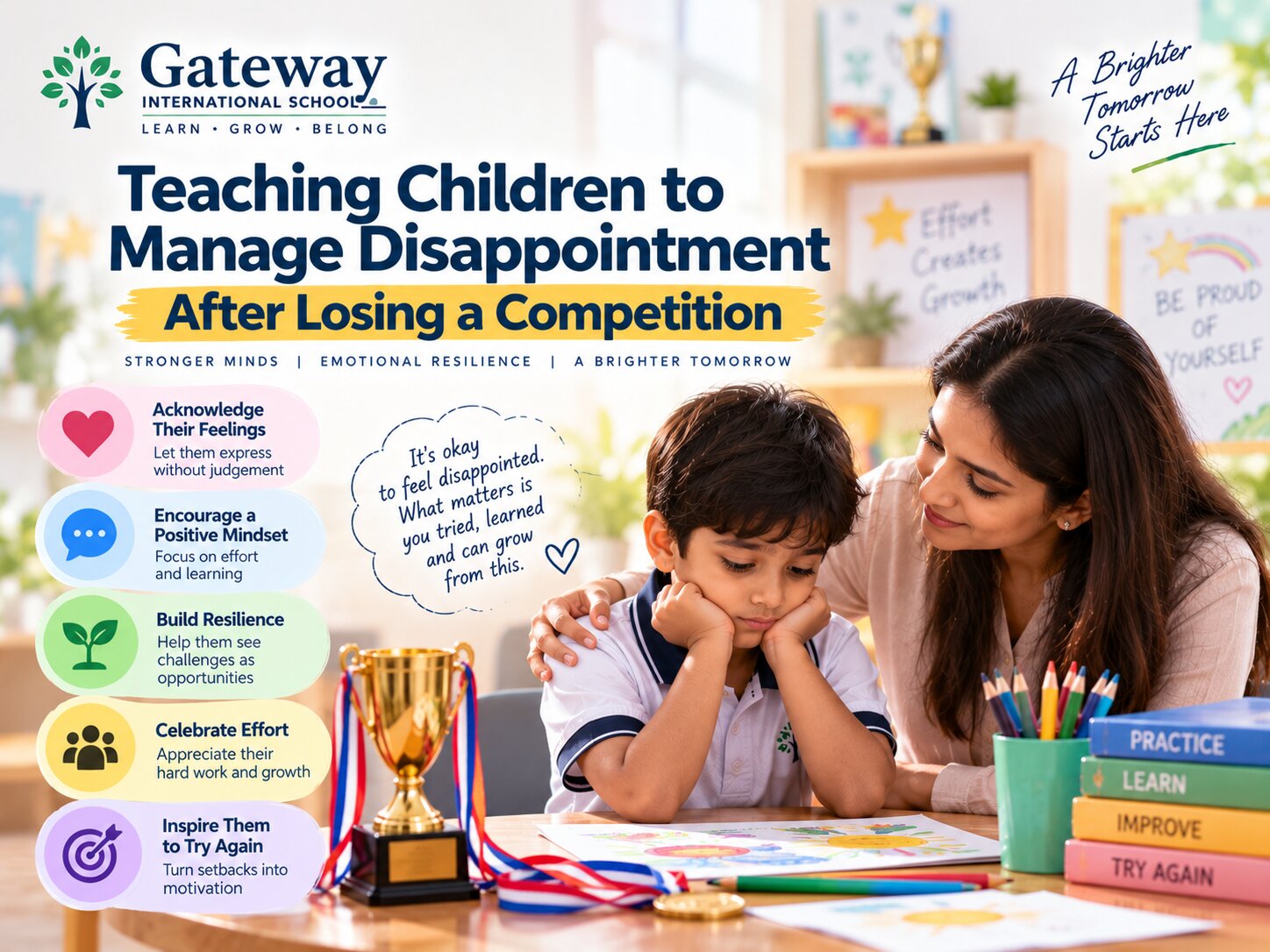
Teaching Children to Manage Disappointment After Losing a Competition
Winning a competition can bring excitement, pride, and a sense of achievement. But what happens when a child prepares for weeks, gives their best effort, and still does not win?
For some children, losing a competition may lead to tears, frustration, anger, or a feeling that they are not good enough. Whether it is a sports match, a drawing contest, a dance performance, a spelling bee, or an academic competition, disappointment can be difficult for young minds to process.
As parents and educators, our natural instinct may be to comfort children immediately or remind them that winning is not everything. While these responses are well-intentioned, children also need opportunities to understand their emotions, recover from setbacks, and develop the confidence to try again.
Learning how to handle disappointment is an important life skill that helps children develop emotional resilience, self-confidence, and a healthier attitude towards success and failure.
In this guide, Gateway Schools explores practical ways parents and teachers can help children manage disappointment after losing a competition and turn challenging experiences into opportunities for growth.
Why Is Losing a Competition So Difficult for Children?
Children may experience disappointment more intensely than adults expect. Their understanding of competition, achievement, and self-worth continues to develop throughout childhood.
Several factors can influence how a child responds to losing.
1. They Connect Winning with Self-Worth
Some children begin to believe that winning proves they are talented, intelligent, or valuable. When they lose, they may interpret the result as evidence that they are not good enough.
For example, a child who does not win a mathematics competition may say, “I am bad at maths,” even though the result reflects only one performance.
Children need reassurance that their worth is not determined by trophies, rankings, grades, or awards.
2. They Fear Disappointing Others
Children may worry about how parents, teachers, friends, or teammates will react when they lose.
If they believe that adults expect them to win, they may experience additional pressure or feel ashamed of the result.
Creating an environment where effort and learning matter more than winning can help reduce this fear.
3. They Struggle to Regulate Strong Emotions
A disappointing result can trigger frustration, sadness, embarrassment, or anger. Younger children may not yet have the language or emotional regulation skills needed to express these feelings constructively.
They may cry, withdraw, argue, or refuse to participate in another competition.
These reactions do not automatically indicate poor behaviour. They may reflect a child who needs support to understand and manage an overwhelming emotion.
4. They Compare Themselves with Other Children
Children often compare their performance with that of friends, classmates, siblings, or teammates.
Seeing another child receive a medal or praise may make losing feel even more painful.
Helping children recognise their own progress can shift their attention away from constant comparison and towards personal development.
5. They Have Invested Time and Effort
A child who has practised every day may expect their hard work to result in a win.
When that does not happen, they may wonder whether practising was worthwhile.
Parents can help children understand that effort builds skills and experience, even when the immediate outcome is not what they hoped for.
10 Ways to Teach Children to Handle Disappointment After Losing
1. Acknowledge Their Feelings Instead of Dismissing Them
When a child loses, avoid immediately saying, “It is only a competition,” or “You should not cry.”
Although adults may see the event as a small setback, it can feel significant to the child.
Instead, acknowledge the emotion.
You could say:
- “I can see that you are disappointed.”
- “You worked hard for this, and I understand why losing feels upsetting.”
- “It is okay to feel sad when something does not go the way you hoped.”
Acknowledging feelings does not mean agreeing with every reaction. It means helping children recognise their emotions before deciding how to respond.
Once the child feels heard, they may become more willing to discuss the experience.
2. Teach Children That Losing Does Not Define Them
Children need to understand that one result does not determine their abilities, potential, or personal worth.
A child who loses a drawing competition is not necessarily a poor artist. A student who does not win a quiz may still have strong academic skills.
Help children separate their identity from the outcome.
Instead of saying, “You are the best, so you should have won,” try saying, “This result does not change the fact that you practised, learned new skills, and had the courage to participate.”
Avoid exaggerated praise that makes children feel they must always be exceptional. Genuine encouragement helps them develop a more realistic and stable sense of self-confidence.
3. Focus on Effort, Improvement, and Learning
Winning depends on several factors, including preparation, performance on the day, competition rules, and the abilities of other participants.
Children can control some aspects of their performance, but they cannot control every outcome.
Ask questions such as:
- What did you enjoy about preparing for the competition?
- What is one thing you did well?
- What did you learn from participating?
- What would you like to practise before your next competition?
For example, a child who loses a swimming race may realise that their starting technique has improved or that they maintained a steady pace throughout the race.
Recognising progress helps children see competition as an opportunity to develop skills rather than simply a test of their ability.
4. Help Children Understand That Emotions Take Time to Settle
Children may not be ready to analyse what happened immediately after losing.
A child who is crying or angry may first need comfort, quiet time, water, or a little space to process the experience.
Encourage simple emotional regulation strategies, such as:
- Taking slow, comfortable breaths.
- Sitting quietly with a trusted adult.
- Naming the emotion they are experiencing.
- Taking a short walk or having a calm break.
- Talking about the event when they feel ready.
Avoid forcing a child to smile, congratulate the winner, or discuss lessons learned while their emotions are still intense.
The aim is to help children learn that feelings are temporary and can be managed without hurting themselves or others.
5. Teach Good Sportsmanship and Respect for Others
Competition offers opportunities to learn about fairness, respect, and consideration for other people.
Children can practise congratulating winners, acknowledging teammates, thanking organisers, and accepting results appropriately.
However, good sportsmanship should be taught without shaming children for feeling disappointed.
You might explain, “You can feel sad that you did not win and still be kind to the person who did.”
Role-playing different situations can help children practise what to say when:
- A friend wins an award they wanted.
- Their team loses a match.
- Another participant performs better.
- They disagree with a result.
These experiences teach children that disappointment and respect can exist together.
6. Encourage a Growth Mindset
A growth mindset involves understanding that abilities can develop through practice, feedback, effective strategies, and learning from mistakes.
When a child says, “I will never win,” help them focus on what they can learn or improve.
For example:
Instead of: “I am terrible at public speaking.”
Try: “I felt nervous during my speech. I can practise speaking slowly and making eye contact next time.”
Instead of: “I will never be good at football.”
Try: “I need more practice with passing and ball control.”
Avoid suggesting that effort guarantees a win. Hard work does not always produce the desired result, but it can help children improve their skills and understand what to try next.
7. Share Age-Appropriate Stories About Setbacks
Stories can help children understand that disappointment is a normal part of learning.
Parents and teachers can share examples of athletes, artists, scientists, or other individuals who encountered setbacks and learned from them.
It can also help to share ordinary experiences from your own life, such as making a mistake at work, struggling to learn a skill, or feeling disappointed when a plan did not work out.
Explain what you felt, what helped you recover, and what you learned.
Avoid presenting setbacks as stories in which everyone eventually becomes famous or successful. Children also need to understand that growth and fulfilment can happen without winning a major award.
8. Help Children Set Personal Goals
When children focus only on winning, they may feel that any other result is a failure.
Personal goals give them additional ways to measure progress.
Before a competition, help your child choose one or two goals within their control.
Examples include:
- Completing a dance routine with confidence.
- Speaking clearly during a presentation.
- Applying a newly learned technique.
- Completing a race without giving up.
- Staying calm when making a mistake.
- Working cooperatively with teammates.
After the event, discuss what went well and what they might try differently next time.
These goals help children recognise achievements that are not reflected in medals or rankings.
9. Model a Healthy Response to Losing
Children learn how to respond to setbacks by observing adults.
If parents react angrily to losing a board game, criticise referees after every defeat, or compare children with winners, they may unintentionally reinforce unhealthy attitudes towards competition.
Try to model calm, respectful responses.
For example, when you lose a game, you might say, “I really wanted to win, but I enjoyed playing. I will try a different strategy next time.”
You can also acknowledge your feelings without blaming others or pretending you are not disappointed.
Children do not need perfect role models. They benefit from seeing adults recognise mistakes, take responsibility, and recover constructively.
10. Encourage Children to Try Again Without Pressuring Them
After a disappointing experience, some children may not want to participate in another competition.
Give them time to recover and discuss what they would like to do next.
You might ask:
- Would you like to try this activity again?
- Is there something you would like to practise first?
- Would you prefer to participate for enjoyment rather than compete?
- What would make the next experience more comfortable?
Encourage perseverance, but do not force children into repeated competitions simply to prove that they are resilient.
Sometimes the best next step is more practice. At other times, a break or a different activity may be appropriate.
Resilience includes learning when to persist, when to adjust a strategy, and when to choose a new direction.
What Should Parents Say When Their Child Loses?
The words adults use can influence how children interpret disappointing experiences.
Here are some practical examples.
What your child says | A supportive response |
“I am a loser.” | “You lost this competition, but that does not make you a loser. One result does not define who you are.” |
“Everyone is better than me.” | “It can feel that way when you are disappointed. Let’s look at what you have learned and where you have improved.” |
“I will never try again.” | “You do not have to decide right now. Let’s take some time, and we can talk about it when you feel ready.” |
“It is not fair. I should have won.” | “You really wanted to win. Let’s talk about what happened and what we know about the result.” |
“My friend won, and I hate it.” | “It is hard when someone else gets the result you wanted. You can feel disappointed and still treat your friend respectfully.” |
“I practised so much for nothing.” | “I understand why it feels that way. What skills did you build while practising, even though the result was not what you hoped for?” |
The goal is not to make disappointment disappear immediately. It is to help children understand their feelings, think about the experience, and respond in healthier ways.
How Schools Can Help Children Develop Emotional Resilience
Schools provide valuable opportunities for children to practise handling success, setbacks, teamwork, and differences in ability.
A supportive school environment can help students understand that learning involves progress, mistakes, feedback, and continued effort.
Create a Culture That Values Participation and Growth
Schools can recognise improvement, teamwork, perseverance, creativity, and responsible participation alongside competitive achievements.
This helps children understand that success can take different forms.
Teach Emotional Awareness
Classroom discussions, stories, and age-appropriate activities can help students identify emotions and learn constructive ways to respond to frustration and disappointment.
Encourage Healthy Competition
Competitions can be designed to promote fair play, collaboration, and personal development rather than creating unnecessary pressure to win.
Teachers can also help students reflect on what they learned after an event.
Provide Constructive Feedback
Feedback should identify specific strengths and areas for improvement rather than labelling a child as talented or untalented.
For example, a teacher might explain how a student improved their presentation structure and suggest one skill to practise next.
Support Students Who Need More Help
Some children experience intense distress around competition or become extremely fearful of making mistakes.
Teachers and parents can work together to understand the child’s concerns and identify appropriate support.
At Gateway Schools, opportunities for learning, participation, and personal development can help children build confidence and develop the interpersonal and emotional skills they need to navigate challenges.
Common Mistakes Parents Should Avoid
Even supportive parents can unintentionally make losing more difficult for children.
Comparing children with siblings or classmates: Statements such as “Your friend won, so why couldn’t you?” can create shame and reduce confidence.
Offering rewards only for winning: When prizes and praise are tied exclusively to results, children may become more afraid of failure.
Dismissing disappointment: Telling children to stop crying or insisting that the competition does not matter may discourage them from expressing their feelings.
Blaming judges or opponents without evidence: This can prevent children from reflecting constructively on their own performance and understanding the rules.
Immediately trying to fix the situation: Children may need empathy and time before they are ready for advice or solutions.
Pushing them to compete again too quickly: Children need opportunities to recover and make choices about their next steps.
Praising effort without acknowledging the actual experience: It is helpful to recognise effort while also listening to genuine concerns and offering specific feedback.
The most effective approach combines emotional support, realistic encouragement, and opportunities for learning.
When Should Parents Seek Additional Support?
Feeling upset after losing is a normal experience. However, consider speaking with your child’s teacher, paediatrician, or a qualified child mental health professional if you notice persistent patterns such as:
- Extreme distress after minor mistakes or setbacks.
- Repeated statements that they are worthless or incapable.
- Avoiding activities they previously enjoyed because they fear failure.
- Frequent aggressive reactions that are difficult to manage.
- Significant anxiety about schoolwork, sports, or other performance situations.
- Disappointment that repeatedly interferes with sleep, relationships, or everyday activities.
These behaviours do not automatically indicate a disorder, but they may suggest that the child needs additional help understanding and managing their emotions.
Early support can help children develop healthier coping strategies and rebuild confidence.
Frequently Asked Questions
1. Is it normal for children to cry after losing a competition?
Yes. Crying can be a normal response to disappointment, particularly when a child has invested time and effort in an activity. Offer comfort, acknowledge the feeling, and give the child time to recover.
2. At what age should children learn to handle losing?
Children begin developing these skills in early childhood, but emotional regulation and perspective-taking continue to develop over many years. Expectations should be appropriate to the child’s developmental stage, and younger children will generally need more adult support.
3. Should parents let children win games to protect their confidence?
Occasionally adjusting a game to make it accessible or enjoyable for a child can be appropriate, but consistently allowing them to win is not necessary. Children can gradually learn to handle both winning and losing through fair, age-appropriate play and supportive guidance.
4. How can I help a child who refuses to participate after losing?
First, acknowledge the disappointment without forcing an immediate decision. Later, discuss what made the experience difficult and explore whether the child would like more practice, a different approach, or another opportunity when ready.
5. How can teachers help students who are poor losers?
Teachers can model respectful behaviour, establish clear expectations, teach emotional regulation, and encourage reflection after competitions. They should address harmful behaviour calmly while recognising that disappointment itself is a normal emotion.
6. Is losing good for a child’s development?
Losing can provide opportunities to practise emotional regulation, perseverance, perspective-taking, and problem-solving. However, the experience is most beneficial when children receive appropriate support and can reflect on what happened without excessive shame or pressure.
Conclusion: Raising Children Who Can Learn from Every Outcome
Winning can be exciting, but learning how to respond to disappointment is equally valuable.
When children lose a competition, they have an opportunity to practise recognising emotions, accepting outcomes, respecting others, and deciding what they want to do next. These skills can help them navigate challenges in school, relationships, sports, and everyday life.
Parents and educators can support this development by listening without judgement, celebrating progress, modelling healthy responses to setbacks, and creating environments where mistakes are treated as opportunities to learn.
The goal is not to raise children who never feel disappointed. It is to help them develop the confidence and resilience to face disappointment without losing faith in themselves.
At Gateway Schools, a supportive learning environment that values personal growth, collaboration, and meaningful participation can help students develop the life skills they need to approach challenges with confidence and compassion.
Because, in the long run, a child’s ability to learn, recover, and keep growing can matter far more than any single competition result.