


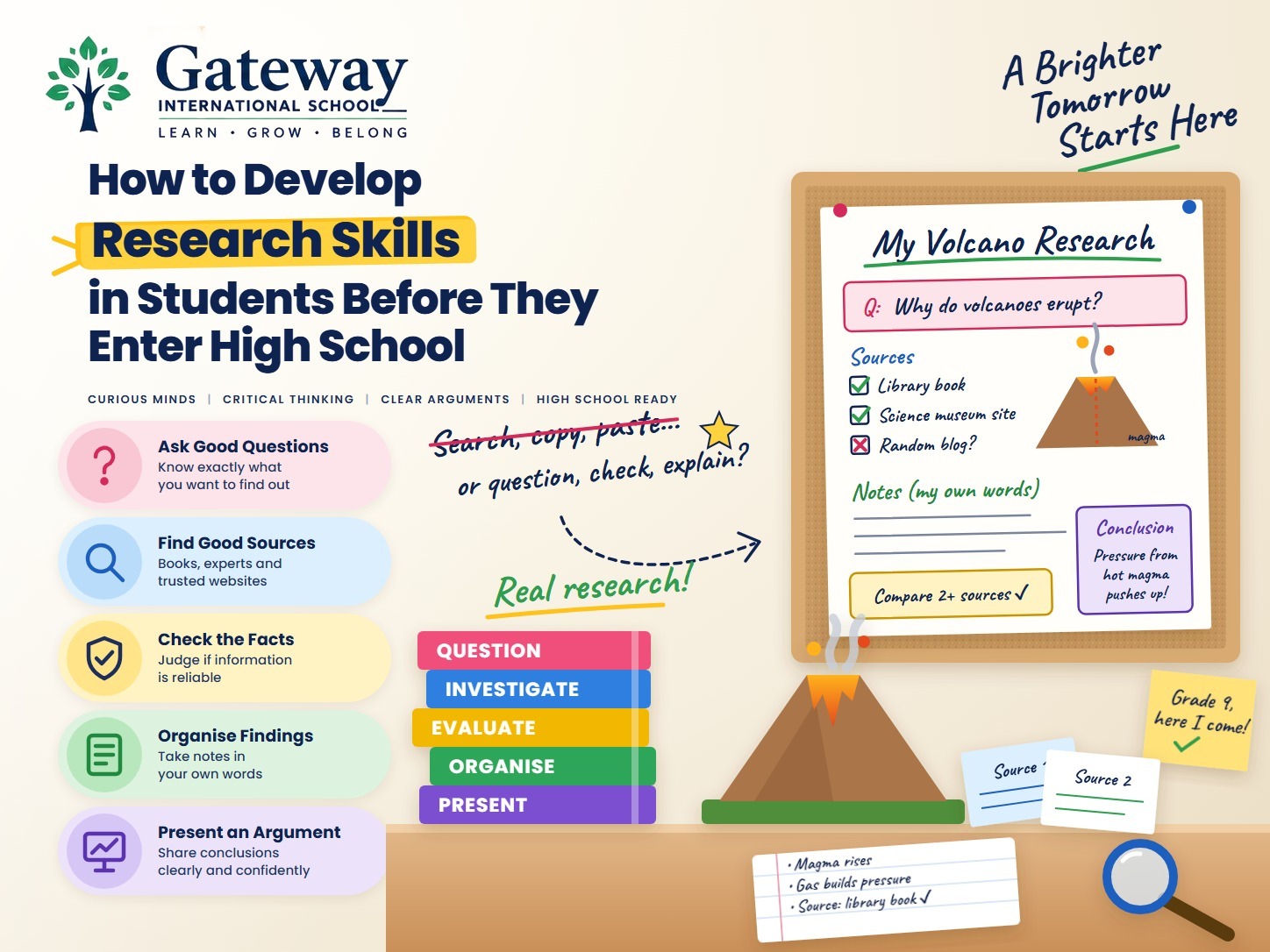
How to Develop Research Skills in Students Before They Enter High School
Ask a Grade 6 student to “find out about volcanoes” and you will often get the same result: a quick search, a few copied paragraphs and a document that looks finished but says very little. It’s not a lack of effort. Nobody ever taught them how to research.
High school changes the game. Whether your child is heading into CBSE senior classes, Cambridge IGCSE or the IB, they will be expected to investigate topics independently, judge the quality of information, organise their findings and present a clear argument. Students who have practised these skills early walk into Grade 9 with a real advantage.
This guide explains what research skills actually are, why they matter, and how parents and teachers can build them step by step during the primary and middle school years.
What Are Research Skills?
Research skills are the abilities that help a student find, evaluate, use and share information. They go well beyond searching online. A student with strong research skills can:
- Ask a good question instead of just choosing a topic
- Plan where and how to find answers
- Locate information from a range of sources
- Evaluate whether a source is trustworthy and relevant
- Take notes in their own words
- Organise ideas and spot patterns
- Draw conclusions supported by evidence
- Communicate findings clearly, giving credit to sources
These skills are useful in every subject, from a science investigation to a history essay, and they continue to matter in university and the workplace.
Why Research Skills Matter Before High School
High school demands independence. In senior grades, students handle longer assignments, internal assessments, practicals and projects with far less hand-holding.
Information is everywhere, and not all of it is reliable. Today’s students grow up surrounded by search results, videos and AI-generated answers. Knowing how to check whether something is accurate, current and unbiased is now a core life skill.
It builds deeper understanding. A student who has investigated a topic rarely forgets it. Research turns learning from memorising into understanding.
It supports board and international programmes. Cambridge and IB pathways include inquiry-based work, such as research projects and extended writing, where students must investigate and argue from evidence. Indian boards too are moving towards competency-based, application-focused learning in line with NEP 2020.
It builds confidence. Children who know how to find answers feel capable of tackling unfamiliar problems instead of waiting to be told what to do.
The Research Process, Made Simple
Even young students can learn a basic research cycle. Teach it as a loop they can repeat with growing sophistication:
- Wonder. Start with curiosity. What do I want to find out?
- Question. Turn the curiosity into a clear, focused question.
- Plan. Where could I look? Who could I ask?
- Find. Gather information from different sources.
- Check. Is this source reliable? Does it agree with others?
- Make sense. Note key points, compare ideas and look for patterns.
- Share. Present findings in a clear way and say where the information came from.
- Reflect. What did I learn? What would I do differently?
Building Research Skills by Age
Early Years and Lower Primary (Ages 4 to 8)
At this stage, research is simply structured curiosity.
- Encourage questions. Celebrate “why” and “how” instead of silencing them.
- Observe and describe. Watch ants in the garden, track the weather, or notice how plants grow. Ask what they see and what they think will happen next.
- Use more than one source. Look something up in a picture book, ask a grandparent and watch a short video together.
- Draw and label findings. Let children record discoveries through drawings, simple charts or a “discovery journal.”
Upper Primary (Ages 8 to 11)
Children can now begin to plan and record more independently.
- Teach question types. Show the difference between a closed question (“What is the capital of Tamil Nadu?”) and an open one (“How has Chennai changed over the last fifty years?”). Open questions lead to real research.
- Introduce note-taking. Teach them to jot down key words and rewrite ideas in their own words instead of copying.
- Use the library. Learn how books are organised and how to use contents pages and indexes.
- Start comparing sources. Ask: “Did both sources say the same thing? Why might they differ?”
- Try mini-projects. A one-week investigation, such as “Where does our household water come from?”, builds stamina and organisation.
Middle School (Ages 11 to 14)
This is the most important window for preparing students for high school.
- Teach source evaluation. Help students ask who created the information, why, when, and whether the claims are backed by evidence.
- Explain primary and secondary sources. A survey they conduct themselves is primary data; an encyclopaedia entry is a secondary source.
- Introduce referencing. Make “where did I get this?” a habit, and explain why giving credit matters and what plagiarism means.
- Practise surveys, interviews and experiments. Collecting their own data makes research real, and links naturally with maths and science.
- Develop argument and structure. Teach them to state a claim, support it with evidence and acknowledge other viewpoints.
- Use technology wisely. Teach effective search techniques, how to spot unreliable websites and how to treat AI tools as a starting point to be verified, never as a final authority.
Practical Activities That Build Research Skills
The “Fact or Fiction?” challenge. Give students a surprising claim and ask them to verify it using at least three sources.
Family interview project. Ask your child to interview an elder about life in their youth, record the answers and write a short profile. It builds questioning, listening and organising skills, and it’s a lovely way to connect generations.
Neighbourhood survey. Students design three or four questions, survey 15 to 20 people on a topic like water use or favourite local places, then present the results as a chart.
Mini science investigation. Pose a testable question, such as “Which material keeps water warm the longest?”, then plan the test, record results and draw conclusions.
Passion project. Let students choose any topic they love, from cricket to coral reefs, research it over a few weeks and present to family or classmates.
Source detective. Give students two articles on the same topic with different viewpoints and ask them to identify differences in facts, tone and purpose.
Reading beyond the textbook. Encourage reading magazines, biographies, news articles for young readers and science journals. Wider reading builds vocabulary, background knowledge and the ability to follow an argument.
How Parents Can Support Research Skills at Home
You don’t need to be an expert. You just need to be curious alongside your child.
- Model curiosity. Say “I don’t know, let’s find out together” often.
- Ask guiding questions. Instead of giving the answer, ask “Where could we look?” or “How could we check that?”
- Resist doing it for them. Let your child struggle productively with finding and organising information.
- Teach them to question what they read. Ask “How do we know this is true?” in everyday conversations, whether about a news story or a viral message.
- Set up a reading-friendly home. Books, magazines, a library membership and a quiet study corner all help.
- Praise process, not just product. Appreciate the questions they asked, the sources they checked and the effort they put in.
- Set healthy tech boundaries. Guide children on safe, responsible internet use and show them how to search with purpose.
Common Mistakes to Avoid
- Copying and pasting. Teach note-taking in their own words from the very beginning.
- Trusting the first search result. Encourage checking at least two or three sources.
- Choosing topics that are too broad. “Space” is a topic; “Why do astronauts lose bone density?” is a research question.
- Skipping the planning stage. A few minutes spent planning saves hours of confusion.
- Treating AI answers as facts. AI tools can be useful for brainstorming, but they can also be wrong, so every claim needs checking against reliable sources.
- Overloading the child. Keep early research tasks short, enjoyable and achievable.
Signs Your Child Is Ready for High School Research
By the end of middle school, a well-prepared student can usually:
- Form focused, open-ended questions
- Use several kinds of sources and tell reliable from unreliable ones
- Take notes and summarise in their own words
- Organise information logically
- Support their opinions with evidence
- Credit their sources
- Present findings clearly, in writing or speech
If some of these are still developing, that’s perfectly normal. These skills grow with steady practice over time.
How to Tell Whether a School Builds Research Skills
When choosing a school, it’s worth asking:
- How are students taught to ask questions and investigate topics?
- Do students complete research projects before Grade 9? Can I see examples?
- How does the school teach referencing and academic honesty?
- How is technology, including AI, used responsibly in learning?
- Is there a library, and how often do students use it?
- How are projects assessed, and do they recognise process as well as final product?
Inquiry-Based Learning at Gateway Group of International Schools
At the Gateway Group of International Schools, learning is designed to go beyond the textbook. Our campuses follow a multisensory, experiential approach that encourages hands-on learning, inquiry and creative expression, so students develop the habits of questioning, investigating and explaining that prepare them for the senior years.
Skills for the future. We focus on competencies such as problem-solving, communication, creativity, decision-making, innovation and resilience.
A choice of curricula. Families can choose from the IB programme at the IB World School in Padur, the Cambridge pathway from Primary to A Levels at Gateway The Complete School in Sholinganallur, and CBSE at campuses in Padur, Neelankarai and Mahabalipuram.
Holistic development. Sports, arts, cultural celebrations, competitions and student leadership opportunities help children grow into confident, well-rounded learners.
Proven outcomes. Gateway alumni have gone on to institutions including VIT, IIIT Hyderabad, SRM Institute of Science and Technology, Symbiosis Law School and universities in the UK and Europe.
Frequently Asked Questions
1. At what age should children start learning research skills?
From the early years. Young children can practise observing, asking questions and finding answers in simple ways. The skills become more structured as they grow.
2. How can I teach my child to research without copying from the internet?
Teach note-taking in their own words from the start. Ask them to close the page and explain what they learned, then write it down. Also discuss why giving credit to sources matters.
3. Is it okay for students to use AI tools for research?
AI tools can help with brainstorming or understanding a topic, but they can make mistakes and invent information. Students should always verify claims against reliable sources and be clear about what they’ve written themselves. Follow your school’s guidelines on AI use.
4. How do I help my child tell reliable sources from unreliable ones?
Teach them to ask who wrote it, why, when it was published, what evidence is given, and whether other trustworthy sources agree.
5. Will research skills help in board exams?
Yes, indirectly. Research builds understanding, analysis and clear writing, which support performance in application-based and analytical questions across boards.
Raise a Curious, Capable Researcher
Research skills aren’t built in a single project. They grow through years of curiosity, practice and guidance. By helping your child ask better questions, check their sources and explain their thinking, you give them something far more valuable than any single answer: the ability to find out for themselves.
Admissions for 2027–28 are open across Gateway campuses. Apply online, explore our admissions page, call 044-2449 3333, or email admission@gatewaytheschool.in to schedule a campus visit.