


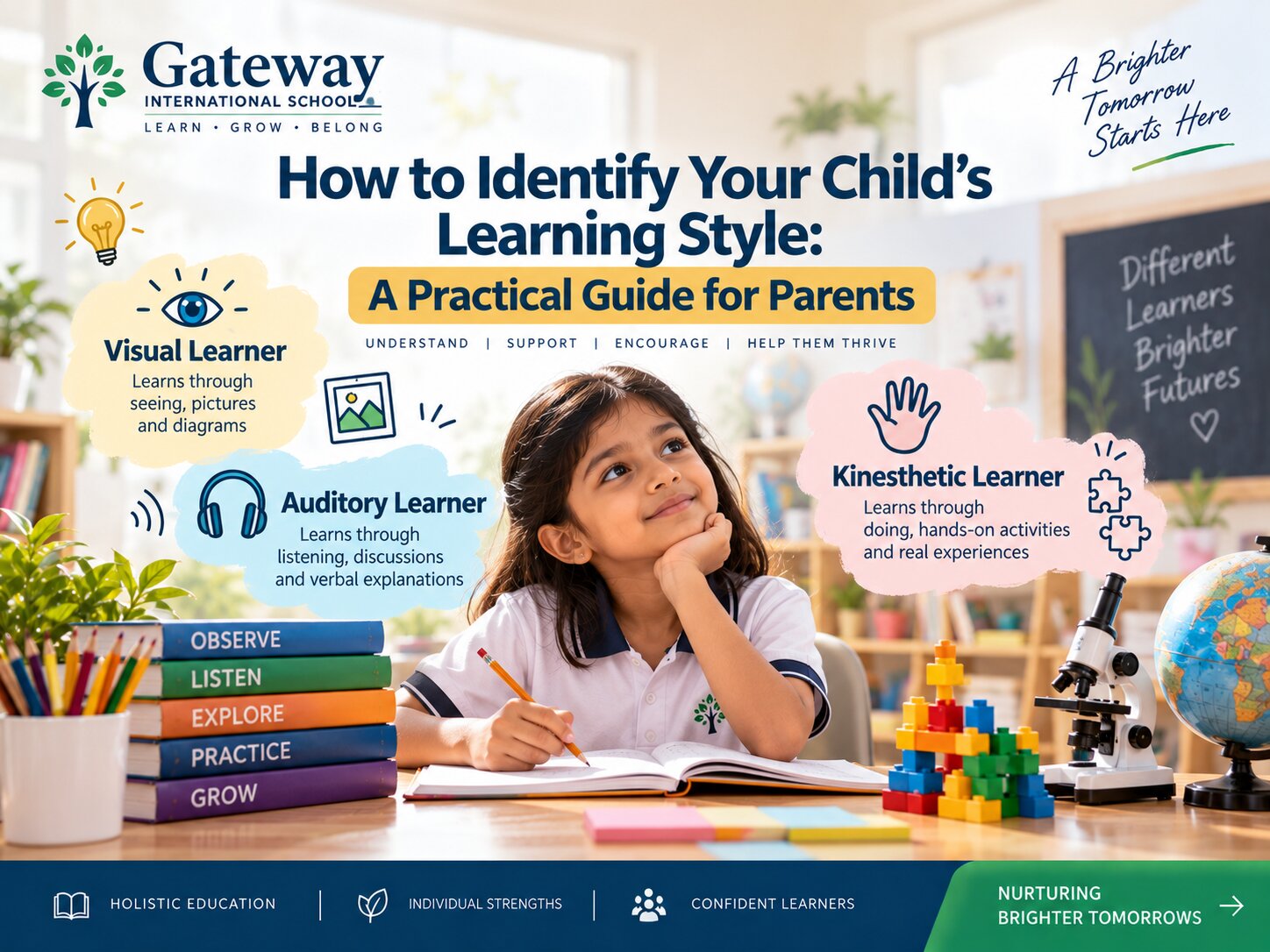
How to Identify Your Child’s Learning Style: A Practical Guide for Parents
Every child learns differently. Some children enjoy reading books and writing notes, while others understand concepts better through experiments, discussions, or hands-on activities. As a parent, understanding how your child engages with new information can help you create a more supportive learning environment at home and encourage a lifelong love of learning.
But how can you identify your child’s learning style? Is your child a visual learner, an auditory learner, or someone who learns best by doing?
In this guide, we explore common ways children engage with information, practical activities parents can try at home, and how schools can support different learning needs.
What Is a Learning Style?
A learning style generally refers to a person’s preferred way of engaging with information. Some children enjoy visual materials, others prefer listening to explanations, and some are drawn to practical activities and physical experiences.
Parents may notice that their child prefers:
- Pictures, diagrams, charts, and visual demonstrations.
- Conversations, storytelling, and verbal explanations.
- Experiments, building activities, and hands-on exploration.
- Reading, writing, and organising information in their own words.
These preferences can offer useful clues about how a child approaches learning.
However, it is important to remember that children do not necessarily have one fixed learning style. Research has not established that matching teaching methods to a supposed visual, auditory, or kinaesthetic learning type consistently improves academic performance. Children benefit from varied teaching methods, opportunities to practise, and approaches suited to the subject and task.
Four Common Ways Children Engage with Learning
1. Visual Learning: Understanding Through What They See
Some children are particularly drawn to visual information. They may enjoy colourful illustrations, maps, diagrams, photographs, videos, and mind maps.
Signs you may notice:
- Your child enjoys picture books and illustrated explanations.
- They like drawing diagrams to explain what they have learned.
- They remember the layout of a page or the location of information in a book.
- They enjoy puzzles, matching games, and visual patterns.
Activities to try at home:
- Use diagrams to explain scientific concepts.
- Create timelines when learning history.
- Use mind maps to connect ideas.
- Encourage your child to draw a picture representing a story or concept.
For example, when teaching the water cycle, a simple diagram showing evaporation, condensation, and precipitation can help make the process easier to understand.
2. Auditory Learning: Understanding Through Listening and Discussion
Some children engage particularly well with spoken explanations, conversations, and stories. Talking through a concept may help them organise their thoughts and identify what they understand.
Signs you may notice:
- Your child enjoys being read to or listening to stories.
- They frequently ask questions during explanations.
- They enjoy discussing what happened at school.
- They like explaining ideas aloud or listening to educational audio.
Activities to try at home:
- Read stories together and discuss the characters.
- Ask your child to explain a concept in their own words.
- Use rhymes or rhythm to practise spelling and basic facts.
- Encourage discussions about everyday experiences.
For example, after reading a story, ask your child to describe the main character, explain the problem, and predict what might happen next.
3. Kinaesthetic Learning: Understanding Through Doing
Some children are especially engaged when they can explore objects, conduct experiments, build models, or solve practical problems.
Signs you may notice:
- Your child enjoys building blocks, puzzles, or craft projects.
- They are curious about how things work.
- They learn enthusiastically through experiments and demonstrations.
- They enjoy activities that involve movement and interaction.
Activities to try at home:
- Use building blocks to demonstrate mathematical concepts.
- Grow a small plant to observe its development.
- Conduct simple science experiments with adult supervision.
- Use everyday objects to practise counting, sorting, and measuring.
For example, measuring ingredients while preparing a recipe can help children understand fractions, quantities, and measurement through a real-world activity.
4. Reading and Writing: Understanding Through Words
Some children prefer working with written information. Reading explanations, writing summaries, making lists, and keeping journals may help them process ideas.
Signs you may notice:
- Your child enjoys reading books or informational articles.
- They like keeping notebooks or writing stories.
- They organise their thoughts through lists.
- They prefer written instructions for certain tasks.
Activities to try at home:
- Encourage a daily reading habit.
- Ask your child to summarise a story in their own words.
- Create vocabulary lists when learning a new language.
- Invite them to keep a journal of interesting discoveries.
For example, after a nature walk, your child could write a short observation journal describing the plants, insects, and weather they noticed.
Remember that these categories are informal ways to describe preferences, not scientifically established learner types. Most children use a combination of approaches, and their preferences can change depending on the task, age, and subject.
How to Identify Your Child’s Learning Preferences
Rather than assigning your child a fixed label, observe how they approach different activities over time.
Step 1: Observe Their Natural Interests
Notice which activities your child chooses during free time. Do they enjoy reading, drawing, building, listening to stories, or conducting experiments?
These interests can help you discover opportunities to make learning engaging.
Step 2: Introduce the Same Concept in Different Ways
Choose a simple topic and present it using different methods.
For example, when teaching multiplication, you could:
- Show a visual array of objects.
- Explain the concept verbally.
- Use physical objects such as buttons or blocks.
- Write number sentences and practise problems.
Observe which methods help your child understand the concept and explain it independently.
Step 3: Ask Questions About Their Experience
Children can often tell you which activities they find helpful.
Try asking:
- What helped you understand this topic?
- Would you like to see an example or try it yourself?
- Can you explain what you learned in your own words?
- Which part was difficult, and what helped you work through it?
These conversations develop self-awareness and encourage children to take an active role in their education.
Step 4: Look for Understanding, Not Just Enjoyment
An activity may be enjoyable without necessarily leading to better understanding. Pay attention to whether your child can recall information later, apply a concept to a new situation, and explain their reasoning.
Short quizzes, practice exercises, discussions, and real-world applications can help you assess progress.
Step 5: Adapt and Experiment
Continue introducing different learning activities. Your child may prefer diagrams for science, discussions for language learning, and practical exercises for mathematics.
The goal is to discover useful strategies for each learning task, rather than determine one permanent learning style.
Why Every Child Needs a Balanced Learning Approach
Although children may have different preferences, effective learning often involves combining several methods.
For example, when learning about plants, a child might:
- Read a short explanation about plant growth.
- Examine labelled diagrams of a plant.
- Listen to a teacher explain photosynthesis.
- Grow a seed and observe its development.
- Write down observations and discuss the results.
This approach connects written information, visual representations, explanations, and practical experience.
Different subjects also call for different approaches. A geometry lesson may benefit from diagrams and models, while language development may require reading, listening, speaking, and writing.
A balanced learning environment gives children multiple ways to understand, practise, and apply what they learn.
How Schools Can Support Different Learning Needs
Schools play an important role in creating classrooms where children can engage with concepts in different ways.
Effective teaching may include:
Interactive classroom activities: Discussions, demonstrations, collaborative projects, and practical exercises help students engage actively with concepts.
Visual and digital resources: Charts, diagrams, videos, and simulations can make abstract ideas more accessible.
Inquiry-based learning: Encouraging students to ask questions, investigate evidence, and develop their own explanations supports curiosity and independent thinking.
Regular feedback: Teachers can identify misunderstandings, recognise progress, and provide appropriate support.
Opportunities for collaboration: Group discussions and projects allow students to share perspectives and learn from one another.
At Gateway Schools, a supportive learning environment can help children explore their interests, develop critical thinking, and build confidence as learners. Parents can learn more about the school’s educational programmes and approach to teaching through the official school website.
Common Mistakes Parents Should Avoid
While understanding your child’s preferences is helpful, avoid these common mistakes:
- Labelling your child too early: Calling a child exclusively a visual or auditory learner may unnecessarily limit their learning experiences.
- Assuming one method works for every subject: Different concepts often require different teaching strategies.
- Comparing siblings: Children develop at different rates and may respond differently to the same activity.
- Focusing only on strengths: Gentle encouragement to practise challenging skills can help children develop new abilities.
- Ignoring persistent difficulties: If your child consistently struggles with reading, writing, attention, or understanding concepts, speak with their teacher and consider whether further assessment or support may be appropriate.
The objective is not to fit children into categories. It is to understand their needs and help them become confident, flexible learners.
Frequently Asked Questions
1. At what age can I identify my child’s learning preferences?
You can begin observing preferences in early childhood through play, stories, conversations, and practical activities. These preferences may evolve as your child grows, so it is best to keep an open mind.
2. Can a child have more than one learning style?
Yes. Children commonly enjoy and benefit from several approaches. Their preferences may also vary according to the subject, task, and learning environment.
3. Should I change my child’s entire study routine based on their learning style?
No. Instead, introduce varied learning methods and evaluate what helps your child understand, remember, and apply information. Combine these approaches with regular practice and feedback.
4. How can I help my child who struggles to concentrate?
Start with manageable study sessions, reduce distractions, include suitable breaks, and divide large tasks into smaller steps. If concentration difficulties persist or affect everyday functioning, discuss your concerns with the child’s teacher or an appropriate professional.
5. What is the most effective learning style for children?
There is no single learning style that is best for every child. Effective learning depends on the subject, prior knowledge, teaching methods, opportunities for practice, and individual needs. A varied and flexible approach is generally more useful than relying on a fixed learning-style category.
Conclusion
Identifying your child’s learning preferences begins with observation, curiosity, and open communication. Whether your child enjoys reading, listening, drawing, experimenting, or solving practical problems, the most important step is to provide opportunities to explore different ways of learning.
Rather than assigning a permanent learning-style label, focus on helping your child understand concepts, practise new skills, ask questions, and become increasingly independent.
Every child can grow into a confident learner when given the right encouragement, meaningful opportunities, and support that responds to their needs.
Explore Gateway Schools to learn more about its educational programmes and discover how a supportive school environment can help children develop the skills and confidence they need for lifelong learning.