


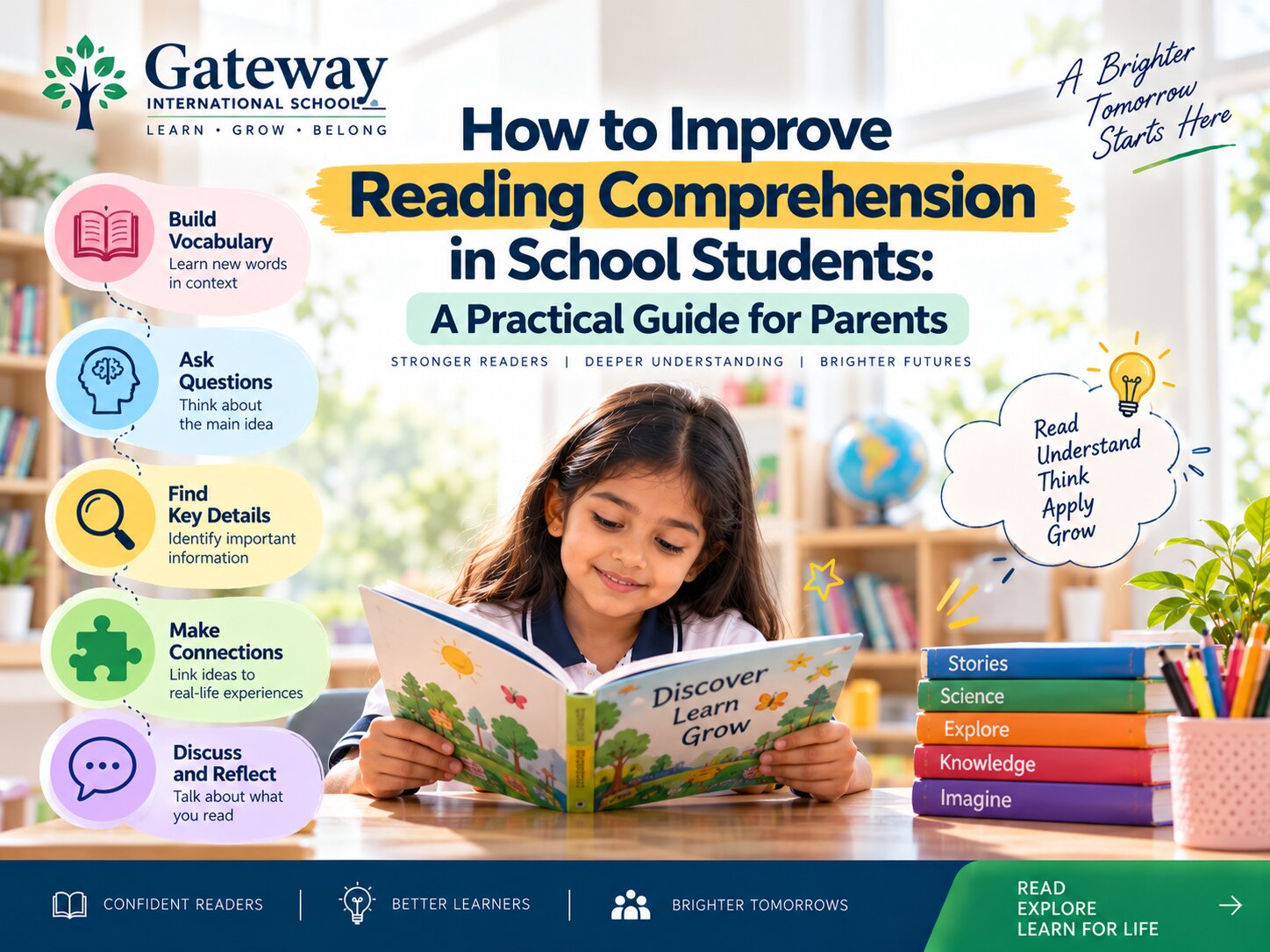
How to Improve Reading Comprehension in School Students: A Practical Guide for Parents
Reading is one of the most important skills children develop during their school years. However, being able to read words aloud does not always mean a child understands what they are reading.
Some students can finish an entire chapter but struggle to explain its main idea, identify important details, understand unfamiliar vocabulary, or answer questions about the text. These challenges can affect their performance across subjects, from English and science to mathematics and social studies.
The good news is that reading comprehension can be strengthened through regular practice, meaningful conversations, and simple strategies at home and school.
In this guide, Gateway Schools explores what reading comprehension means, why it matters, and how parents and educators can help students become confident, thoughtful readers.
What Is Reading Comprehension?
Reading comprehension is the ability to understand, interpret, and make meaning from written information.
It involves more than recognising words. Students must connect ideas, understand vocabulary, identify important information, draw conclusions, and relate what they read to their existing knowledge.
For example, a student reading a story about a child who shares an umbrella with a classmate should be able to explain not only what happened but also why the character acted that way and what the story might teach the reader.
Strong reading comprehension helps students:
- Understand textbooks and classroom instructions.
- Identify main ideas and supporting details.
- Interpret information and make logical inferences.
- Develop vocabulary and language skills.
- Think critically about what they read.
- Express their understanding clearly in speaking and writing.
These skills support learning throughout school and beyond.
Why Do Some Students Struggle with Reading Comprehension?
Reading difficulties can have several causes, and not every student experiences the same challenges.
1. Limited Vocabulary
Students may understand the basic structure of a sentence but struggle when it contains unfamiliar words or expressions.
For example, a student who does not understand words such as evaporation, migration, or consequence may find a textbook passage difficult to follow.
2. Reading Without Thinking
Some children focus on finishing a page rather than understanding the information. They may move quickly through paragraphs without pausing to consider what the text means.
3. Difficulty Identifying Main Ideas
Students sometimes remember individual facts but struggle to explain the central message of a paragraph or chapter.
4. Limited Background Knowledge
Understanding a passage often requires some familiarity with its subject. A text about the solar system, ancient civilisations, or ecosystems may be harder to understand when the student has little prior knowledge.
5. Difficulty Making Inferences
Not every detail is explained directly in a text. Readers often need to combine clues with what they already know.
For example, if a story describes dark clouds, strong winds, and people rushing indoors, students may infer that a storm is approaching.
6. Reading Fluency Challenges
When children struggle to recognise words accurately or read smoothly, much of their attention may be devoted to decoding. This can leave fewer mental resources available for understanding the passage.
7. Distractions and Limited Practice
Frequent interruptions, unsuitable reading materials, or limited opportunities to read and discuss texts may make it harder for students to develop comprehension skills.
Identifying the specific challenge is important because the most effective support depends on what is making reading difficult.
10 Effective Ways to Improve Reading Comprehension in School Students
1. Encourage Daily Reading
One of the simplest ways to strengthen comprehension is to make reading a regular part of a child’s day.
Encourage students to read books, short stories, biographies, articles, and age-appropriate informational texts. A varied reading routine exposes them to different writing styles, vocabulary, and ideas.
How parents can help:
- Set aside 15–20 minutes for reading, adjusting the time to the child’s age and attention.
- Let children choose books that interest them.
- Visit a library or create a small reading corner at home.
- Discuss interesting ideas rather than focusing only on how many pages they finish.
Consistency is more valuable than forcing children to complete long reading sessions.
2. Ask Questions Before, During, and After Reading
Reading comprehension improves when students actively engage with a text instead of passively moving through it.
Questions encourage them to think about what they are reading, connect ideas, and check their understanding.
Before reading:
- What do you think this story or article will be about?
- What do you already know about this topic?
- What would you like to find out?
During reading:
- What is happening in this paragraph?
- Why do you think the character made that decision?
- What might happen next?
After reading:
- What is the main idea?
- Which details support it?
- What did you learn from this text?
- Can you explain the passage in your own words?
For younger children, use simple questions and picture-based discussions. Older students can explore more complex ideas, evidence, and alternative interpretations.
3. Teach Children to Identify the Main Idea
The main idea is the central point that a passage communicates. Supporting details provide explanations, examples, or evidence.
Students who can distinguish between the main idea and minor details are better equipped to summarise information and prepare for examinations.
Try this activity:
Give your child a short paragraph and ask them to identify:
- What is the paragraph mainly about?
- What is the most important point?
- Which two details support that point?
- Can you explain the paragraph in one sentence?
For example, a passage describing how trees provide shade, absorb carbon dioxide, and support wildlife may have the main idea that trees are essential to healthy ecosystems.
Practise with short passages before moving to longer chapters.
4. Build Vocabulary Through Context
Understanding vocabulary is essential for making sense of written information. However, children do not need to stop and look up every unfamiliar word immediately.
Encourage them to use the surrounding sentences, examples, and explanations to work out possible meanings.
Practical activities include:
- Keeping a notebook of unfamiliar words.
- Discussing new words encountered in stories.
- Finding synonyms and antonyms.
- Creating sentences using newly learned vocabulary.
- Using a dictionary to confirm meanings.
For example, in the sentence, “The exhausted runner collapsed onto the bench after the race,” a child might infer that exhausted means extremely tired.
Over time, vocabulary discussions help children understand more complex texts independently.
5. Encourage Summarising in Their Own Words
Summarising requires students to identify essential information and explain it clearly without copying the entire passage.
After reading a story or chapter, ask your child to describe what they learned in three to five sentences, depending on their age and the text.
A useful summary usually includes:
- The main topic or central idea.
- The most important events or points.
- Relevant supporting details.
- The overall conclusion, where appropriate.
Younger children can retell a story verbally or arrange picture cards in the correct sequence. Older students can write summaries of textbook chapters.
Avoid correcting every sentence immediately. First check whether the child has understood the overall meaning.
6. Use Visual Organisers and Mind Maps
Some students find it easier to understand information when they can see how ideas relate to one another.
Visual organisers can help children organise details, compare concepts, and remember sequences.
Useful examples include:
- Story maps: Identify characters, setting, problem, events, and resolution.
- Venn diagrams: Compare similarities and differences between two subjects.
- Flowcharts: Show the sequence of events or steps in a process.
- Mind maps: Connect a central topic to supporting ideas.
- Cause-and-effect charts: Explain why something happened and what followed.
For example, after reading a chapter about the water cycle, students can create a flowchart connecting evaporation, condensation, and precipitation.
Visual organisers should support understanding rather than become an extra task that distracts from the reading itself.
7. Help Students Make Predictions and Inferences
Good readers do more than collect information. They use evidence to interpret what is happening and anticipate what may come next.
A prediction is an informed guess about what might happen. An inference is a conclusion drawn from clues and background knowledge.
Try asking:
- What do you think will happen next?
- Which details helped you reach that conclusion?
- What can you infer about the character’s feelings?
- What does the author suggest without stating it directly?
For example, if a character packs a suitcase, checks a train ticket, and says goodbye to friends, students might infer that the character is preparing to travel.
Encourage children to explain the clues behind their answers. This develops reasoning skills and helps them distinguish evidence-based interpretations from guesses.
8. Connect Reading to Real-Life Experiences
Children often understand unfamiliar ideas more easily when they can connect them to something they have experienced.
Before reading a text about plants, discuss a garden or a plant growing at home. Before reading about maps, look at a neighbourhood map together. Before exploring a historical event, discuss what students already know about the period.
Parents can also encourage children to read everyday materials such as:
- Recipes and cooking instructions.
- Maps and directions.
- Age-appropriate news articles.
- Product labels and simple manuals.
- Museum information and educational signs.
These activities show children that reading is not limited to textbooks and examinations. It is a skill they can use to understand the world around them.
9. Teach Students to Recognise Different Text Types
Different texts serve different purposes, and students benefit from understanding how to approach each one.
A story, a scientific explanation, a newspaper article, and a set of instructions are not read in exactly the same way.
Help children recognise whether a text is intended to inform, explain, persuade, entertain, or instruct.
For example:
- In a story, look for characters, setting, conflict, and resolution.
- In a science passage, identify concepts, processes, and evidence.
- In an opinion article, distinguish the author’s claim from supporting reasons.
- In instructions, identify the sequence of steps and any warnings.
This approach is especially useful as students progress to more complex academic texts across different subjects.
10. Practise Active Reading and Self-Monitoring
Active readers regularly check whether they understand what they are reading. If a passage becomes confusing, they pause and use strategies to clarify it.
Teach students to ask themselves:
- Do I understand this paragraph?
- Can I explain the main point?
- Is there a word or sentence I need to revisit?
- Should I reread the passage or look for another explanation?
Encourage students to slow down when necessary, reread difficult sentences, break long paragraphs into smaller sections, and use headings or diagrams to clarify meaning.
The objective is not to make children stop after every sentence. It is to help them recognise when their understanding is unclear and know what to do next.
Reading Comprehension Activities by Age Group
Children need different kinds of reading support as they grow. The following activities offer a starting point.
Age or stage | Activities to try | Skills supported |
Preschool and early readers | Picture walks, storytelling, naming objects, discussing illustrations | Oral language, sequencing, listening |
Early primary school | Short stories, simple retelling, main-character questions, word games | Basic understanding, vocabulary, recall |
Upper primary school | Chapter summaries, mind maps, predictions, cause-and-effect charts | Main ideas, inference, organising information |
Middle and secondary school | Comparing texts, evaluating evidence, analysing arguments, summarising textbook chapters | Critical thinking, interpretation, academic reading |
These are flexible suggestions rather than strict age-based rules. Select activities according to the student’s current reading ability, interests, and developmental needs.
How Teachers Can Improve Reading Comprehension in the Classroom
Teachers play an essential role in helping students develop effective reading strategies across the curriculum.
Model How Good Readers Think
Teachers can demonstrate how to identify a main idea, interpret an unfamiliar word, make an inference, and check understanding while reading.
This makes otherwise invisible thinking processes easier for students to learn.
Provide Guided Reading Opportunities
Students benefit from reading texts with appropriate support, discussing their meaning, and gradually applying strategies independently.
Texts should provide a useful level of challenge without being so difficult that students cannot follow the central ideas.
Integrate Reading Across Subjects
Reading comprehension should not be limited to language lessons. Science, mathematics, geography, and history all require students to interpret written information.
For example, a science teacher can ask students to explain a process from a textbook, while a mathematics teacher can help them identify what a word problem is asking before attempting to solve it.
Offer Specific Feedback
Instead of simply marking an answer incorrect, teachers can help students understand whether they missed the main idea, misunderstood a word, overlooked a clue, or used insufficient evidence.
Targeted feedback helps students develop more effective strategies.
Monitor Progress and Provide Support
Short comprehension exercises, oral retellings, discussions, and written responses can help teachers identify strengths and areas requiring additional attention.
Students who consistently struggle may benefit from more targeted instruction in decoding, fluency, vocabulary, oral language, or comprehension strategies, depending on their needs.
Common Mistakes to Avoid When Teaching Reading Comprehension
Even well-intentioned reading routines can become less effective when the focus is misplaced.
Focusing only on reading speed: Reading quickly does not guarantee understanding. Accuracy, fluency, and comprehension all matter.
Asking only factual questions: Questions about names and dates are useful, but students should also explain reasons, draw inferences, and connect ideas.
Choosing texts that are too difficult: Excessively challenging material can frustrate children and make it harder to practise comprehension strategies successfully.
Correcting every mistake immediately: Give students time to think, explain their reasoning, and attempt to solve problems independently.
Treating reading as an examination task: Stories, discussions, and personal interests can make reading more enjoyable and encourage sustained practice.
Ignoring persistent difficulties: If a child struggles despite consistent support, consider whether additional assessment or targeted instruction may be needed.
When Should Parents Seek Additional Support?
Occasional difficulty understanding a passage is normal, particularly when children encounter new vocabulary or unfamiliar subjects.
However, consider discussing your concerns with your child’s teacher if they consistently:
- Struggle to explain what they have just read.
- Have difficulty understanding age-appropriate instructions or texts.
- Read words accurately but cannot explain their meaning.
- Find reading increasingly frustrating despite regular practice.
- Show persistent difficulties with word recognition, reading fluency, or language comprehension.
Teachers can help identify the specific difficulty and recommend appropriate next steps. Depending on the child’s needs, further assessment by a qualified educational or developmental professional may be helpful.
Early support can make it easier for children to develop the skills and confidence needed for independent learning.
Frequently Asked Questions
1. How can I improve my child’s reading comprehension at home?
Encourage regular reading, ask questions about the text, discuss unfamiliar vocabulary, and invite your child to summarise what they have learned. Short, consistent activities are often easier to maintain than lengthy practice sessions.
2. What is the difference between reading fluency and reading comprehension?
Reading fluency involves reading accurately, at an appropriate pace, and with suitable expression. Reading comprehension involves understanding and interpreting the meaning of the text. Both skills contribute to successful reading.
3. Does reading more books automatically improve comprehension?
Regular reading provides valuable exposure to vocabulary, language, and ideas. However, comprehension also benefits from discussion, explicit instruction, background knowledge, and opportunities to practise explaining and interpreting texts.
4. How can I help a child who reads well but does not understand what they read?
Pause after short passages and ask the child to explain the main idea in their own words. Discuss vocabulary, clarify unfamiliar concepts, and ask questions that require them to connect details and draw conclusions. If the difficulty persists, consult the child’s teacher.
5. Which books are best for improving reading comprehension?
Choose age-appropriate books that match your child’s reading ability and interests. Include a mixture of fiction, nonfiction, biographies, informational texts, and stories from different cultures. Gradually introduce more complex texts as the child’s skills develop.
6. How long should children read each day?
The appropriate duration depends on the child’s age, reading level, and concentration. Begin with a manageable period and increase it gradually as reading becomes a comfortable routine. Quality of engagement matters alongside time spent reading.
Conclusion: Building Confident Readers for Lifelong Learning
Reading comprehension is a foundational skill that helps students learn independently, think critically, and communicate their understanding across subjects.
By encouraging daily reading, discussing ideas, developing vocabulary, practising summarisation, and helping children ask thoughtful questions, parents and teachers can make reading more meaningful.
Every child develops at a different pace. With consistent practice, appropriate instruction, and encouragement, students can gradually become more confident in understanding and interpreting the information they encounter.
At Gateway Schools, fostering curiosity, independent thinking, and meaningful engagement with learning can help students build the reading skills they need to succeed academically and throughout life.
Explore Gateway Schools to learn more about its educational programmes and approach to supporting students’ learning and development.