


Why Interdisciplinary Projects Help Students Connect Classroom Learning to Real Life
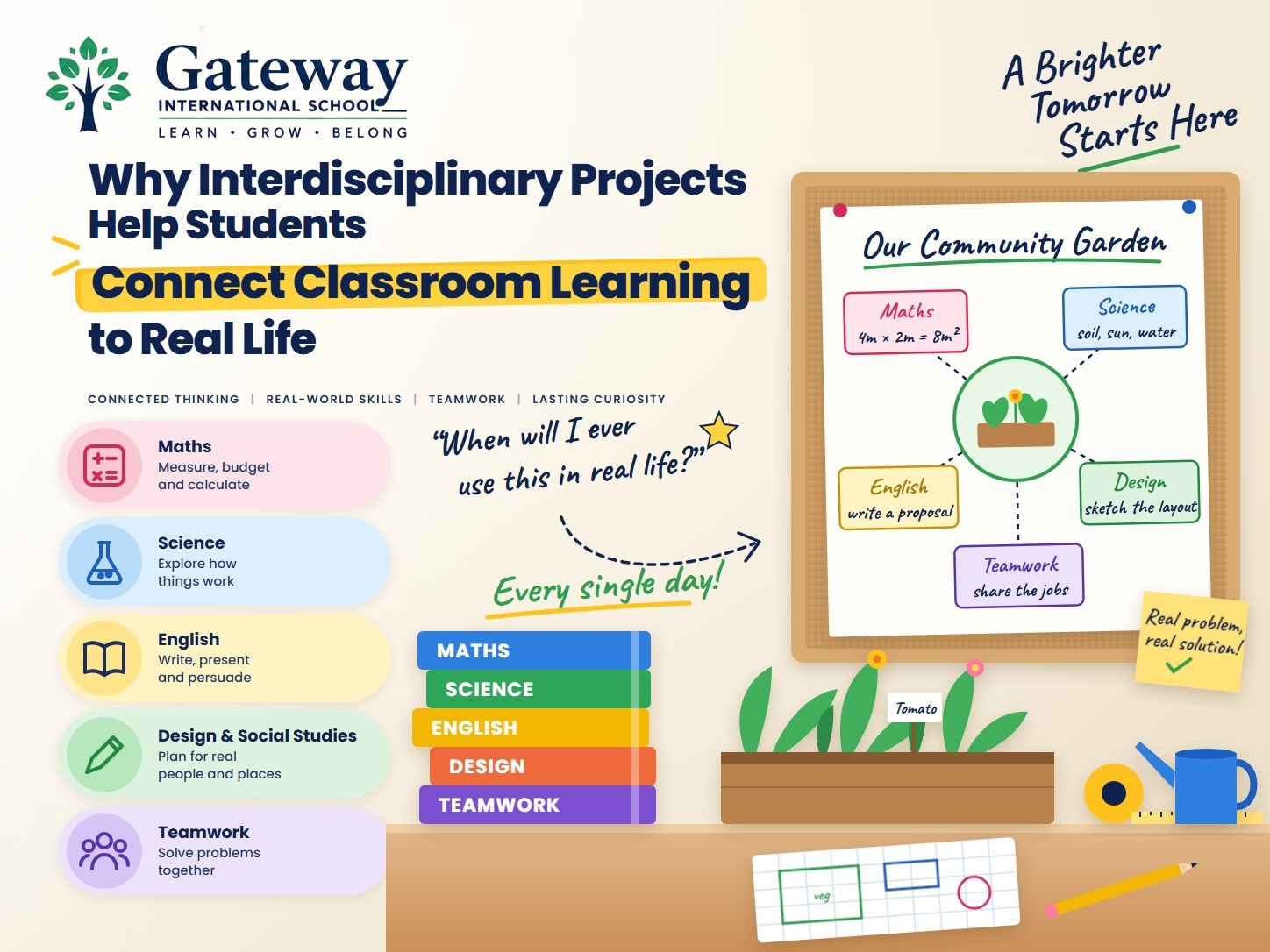
Every parent has heard the question at some point: “When will I ever use this in real life?”
It’s a fair question. In a traditional timetable, subjects are taught in separate 40-minute blocks. Mathematics ends, science begins, then comes English, then social studies. Children learn each subject well, but they rarely see how the subjects fit together. Yet the real world doesn’t work in subject periods. Planning a community garden involves science, maths, design, writing and teamwork all at once.
This is exactly what interdisciplinary projects are designed to do. In this guide, we explain what they are, why they work, what they look like in practice, and how parents can support them at home.
What Are Interdisciplinary Projects?
An interdisciplinary project brings knowledge and skills from two or more subjects together to explore a single question, problem or theme. Instead of studying a topic through just one subject, students approach it from several angles.
For example, a project on water scarcity might involve:
- Science: understanding the water cycle, groundwater and water quality
- Mathematics: collecting data, calculating usage and drawing graphs
- Geography and social studies: exploring how water shortages affect communities
- English: writing a report or persuasive speech
- Art and design: creating a poster or a model of a water-saving solution
The subjects stay intact. What changes is that students see them working together on something that matters.
Why Interdisciplinary Projects Work
1. They Answer the “Why Am I Learning This?” Question
When students use a mathematical idea to solve a problem they care about, the concept stops being abstract. A graph becomes a tool for telling a story. A scientific principle becomes a way to explain something happening in their own neighbourhood. This sense of purpose makes learning more meaningful and memorable.
2. They Build Deeper Understanding
Recalling a fact for a test is one thing. Applying it in an unfamiliar situation is another. Interdisciplinary projects ask students to transfer what they know across contexts, which is one of the strongest signs of real understanding.
3. They Develop Critical Thinking and Problem-Solving
Real problems rarely have a single correct answer. Students learn to ask questions, weigh evidence, test ideas, deal with setbacks and refine their approach. These habits of mind serve them well in exams and far beyond.
4. They Strengthen Communication and Collaboration
Most projects are done in teams. Students learn to share responsibilities, listen to different views, resolve disagreements and present their ideas clearly. These are the very skills employers and universities consistently look for.
5. They Encourage Creativity
When students have room to decide how to approach a problem and present their findings, they think more creatively. A model, a short film, a debate, an experiment or a community survey can all be valid ways to show learning.
6. They Increase Engagement and Ownership
Children tend to put in more effort when they have a voice and a choice in what they’re doing. Projects give students ownership of their learning, which builds motivation, confidence and independence.
7. They Prepare Students for the Future
Today’s biggest challenges, from climate change and public health to artificial intelligence, cut across many fields. Students who can connect ideas across disciplines are better equipped to understand and respond to them.
How This Fits with Modern Education
The shift towards connected, experiential learning is part of a wider global movement in education. India’s National Education Policy (NEP) 2020 promotes multidisciplinary and holistic education, with greater emphasis on experiential learning, critical thinking and application over rote memorisation. Internationally recognised programmes such as the IB and Cambridge also place importance on inquiry, application and the ability to link learning across subjects.
Whichever curriculum a school follows, the principle is the same: knowledge becomes more powerful when students can apply it.
What Interdisciplinary Projects Look Like at Different Ages
Early Years and Primary. Learning is naturally connected at this age. A theme such as “Our Neighbourhood” can bring together language through storytelling, maths through counting and measuring, science through observing plants and animals, and art through drawing maps and models.
Middle School. Students can take on longer, more structured projects. For instance, designing a sustainable school canteen might combine nutrition science, budgeting and data handling, persuasive writing and poster design.
Senior School. Projects become more ambitious and research-driven. Students might investigate the impact of technology on local businesses, bringing together economics, statistics, ethics, communication and digital skills, or build a model for a smarter, greener city drawing on physics, geography, mathematics and design.
These are illustrative examples of the kinds of projects that work well at each stage.
Signs of a Good Interdisciplinary Project
Not every group activity is a meaningful interdisciplinary project. A strong one usually has:
- A real, engaging question that students genuinely want to explore
- Clear links between subjects, not just a topic with a different subject label attached
- Student voice and choice in how they investigate and present
- Opportunities for reflection, so students understand what they learned and how
- Teacher guidance that supports learning without giving away every answer
- Fair assessment that recognises both subject knowledge and skills such as collaboration and communication
Do Projects Compromise Academic Rigour?
This is a common and understandable concern, especially for parents thinking about board exams and entrance tests. The answer is no, when projects are well designed.
Strong projects don’t replace core subject learning. They reinforce it. A student who has applied a mathematical concept to a real situation will usually understand it more securely than one who has only practised it in exercises. The best schools balance both: solid subject fundamentals, supported by applied learning that deepens understanding.
How Parents Can Support Interdisciplinary Learning at Home
You don’t need special resources to support this kind of learning. A few simple habits go a long way.
- Ask open-ended questions. Instead of “What did you learn today?”, try “What problem were you trying to solve?” or “How could you use that idea outside school?”
- Connect learning to daily life. Cooking involves fractions and chemistry. Travel involves geography, budgeting and culture. Shopping involves percentages and decision-making.
- Encourage curiosity. When your child asks “why”, explore the answer together rather than rushing to give one.
- Allow for productive struggle. Resist the urge to solve every problem for them. Learning to work through difficulty is part of the process.
- Celebrate effort and process. Praise persistence, creativity and teamwork, not just the final product.
- Visit museums, nature spots and local events. Real experiences give children rich material to connect with what they learn in class.
Questions to Ask a School About Project-Based Learning
If you’re evaluating schools, these questions can help you understand how seriously a school takes applied learning:
- How often do students work on projects that connect multiple subjects?
- Can you share examples of recent projects at my child’s grade level?
- How are projects assessed?
- How do you make sure projects strengthen, not replace, core subject knowledge?
- Do students get opportunities to present their work to an audience?
Experiential Learning at Gateway Group of International Schools
At the Gateway Group of International Schools, learning is designed to go beyond the textbook. Across our campuses, we follow a multisensory, experiential approach that encourages hands-on learning, inquiry and creative expression, so students can see how ideas connect to the world around them.
Skills for the future. We focus on the competencies students need to thrive: problem-solving, communication, creativity, decision-making, innovation and resilience.
Learning that suits every child. Experiential teaching caters to diverse learning styles and helps deepen understanding and long-term retention.
A choice of curricula. Families can choose from the IB programme at the IB World School in Padur, the Cambridge pathway from Primary to A Levels at Gateway The Complete School in Sholinganallur, and CBSE at campuses in Padur, Neelankarai and Mahabalipuram.
Holistic development. Sports, arts, cultural celebrations, competitions and student leadership opportunities help children grow into confident, well-rounded individuals.
Strong outcomes. Gateway alumni have gone on to institutions including VIT, IIIT Hyderabad, SRM Institute of Science and Technology, Symbiosis Law School and universities in the UK and Europe.
Frequently Asked Questions
1. What is an interdisciplinary project?
It’s a project that combines knowledge and skills from two or more subjects to explore a single theme, question or problem, helping students see how subjects connect in real life.
2. What is the difference between interdisciplinary and project-based learning?
Project-based learning refers to learning through extended, hands-on projects. Interdisciplinary learning refers to connecting multiple subjects. Many projects are both: students work on a real-world project that draws on several subjects.
3. Do interdisciplinary projects help in board exams?
Yes, indirectly. Applying concepts in real contexts builds deeper understanding, which supports performance in application-based and analytical questions.
4. At what age should children start interdisciplinary learning?
It can begin in the early years. Young children naturally learn through connected themes, and the complexity of projects grows as students get older.
5. How can I tell if a school’s project work is meaningful?
Look for real questions, links across subjects, student choice, teacher guidance and thoughtful assessment. Ask to see examples of student work.
Help Your Child Learn for Life, Not Just for Exams
When students see how science, mathematics, language, art and technology work together, learning becomes more purposeful, and the classroom becomes connected to the world beyond it. That is the foundation of lifelong learning.
Admissions for 2027–28 are open across Gateway campuses. Apply online, explore our admissions page, call 044-2449 3333, or email admission@gatewaytheschool.in to schedule a campus visit.