


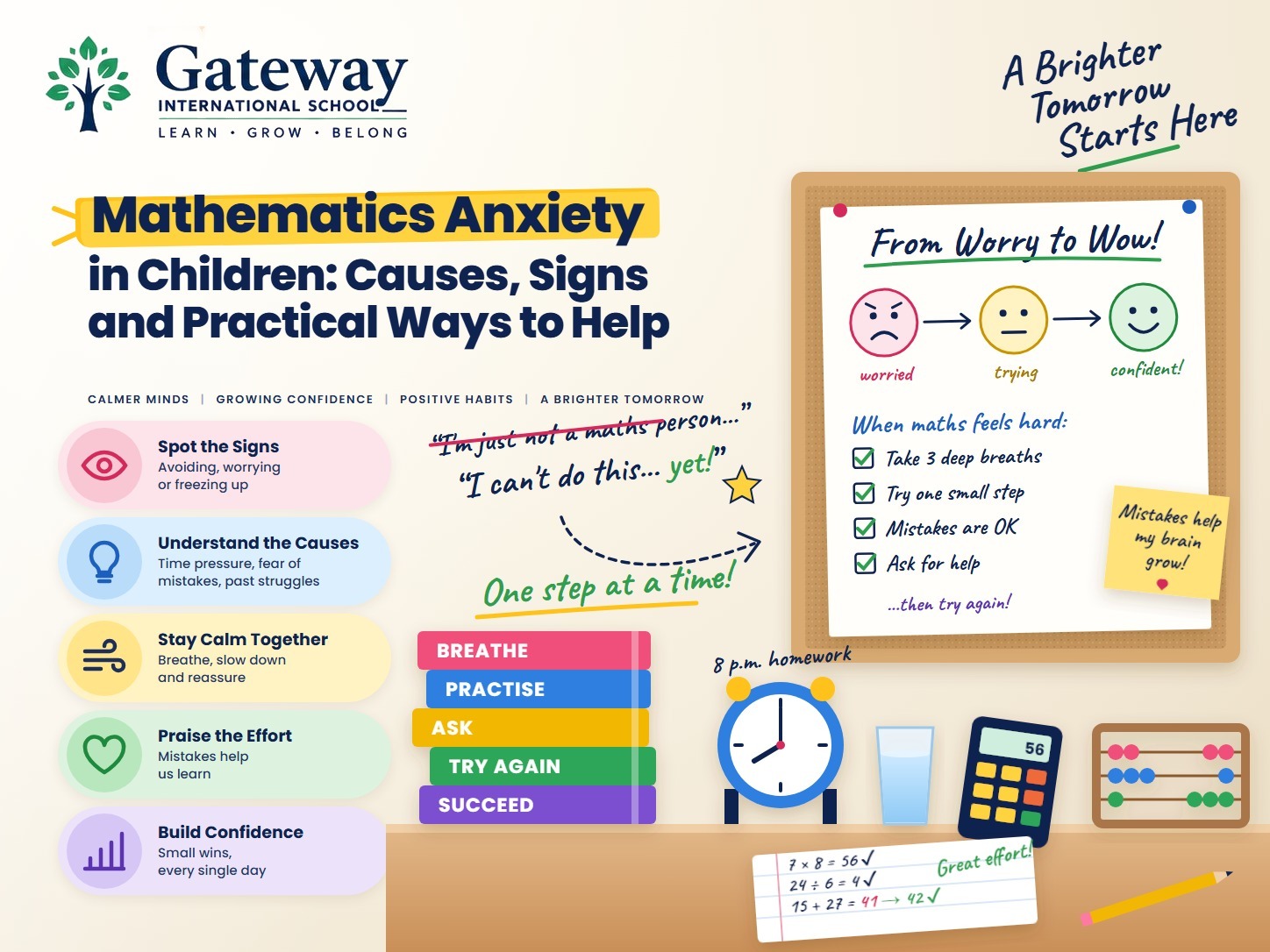
Mathematics Anxiety in Children: Causes, Signs and Practical Ways to Help
It’s 8 p.m. The maths homework is open on the table, and your child has suddenly developed a headache, an urgent need for water and a sudden interest in tidying their bag. Or perhaps they sit frozen, staring at a problem they solved without difficulty yesterday.
If this feels familiar, your child may be dealing with more than a dislike of the subject. For many children, maths triggers genuine worry, and that worry can get in the way of learning. This is called mathematics anxiety, and the good news is that it can be understood, addressed and overcome.
This guide explains what maths anxiety is, why it develops, how to spot the signs, and what parents and teachers can do to help children feel calmer and more confident with numbers.
What Is Mathematics Anxiety?
Mathematics anxiety is a feeling of tension, fear or dread that comes up when a child faces maths, whether that’s a test, homework, a question in class or even a casual number problem.
It is important to understand what it is not:
- It is not the same as being “bad at maths.” Anxiety is an emotional response, and children who are perfectly capable can still be affected by it.
- It is not laziness or lack of effort. Many anxious children care a great deal and worry precisely because they want to do well.
- It is not the same as dyscalculia. Dyscalculia is a specific learning difficulty with number concepts. The two can occur together, but they are different issues and need different support.
Because anxiety can affect performance, parents sometimes assume a child “just can’t do maths” when the real obstacle is worry.
Why Maths Anxiety Affects Performance
Understanding the mechanism helps parents respond with patience instead of frustration.
When a child feels anxious about a maths task, the stress response can impair working memory, the mental workspace we use to hold and manipulate information while solving a problem. A child who fully understands the material may still underperform because their mental energy is going into managing the anxiety. outschooloutschool
A broad review of research confirms that working memory plays a significant role in the link between maths anxiety and maths performance. nih
This often creates a loop. Children who feel anxious about maths are more likely to perform poorly, and children who perform poorly are more likely to become anxious. Each difficult experience reinforces the worry, which makes the next experience harder. The encouraging part is that loops can be broken. thirdspacelearning
Common Causes of Maths Anxiety
Maths anxiety rarely has a single cause. It usually builds up from a combination of experiences.
1. Early Struggles and Learning Gaps
Maths builds on itself. If a child misses or only half-understands a foundation concept, such as place value, fractions or multiplication tables, later topics feel confusing. Repeated confusion can turn into fear.
2. Negative Experiences in the Classroom
Being laughed at for a wrong answer, being told off for mistakes, or feeling embarrassed in front of classmates can leave a lasting emotional mark. Children who feel unsafe making mistakes tend to avoid participating.
3. Pressure, Speed and Timed Tests
Heavy emphasis on speed, ranking and marks can make maths feel like a performance rather than a subject to understand. Timed tests in particular can set off anxiety in children who think carefully rather than quickly.
4. Messages from Adults
Children pick up attitudes quickly. Research suggests that parents with more negative attitudes towards maths tend to do fewer maths activities at home, which was linked to higher maths anxiety in their children. Casual remarks such as “I was never good at maths either” or “maths is just not for everyone” can unintentionally signal that struggling is normal and that ability is fixed. utb
Parental help with homework can matter too. One widely discussed study found that when maths-anxious parents helped frequently with homework, their children learned less maths and developed more maths anxiety over the school year. This doesn’t mean parents should stop helping. It means how we help matters, which we cover below. monstermath
5. A Fixed Mindset About Ability
Children who believe “I’m either a maths person or I’m not” tend to give up faster when things get hard. A growth mindset, the belief that ability develops through effort and good strategies, is a powerful protective factor.
6. Learning Differences
Some children may have an underlying difficulty, such as dyscalculia, attention difficulties or specific language or memory challenges, that makes maths harder and anxiety more likely. If you suspect this, a professional assessment can help.
Signs of Maths Anxiety to Watch For
Maths anxiety doesn’t always look like obvious distress. Some children cry or panic, while others show it in quieter ways. Look out for:
Emotional signs
- Saying “I hate maths,” “I’m stupid at maths” or “I can’t do it” before even trying
- Worry, irritability or tearfulness around homework or tests
- Low confidence that seems specific to maths
Physical signs
- Headaches, stomach aches or nausea before maths class or tests
- Restlessness, sweating or a racing heart
- Sleep problems before a maths test
Behavioural signs
- Avoiding or delaying maths homework
- Procrastinating, getting distracted or suddenly needing “something else” to do
- Rushing through work to get it over with, or refusing to attempt problems
- Frequent absence or requests to stay home on test days
- Perfectionism, such as erasing repeatedly or being unable to move on from one mistake
Performance signs
- Doing well in practice but poorly in tests
- Making careless errors on questions they actually know
- A sudden dip in marks that doesn’t match their understanding in conversation
No single sign proves anything. What matters is a pattern of worry that is specific to maths and affects your child’s wellbeing or learning.
Practical Ways Parents Can Help
1. Watch Your Own Words
Avoid saying you were bad at maths or that you dislike it. Try something like: “Maths can be tricky, but we can figure it out step by step.” Your attitude is contagious, so model curiosity and persistence.
2. Make It Safe to Make Mistakes
Treat mistakes as useful information, not failures. Ask, “What did you try? What happened? What could we try next?” Praise effort, strategy and persistence rather than only correct answers or high marks.
3. Help Without Taking Over
When helping with homework, resist the urge to grab the pencil or hand over the answer. Instead:
- Ask your child to explain their thinking out loud
- Offer guiding questions like “What do we know already?” and “Can you draw it?”
- Stay calm and patient, even when it takes time
- If you feel anxious about the topic yourself, say so honestly and look it up together, rather than hiding it
4. Keep Maths Practice Short, Regular and Calm
Twenty relaxed minutes a day does more good than a stressful two-hour session before a test. Small, frequent practice builds fluency and confidence without overwhelming working memory.
5. Fix the Foundations
If your child is struggling, go back to find the gap. Ask the teacher which concepts are shaky. Reviewing earlier topics isn’t a step backwards; it’s what makes later progress possible.
6. Make Maths Part of Everyday Life
Show children that maths is useful, not just a school subject:
- Cooking: measuring, doubling a recipe, converting units
- Shopping: comparing prices, calculating discounts, handling change
- Travel: reading timetables, estimating time and distance
- Games: board games, card games, puzzles and cricket scores
When maths connects to something enjoyable, it feels less threatening.
7. Use Visuals and Hands-On Tools
Drawing diagrams, using objects, building with blocks, folding paper for fractions and using number lines help children see what’s happening instead of memorising rules.
8. Teach Simple Calming Techniques
Before a test or tricky homework, help your child take a few slow, deep breaths. A short walk, a glass of water or a moment of quiet can help settle nerves. Some children benefit from jotting down their worries before a test, which can free up mental space.
9. Look After Sleep, Food and Routine
Tired, hungry or overscheduled children are more prone to stress. A steady routine with enough sleep makes a real difference.
10. Stay in Touch with the Teacher
Share what you’re noticing and ask what the teacher sees in class. Working together means your child gets consistent messages and support at home and at school.
How Teachers and Schools Can Help
Schools play a major role in shaping how children feel about maths. Effective approaches include:
- Creating a classroom where mistakes are welcome. Discussing errors openly, without embarrassment, helps children see them as part of learning.
- Building understanding before speed. Using concrete materials, visuals and real-life problems before moving to abstract methods.
- Avoiding public comparison. Not ranking children or calling out low scores in front of peers.
- Offering variety in assessment. Using projects, discussions, quizzes and practical tasks alongside timed tests.
- Differentiating support. Giving extra help to children who need it, and extension tasks to those ready for more.
- Using low-stakes practice. Frequent small quizzes without heavy marks attached can reduce the fear of “big” tests.
- Encouraging a growth mindset. Language like “not yet” and “let’s find another way” sends a powerful message.
When to Seek Extra Support
Most children respond well to patient support at home and school. Consider speaking to the school counsellor, coordinator or a qualified professional if:
- Your child’s distress around maths is intense or lasts for a long time
- Anxiety is spreading to other subjects or to school in general
- Physical symptoms such as stomach aches or sleep trouble keep recurring
- Your child avoids school on maths days
- You suspect a learning difficulty such as dyscalculia
- Marks are falling despite regular effort and support
Asking for help is a sign of care, not a sign that something is wrong with your child.
Common Mistakes to Avoid
- Saying “maths isn’t your thing.” This tells children their ability is fixed.
- Over-emphasising marks and ranks. It raises pressure and can reduce curiosity.
- Drilling endlessly. More worksheets don’t cure anxiety and can make it worse.
- Comparing siblings or classmates. It damages confidence quickly.
- Rushing in with the answer. It prevents children from building their own problem-solving skills.
- Ignoring the problem. Anxiety rarely disappears on its own, and avoidance can deepen the gap.
Building Maths Confidence at Gateway Group of International Schools
At the Gateway Group of International Schools, we believe every child has hidden potential waiting to be discovered. Our campuses follow a multisensory, experiential approach that encourages hands-on learning, inquiry and creative expression, an approach that helps students understand concepts deeply instead of simply memorising procedures.
A caring learning environment. We aim to provide a challenging, safe and supportive environment where children feel comfortable asking questions and learning from mistakes.
Skills for the future. We focus on competencies such as problem-solving, decision-making, creativity, communication and resilience, which grow when children are encouraged to think and try.
Partnership with parents. We value collaboration between parents, facilitators and students, so concerns can be shared early and addressed together.
A choice of curricula. Families can choose from the IB programme at the IB World School in Padur, the Cambridge pathway from Primary to A Levels at Gateway The Complete School in Sholinganallur, and CBSE at campuses in Padur, Neelankarai and Mahabalipuram.
Holistic development. Sports, arts, cultural celebrations and leadership opportunities help children build the broader confidence that supports all areas of learning.
Frequently Asked Questions
1. What is maths anxiety?
It is a feeling of fear, tension or worry that arises when a child faces maths tasks such as homework, tests or classroom questions. It can reduce performance even when a child understands the material.
2. Is maths anxiety the same as being bad at maths?
No. Maths anxiety is an emotional response. Capable children can experience it, and it can make them perform below their real ability.
3. What causes maths anxiety in children?
Common causes include early learning gaps, negative classroom experiences, pressure around speed and marks, adults’ attitudes towards maths, a fixed mindset and sometimes underlying learning differences.
4. How can I tell if my child has maths anxiety or dyscalculia?
Maths anxiety is an emotional reaction to maths. Dyscalculia is a specific learning difficulty with number concepts. They can occur together, so if you’re unsure, speak to the school and consider a professional assessment.
5. Can maths anxiety be overcome?
Yes. With patient support, a calm approach, strengthened foundations and a positive attitude, most children become more confident over time.
6. Should I stop helping with maths homework if I’m anxious about maths myself?
No, but change how you help. Ask your child to explain their thinking, learn alongside them, avoid negative remarks about maths and ask the teacher for guidance when needed.
7. Does maths anxiety go away on its own?
Not always. Without support, avoidance can deepen learning gaps, so early attention is helpful.
Help Your Child Make Peace with Numbers
Maths anxiety is common, real and very treatable. When children feel safe, supported and understood, the fear begins to fade, and curiosity has room to grow. By choosing your words carefully, celebrating effort and working closely with your child’s school, you can help your child see maths not as something to dread, but as something they can do.
Admissions for 2027–28 are open across Gateway campuses. Apply online, explore our admissions page, call 044-2449 3333, or email admission@gatewaytheschool.in to schedule a campus visit.