


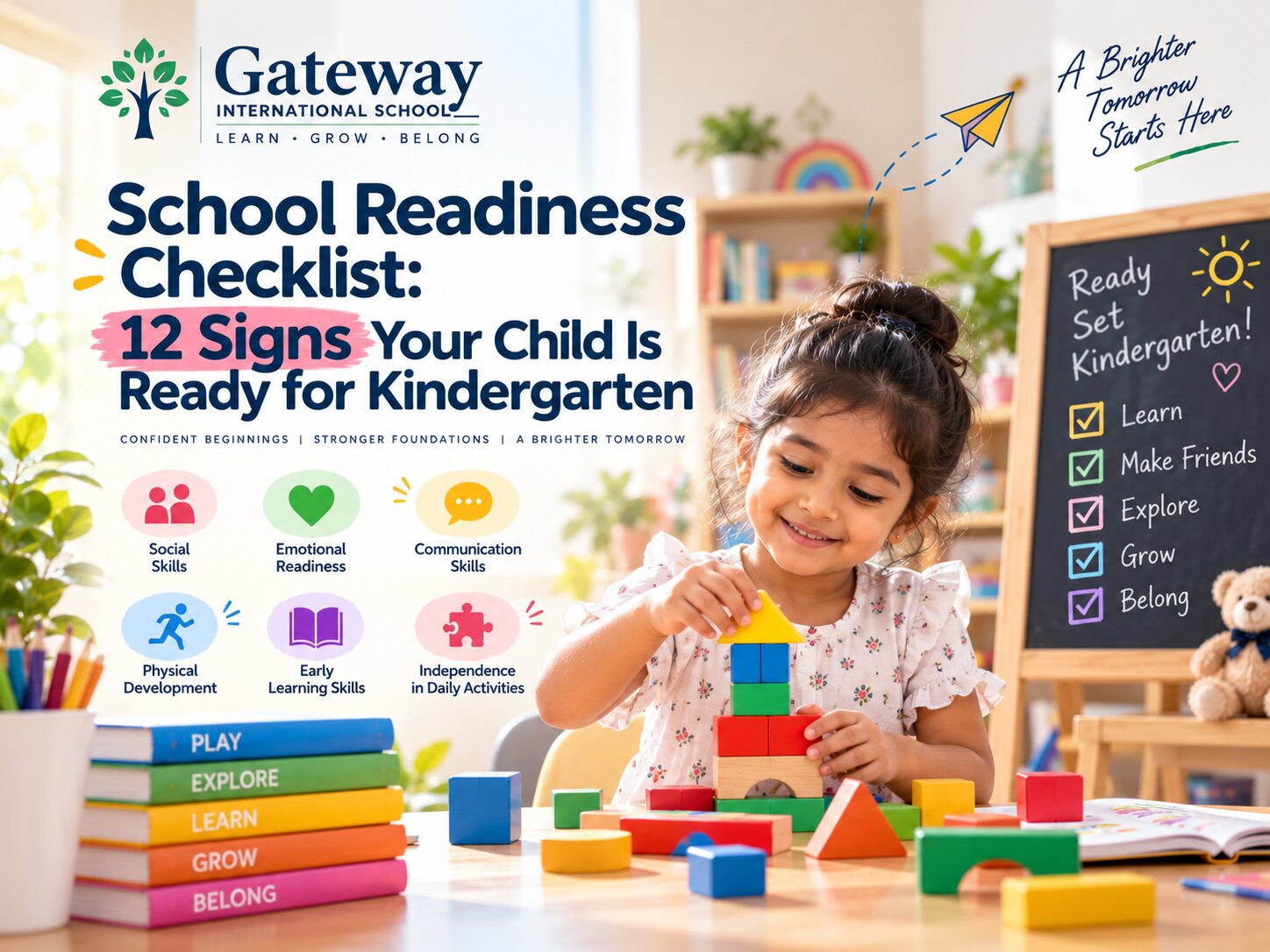
School Readiness Checklist: 12 Signs Your Child Is Ready for Kindergarten
Starting kindergarten is an exciting milestone for both children and parents. It marks the beginning of a new journey filled with friendships, discoveries, classroom activities, and opportunities to develop essential life skills.
However, many parents wonder whether their child is truly ready for school. Will they be able to communicate their needs, follow simple instructions, interact with other children, and manage everyday activities independently?
The good news is that school readiness is about much more than knowing the alphabet or counting numbers. It involves a combination of social, emotional, physical, language, and early learning skills that help children adjust to a structured learning environment.
In this guide, Gateway Schools explores 12 signs of kindergarten readiness, practical ways parents can prepare their children, and what to consider when choosing the right early learning environment.
What Is School Readiness?
School readiness refers to the skills, behaviours, and developmental abilities that help children participate comfortably in a school environment.
These skills develop gradually through everyday experiences such as playing, talking, exploring, listening to stories, interacting with others, and learning to complete simple tasks.
Every child develops at a different pace. A child may be confident socially but still need help with self-care, while another may enjoy learning activities but take longer to feel comfortable in a new environment.
There is no single checklist that determines whether a child is ready for kindergarten. Instead, parents can use the following signs as a guide to understand their child’s strengths and identify areas where additional support may help.
12 Signs Your Child Is Ready for Kindergarten
1. Your Child Can Communicate Basic Needs
Being able to communicate basic needs helps children feel more secure in a classroom.
Your child may be ready if they can:
- Tell an adult when they are hungry, thirsty, tired, or uncomfortable.
- Ask for help when needed.
- Communicate simple thoughts, feelings, or requests.
- Understand and respond to familiar questions.
Children do not need perfect pronunciation or advanced vocabulary before starting school. What matters is that they have ways to communicate and that adults can understand their needs.
How parents can help: Talk to your child throughout the day, read stories together, and encourage them to describe their experiences. Give them time to express themselves without constantly correcting their speech.
2. Your Child Can Follow Simple Instructions
Kindergarten involves everyday instructions such as putting toys away, joining a group activity, washing hands, and collecting learning materials.
Your child may be developing school readiness if they can follow familiar one- or two-step instructions, particularly when the directions are clear and appropriate for their age.
How parents can help: Turn everyday routines into small learning opportunities. For example, ask your child to put their shoes away and then bring their water bottle. Use simple language and demonstrate what you mean when necessary.
3. Your Child Is Beginning to Manage Emotions
Starting school can bring excitement, uncertainty, frustration, and separation anxiety. Children do not need to manage every emotion independently, but they benefit from gradually learning how to express feelings and accept support.
Look for signs that your child:
- Can communicate basic emotions.
- Begins to calm down with reassurance.
- Can recover from minor disappointments with adult support.
- Is gradually learning to wait, take turns, or cope with changes.
How parents can help: Name emotions during everyday situations. Say, “You seem disappointed that playtime is over. Let’s talk about it.” Offer comfort, maintain predictable routines, and practise small transitions.
Remember that occasional crying, frustration, or tantrums do not automatically mean a child is unprepared for school.
4. Your Child Shows Interest in Other Children
Kindergarten provides opportunities to make friends, cooperate, share experiences, and participate in group activities.
Your child may show readiness by:
- Showing curiosity about other children.
- Playing alongside or with other children.
- Participating in simple group activities.
- Beginning to understand sharing and turn-taking.
Not every child will immediately join group play. Some children observe quietly before participating, and others need additional time to feel comfortable.
How parents can help: Arrange opportunities to play with other children, visit parks, or participate in age-appropriate group activities. Encourage cooperation without expecting your child to share perfectly every time.
5. Your Child Is Developing Independence in Self-Care
Kindergarten routines often involve simple self-care activities. Depending on the school’s expectations and the child’s developmental stage, these may include eating, washing hands, using the toilet, and managing personal belongings.
Your child may be developing independence if they can:
- Attempt to eat with age-appropriate utensils.
- Wash and dry their hands with appropriate supervision.
- Communicate when they need to use the toilet.
- Attempt to put on shoes or manage simple clothing.
- Recognise their own belongings.
Children may still need adult assistance, and expectations vary by age and school.
How parents can help: Practise self-care activities at home without rushing. Allow your child to try tasks independently and offer help when needed.
6. Your Child Can Separate from Familiar Adults with Support
Separation from parents or caregivers can be one of the biggest adjustments when starting kindergarten.
Signs of developing readiness may include:
- Staying with a trusted adult for short periods.
- Participating in an activity while a parent is nearby or temporarily away.
- Accepting comfort from another familiar caregiver.
- Gradually becoming comfortable in new environments.
Some children may cry during the first few school days, even when they are otherwise ready to participate in classroom activities.
How parents can help: Arrange short separations with trusted caregivers, visit the school before the first day if possible, and establish a consistent goodbye routine. Avoid sneaking away without saying goodbye, as this may make separation more confusing.
7. Your Child Shows Curiosity About the World
Curiosity is an important foundation for early learning. Children naturally explore their surroundings by asking questions, observing changes, and trying new activities.
Look for behaviours such as:
- Asking questions about everyday objects and events.
- Exploring toys and discovering how things work.
- Showing interest in animals, nature, stories, or everyday activities.
- Enjoying simple experiments or problem-solving tasks.
How parents can help: Encourage questions, explore nature together, build with blocks, and let your child investigate safe everyday objects. You do not need to know every answer. Discovering answers together can make learning more enjoyable.
8. Your Child Can Participate in Short Activities
Kindergarten includes stories, songs, creative activities, games, and teacher-guided experiences. Children gradually learn to participate in these activities while managing their attention.
Your child may be developing this skill if they can:
- Listen to a short story.
- Participate in a simple game.
- Complete an age-appropriate puzzle.
- Spend a little time drawing, building, or creating something.
- Return to an activity after a brief distraction.
Young children naturally move between activities, and sustained attention varies considerably with age, interest, sleep, and the environment.
How parents can help: Offer short, enjoyable activities and gradually increase their duration when your child is comfortable. Alternate quiet activities with active play rather than expecting long periods of sitting still.
9. Your Child Is Developing Early Language and Literacy Skills
Children do not need to read independently before entering kindergarten. Early literacy is about developing the foundations for reading, writing, listening, and communication.
Useful emerging skills include:
- Enjoying picture books and stories.
- Recognising familiar objects and pictures.
- Listening to rhymes, songs, and simple stories.
- Recognising their own name, where developmentally appropriate.
- Showing interest in drawing, scribbling, or making marks on paper.
How parents can help: Read together daily, sing rhymes, talk about pictures, and encourage drawing. Focus on enjoyment and communication rather than formal reading drills.
10. Your Child Is Exploring Early Mathematical Concepts
Early mathematical understanding develops through everyday experiences well before children begin formal mathematics lessons.
Your child may demonstrate emerging skills by:
- Counting a few familiar objects.
- Sorting toys by colour, shape, or size.
- Comparing which object is bigger or smaller.
- Recognising simple patterns.
- Exploring concepts such as more, less, full, and empty.
These abilities develop at different rates, and children do not need to master a specific number range before kindergarten unless the school has particular age-related expectations.
How parents can help: Count fruit while shopping, sort toys during cleanup, compare the sizes of objects, and identify patterns in clothing or household items. Keep activities playful and practical.
11. Your Child Is Developing Gross and Fine Motor Skills
Physical development supports many everyday classroom activities, from moving safely around the school to drawing and manipulating learning materials.
Gross motor skills involve larger movements, such as walking, running, climbing, and balancing. Fine motor skills involve smaller movements, such as holding crayons, turning pages, stacking blocks, and using simple tools.
How parents can help: Encourage outdoor play, drawing, playdough activities, building blocks, puzzles, and age-appropriate crafts. Provide safe opportunities to practise different movements without demanding perfect handwriting or precise drawing.
12. Your Child Is Beginning to Adapt to Routines
School days generally follow predictable routines, including arrival, classroom activities, meals, playtime, and transitions between tasks.
Your child may be developing readiness if they can:
- Follow familiar daily routines with reminders.
- Move between activities with adult guidance.
- Begin to understand waiting for their turn.
- Participate in simple cleanup routines.
- Adjust gradually when plans change.
How parents can help: Establish consistent wake-up, meal, play, and bedtime routines. Practise packing a school bag together and explain what a typical school day might look like.
Predictability helps children feel secure and understand what to expect.
Kindergarten Readiness Checklist for Parents
Use this quick checklist to reflect on your child’s current skills. It is a conversation starter, not a test or admission assessment.
- My child can communicate basic needs in a way familiar adults understand.
- My child can follow simple instructions with appropriate support.
- My child is learning to express and manage emotions.
- My child shows some interest in interacting with other children.
- My child is developing age-appropriate self-care skills.
- My child can separate from a caregiver with support, even if initially upset.
- My child shows curiosity and interest in exploring.
- My child can participate in short, age-appropriate activities.
- My child enjoys stories, conversations, songs, or early literacy activities.
- My child is exploring counting, sorting, shapes, or patterns.
- My child is developing physical coordination and fine motor skills.
- My child is becoming familiar with everyday routines.
How should you interpret the checklist?
If your child demonstrates many of these skills, that can be encouraging. If some skills are still developing, it does not automatically mean your child is not ready for kindergarten. Discuss your observations with the school and ask what support is available.
A child’s readiness should be considered alongside their age, developmental needs, individual circumstances, and the school’s admission requirements.
How to Prepare Your Child for Kindergarten
Once you have considered your child’s current skills, a few simple changes at home can help make the transition to school smoother.
Establish a Consistent Daily Routine
Gradually align bedtime, wake-up time, meals, and morning activities with the school schedule. A predictable routine can help children feel more secure when school begins.
Encourage Play-Based Learning
Activities such as puzzles, pretend play, storytelling, blocks, drawing, and outdoor exploration develop important skills without making learning feel like work.
Practise Everyday Independence
Give your child opportunities to put away toys, carry their water bottle, wash their hands, and manage simple belongings. Offer encouragement rather than expecting them to complete every task perfectly.
Talk Positively About School
Explain what children might do at school, such as listening to stories, meeting teachers, making friends, and participating in activities. Use realistic, reassuring language rather than promising that every experience will be easy.
Visit the School Before the First Day
If the school permits it, attend an orientation session, explore the classroom, or meet the teacher. Familiarity with the environment can make the first few days less overwhelming.
Build a Partnership with Teachers
Share relevant information about your child’s interests, communication, routines, and support needs. Teachers can use these insights to help children settle in and participate comfortably.
When Should Parents Seek Additional Guidance?
Children develop at different rates, and one behaviour alone rarely tells the whole story. However, if you have ongoing concerns about your child’s communication, hearing, vision, movement, social interaction, or ability to participate in everyday activities, discuss them with your paediatrician or an appropriate child-development professional.
You can also speak with the school’s admissions or early-years team about age eligibility, classroom expectations, available support, and any recommended assessments.
Seeking guidance early can help families understand their child’s needs and identify appropriate support.
How to Choose the Right Kindergarten for Your Child
Readiness is not only about the child adapting to school. The school environment also plays an important role in helping children feel secure, included, and ready to learn.
When evaluating kindergarten options, consider:
A nurturing environment: Are children welcomed warmly and treated with patience and respect?
Age-appropriate teaching: Does the programme balance early academic foundations with play, exploration, movement, and social interaction?
Teacher support: Can teachers respond to different developmental needs and help children adjust to classroom routines?
Communication with parents: Does the school provide clear information about progress, classroom experiences, and concerns?
Health and safety: Are supervision, hygiene, safe play spaces, and child-protection practices taken seriously?
A positive first-school experience: Does the school help children build confidence, curiosity, independence, and positive relationships?
The right environment can make a meaningful difference in how children experience their first years of formal education.
At Gateway Schools, parents can explore the school’s educational programmes and approach to early learning to understand whether they align with their child’s needs and family expectations.
Frequently Asked Questions About Kindergarten Readiness
1. What is the right age for a child to start kindergarten?
The appropriate age depends on the school’s programme, the admission year, and applicable education requirements. Parents should confirm the school’s current age eligibility criteria rather than relying on a general age recommendation.
2. Should my child know the alphabet and numbers before kindergarten?
Not necessarily. Familiarity with letters, numbers, stories, and counting can be helpful, but kindergarten also develops these skills. Communication, curiosity, social development, and everyday independence are important parts of readiness.
3. What if my child cries when I leave them at school?
Some separation anxiety is common during transitions. A consistent goodbye routine, reassurance, and communication with teachers can help. If distress remains intense or persistent, discuss it with the school to develop a supportive plan.
4. Is my child ready for kindergarten if they are shy?
Yes, shyness alone does not mean a child is unready. Some children need more time to observe, become comfortable, and participate. A welcoming classroom can help them build confidence gradually.
5. How can I help my child become more independent before school starts?
Practise simple everyday tasks such as putting away toys, washing hands, eating with suitable utensils, communicating needs, and managing belongings. Encourage attempts and provide assistance when necessary.
6. What if my child is not ready in every area?
No child needs to demonstrate every skill perfectly before starting kindergarten. Talk to teachers about your child’s strengths, areas of difficulty, and the support available. If you have developmental concerns, seek appropriate professional guidance.
Conclusion
Kindergarten readiness is not about achieving perfection before the first day of school. It is about helping children develop the foundational skills they need to explore, communicate, build relationships, and participate in new experiences.
By observing your child’s development, encouraging independence, making time for play, and working closely with educators, you can help create a positive transition into formal education.
Every child has their own developmental journey. With patience, encouragement, and a supportive learning environment, children can take their first steps into kindergarten with growing confidence and curiosity.
Explore Gateway Schools to learn more about its educational approach and discover how the right school environment can support your child’s next learning milestone.