


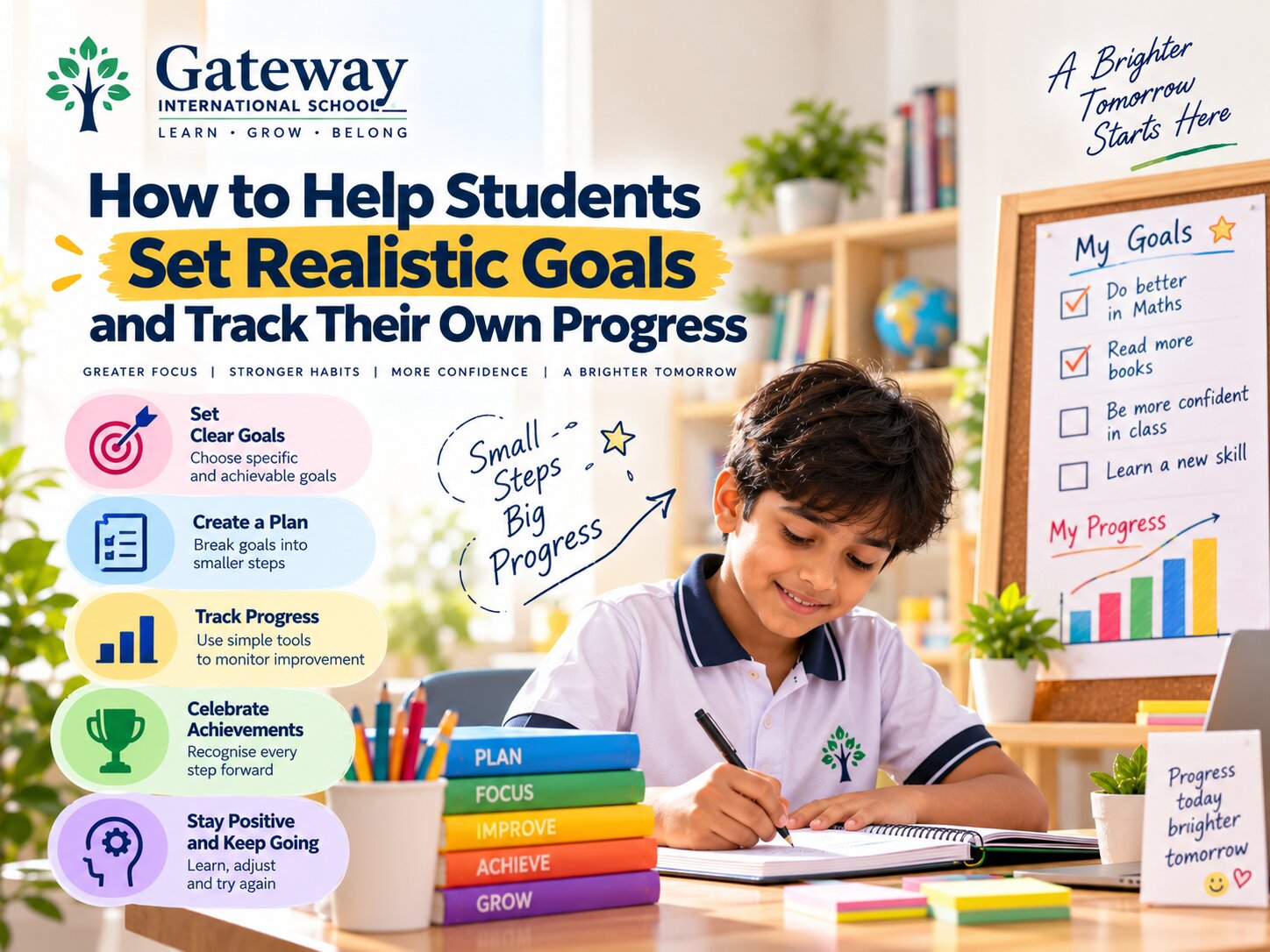
How to Help Students Set Realistic Goals and Track Their Own Progress
Every student wants to do well in school, whether that means improving grades, becoming more confident in mathematics, reading more books, participating in classroom discussions, or learning a new skill. However, knowing what they want to achieve is only the first step. Students also need to understand how to set realistic goals, take consistent action, and recognise their progress along the way.
Without a clear plan, even motivated students can feel overwhelmed by large expectations. They may begin studying enthusiastically but lose momentum when results take longer than expected. Others may focus entirely on marks and rankings without noticing the smaller improvements that lead to long-term success.
Teaching students to set realistic goals and track their own progress helps them develop responsibility, motivation, self-awareness, and independent learning skills.
In this guide, Gateway Schools explores practical goal-setting strategies, progress-tracking methods, and ways parents and teachers can help students turn their ambitions into achievable actions.
Why Is Goal Setting Important for Students?
Goal setting gives students a clear direction for their learning. Instead of simply hoping to improve, they can identify what they want to achieve and decide how to work towards it.
When used thoughtfully, goal setting can help students:
- Improve focus: Clear goals help students prioritise important tasks.
- Build self-confidence: Recognising progress can help students see what they are capable of achieving.
- Develop responsibility: Students learn to take ownership of their learning and decisions.
- Manage time effectively: Breaking larger goals into smaller tasks makes it easier to plan study sessions and activities.
- Build perseverance: Students can learn to continue working towards a goal when progress is slow.
- Reflect on learning: Reviewing results helps students understand which strategies work and what needs to change.
Goal setting is not about putting children under pressure to achieve more. It is about helping them understand their abilities, make informed choices, and develop habits that support continued growth.
What Makes a Student Goal Realistic?
A realistic goal is one that challenges a student while remaining achievable given their current skills, available time, resources, and other responsibilities.
For example, a student who struggles with fractions may set a goal to practise five problems each day and improve their understanding over the next two weeks.
By contrast, deciding to master an entire mathematics syllabus in two days may create unnecessary pressure and lead to frustration.
A useful goal should be:
Specific: The student knows exactly what they want to accomplish.
Measurable: They can identify evidence of progress.
Achievable: The goal matches their current abilities and available resources while allowing room for growth.
Relevant: It matters to the student and supports their learning or personal development.
Time-bound: There is a reasonable timeframe for reviewing progress.
These principles are commonly known as the SMART goal framework. They can help students turn broad ambitions into practical plans.
8 Steps to Help Students Set Realistic Goals
1. Start with What the Student Wants to Improve
Effective goals begin with understanding what matters to the student.
Instead of immediately setting targets for grades or examination results, ask questions such as:
- Which subject would you like to understand better?
- What skill would you like to develop?
- Which part of studying feels difficult at the moment?
- What would you like to feel more confident doing?
- Is there something you would like to learn outside the classroom?
A student might want to read more confidently, participate in class, improve handwriting, understand science concepts, or become more organised.
Allowing students to contribute to their own goals helps them understand why the goal matters and encourages a greater sense of ownership.
2. Turn Broad Ambitions into Specific Goals
Many students begin with goals that are too general.
For example, “I want to become better at English” does not explain what the student needs to do.
Help them identify a more specific objective.
Broad ambition | More specific goal |
Improve English | Read one age-appropriate story each week and summarise it in my own words |
Get better at mathematics | Practise five problems on the topic I find difficult, four days a week |
Become more organised | Prepare my school bag and check my timetable every evening |
Participate more in class | Prepare one question or observation before each science lesson |
Improve writing | Write one short paragraph three times a week and review it with feedback |
The goal should describe an action the student can take, not simply an outcome they hope will happen.
3. Make Sure the Goal Is Appropriate for Their Current Level
A goal should provide a meaningful challenge without becoming unrealistic.
Before setting a target, help the student consider:
- What can I do independently right now?
- Which skills do I still need to practise?
- How much time can I reasonably dedicate to this goal?
- What support or resources might I need?
- What other schoolwork or activities do I need to manage?
For instance, a student who currently reads one book a month might begin by aiming to finish two manageable books over the next month rather than setting an arbitrary target of ten books.
As their confidence and skills develop, they can adjust the goal.
Remember that progress varies from student to student. Goals should reflect individual needs rather than comparisons with classmates.
4. Break Large Goals into Smaller Milestones
Large goals can feel overwhelming when students do not know where to begin.
Breaking a goal into smaller milestones makes it easier to take action and recognise progress.
Consider a student who wants to improve their performance in mathematics over eight weeks.
Their milestones might include:
- Week 1: Identify the topics they find most difficult.
- Weeks 2–3: Review key concepts and practise basic questions.
- Weeks 4–5: Attempt more challenging problems and review mistakes.
- Weeks 6–7: Complete practice exercises under timed conditions where appropriate.
- Week 8: Review progress and identify topics that still need attention.
Each milestone creates a manageable next step.
Smaller goals also help students recover from setbacks. If they miss one study session, they can resume the plan instead of feeling that the entire goal has failed.
5. Focus on Actions Students Can Control
Some outcomes depend on factors beyond a student’s control. Examination marks, competition rankings, and selection decisions can be influenced by several circumstances.
Students can still set outcome goals, but they should also establish process goals that focus on actions within their control.
For example:
Outcome goal: Improve my science examination score.
Process goals:
- Review one topic each evening according to my study plan.
- Answer practice questions after revising each topic.
- Ask my teacher for help with concepts I do not understand.
- Review mistakes and practise similar questions.
The outcome provides direction, while the process goals give the student a practical route towards improvement.
6. Set a Realistic Timeline
Goals need enough time for students to practise, receive feedback, and improve.
A short-term goal might involve completing a reading assignment over a week. A longer-term goal could involve improving writing skills over a school term.
When choosing a timeline, consider the difficulty of the task, the student’s existing workload, and opportunities for practice.
Avoid filling every available hour with academic targets. Children also need time for sleep, recreation, relationships, physical activity, and unstructured play.
A balanced plan is more sustainable than an intensive schedule that is difficult to maintain.
7. Anticipate Challenges Before They Happen
Students are more likely to maintain their efforts when they have a plan for common obstacles.
Ask them to consider:
- What might make this goal difficult?
- What will I do if I miss a planned session?
- Who can help if I do not understand something?
- How can I reduce distractions?
- What can I do when I feel discouraged?
For example, a student who finds it difficult to concentrate at home might decide to complete a short study session before using entertainment apps.
Another student might arrange to ask their teacher a question whenever a concept remains unclear after independent practice.
Planning for obstacles teaches students that challenges are normal and can often be managed with adjustments.
8. Let Students Take Ownership of Their Goals
Parents and teachers can provide guidance, but students should gradually learn to make decisions about their own learning.
Allow them to choose suitable goals, select tracking methods, and suggest changes when a plan is not working.
For younger children, this may involve choosing a book to read or marking completed activities on a chart.
Older students can manage weekly planners, review practice-test results, and decide which topics require more attention.
The aim is to develop independence rather than make students dependent on constant reminders or adult supervision.
How Can Students Track Their Own Progress?
Setting a goal is only part of the process. Students also need ways to recognise whether their actions are helping them improve.
Progress tracking should be simple, consistent, and focused on useful information rather than constant monitoring.
1. Use a Weekly Progress Tracker
A weekly tracker helps students record whether they completed planned activities.
For example, a student working towards better reading comprehension might use this table:
Day | Planned activity | Completed? | Reflection |
Monday | Read a short story | Yes | Understood the main idea |
Tuesday | Summarise a passage | Yes | Needed help with vocabulary |
Wednesday | Answer comprehension questions | No | Had another school assignment |
Thursday | Review unfamiliar words | Yes | Remembered several new words |
Friday | Retell the story | Yes | Explained the events more clearly |
The purpose is not to achieve a perfect record. It is to help the student notice patterns and decide what to do next.
2. Maintain a Learning Journal
A learning journal gives students space to reflect on their experiences.
At the end of a study session or week, they can answer three simple questions:
- What did I learn?
- What did I find difficult?
- What will I try next?
For younger students, these reflections can be spoken aloud or represented through drawings.
Older students may write short entries describing how their understanding has changed, which strategies helped, and what they still need to practise.
Over time, a journal can help students recognise improvement that might otherwise go unnoticed.
3. Use Checklists for Daily Habits
Checklists are useful for goals involving routines and repeated actions.
For example, a student working on organisation might use a daily checklist:
- Check the school timetable.
- Complete planned homework.
- Pack books and learning materials.
- Prepare clothes or sports equipment for the next day.
- Review tomorrow’s priorities.
Keep the checklist short enough to be manageable. If every small action becomes a tracked task, the process can feel burdensome rather than helpful.
4. Compare Work Samples Over Time
Some improvements are easier to see by comparing work completed at different stages.
Students can keep samples of essays, drawings, mathematics exercises, presentations, or reading summaries.
For example, comparing an early essay with a later one may reveal improvements in sentence structure, organisation, vocabulary, and clarity.
Encourage students to identify specific changes rather than simply deciding that one piece of work is better than another.
This helps them understand what progress looks like in practical terms.
5. Use Practice Tests and Feedback
Practice tests can help students understand what they know and identify areas that need further attention.
However, a single score should not be treated as a complete measure of ability.
After completing a practice test, encourage students to review:
- Which questions they answered correctly.
- Which mistakes resulted from misunderstanding.
- Which errors involved calculation, reading, or time management.
- Which topics need additional practice.
- Whether their preparation strategy was effective.
Teacher feedback can help students understand why an answer was incorrect and how to improve it.
6. Review Progress at Regular Intervals
Students should revisit their goals periodically rather than waiting until the final deadline.
A short weekly review can help them identify what is working and what needs to change.
Ask:
- Am I making progress?
- Which actions have helped me most?
- Is the goal still realistic?
- Do I need additional support?
- What should I focus on next week?
If progress is slower than expected, adjust the strategy or timeline. Changing a goal when circumstances change is a useful skill, not a sign of failure.
How Parents Can Support Goal Setting Without Creating Pressure
Parents play an important role in helping children develop realistic expectations and sustainable habits.
Encourage Effort and Strategy
Instead of focusing exclusively on grades, recognise actions that support improvement.
For example, praise a child for identifying mistakes, asking questions, practising consistently, or trying a different approach to a difficult problem.
Specific feedback helps children understand which behaviours are useful.
Avoid Comparing Children
Every child has different strengths, interests, developmental needs, and learning circumstances.
Comparing siblings or classmates may create unnecessary pressure and distract children from their own progress.
Help your child compare their current skills with their previous work instead.
Allow Room for Mistakes
Students may miss deadlines, forget tasks, or struggle to achieve a target.
Respond by helping them understand what happened and plan a practical adjustment.
For example, if a student repeatedly struggles to complete homework, explore whether the schedule is realistic or whether they need help understanding the assignments.
Make Time for Conversations
A brief conversation about a child’s goals can be more useful than repeatedly asking whether they have completed their work.
Ask what they are learning, which challenges they are facing, and what support they need.
This encourages children to share concerns and develop problem-solving skills.
Protect Time for Rest and Play
A healthy goal-setting routine should support a child’s overall development, not turn every activity into a performance target.
Ensure that academic goals leave adequate time for sleep, hobbies, friendships, physical activity, and relaxation.
How Teachers Can Build Goal-Setting Skills in the Classroom
Schools can help students develop goal-setting and self-monitoring skills through regular classroom practices.
Collaborative goal setting: Teachers can work with students to identify learning objectives and choose appropriate next steps.
Clear success criteria: Explaining what successful work looks like helps students understand how to evaluate their progress.
Self-assessment opportunities: Reflection questions, checklists, and learning journals help students monitor their understanding.
Constructive feedback: Specific feedback helps students identify what they did well and what they can improve.
Celebrating meaningful progress: Recognising improved understanding, perseverance, collaboration, and independent problem-solving reinforces positive learning habits.
Age-appropriate responsibility: Younger children may use visual charts, while older students can maintain planners, portfolios, and longer-term academic goals.
At Gateway Schools, a supportive educational environment can help students develop the confidence, reflection skills, and responsibility needed to take an active role in their learning.
A Practical Student Goal-Setting Worksheet
Students can use the following framework to create a simple plan.
Planning question | Example |
What do I want to improve? | My understanding of fractions |
Why is this important to me? | I want to solve mathematics problems more confidently |
What will I do? | Practise five problems four days a week |
What support might I need? | Ask my teacher about mistakes I cannot understand |
How will I track progress? | Record completed practice and review errors |
When will I review my goal? | At the end of each week |
What will I do if I struggle? | Revisit examples and ask for help |
How will I recognise progress? | Explain concepts more clearly and solve more problems independently |
Students should be encouraged to adapt this framework to their age, interests, and learning needs.
A goal does not need to be complicated to be useful. The most important elements are a clear purpose, manageable actions, and regular reflection.
Common Goal-Setting Mistakes Students Should Avoid
Even motivated students can find it difficult to maintain their goals when the planning process becomes unrealistic.
Setting too many goals at once: Start with one or two priorities so students can focus their efforts.
Choosing goals based only on marks: Include learning habits, confidence, organisation, and skill development.
Making goals too vague: Replace “study harder” with a specific activity that can be completed and reviewed.
Ignoring setbacks: Missing a session is an opportunity to adjust the plan, not abandon the goal.
Tracking activity without checking learning: Completing many study hours does not necessarily mean a student understands the material. Include practice, feedback, and evidence of progress.
Expecting immediate results: Skills develop at different rates. Regular practice and thoughtful adjustments are often more useful than rushing towards a deadline.
Treating the tracker as a punishment: Progress records should help students learn, not become a source of shame when targets are missed.
Frequently Asked Questions
1. At what age should children start setting goals?
Children can begin with simple goals in early childhood, such as putting toys away or finishing a short activity. As they grow older, they can take on more complex academic, personal, and long-term goals.
2. What is an example of a SMART goal for a student?
A student might set the goal: “For the next four weeks, I will practise five mathematics problems on fractions four days each week and review my mistakes every Friday.” This goal specifies the action, provides a way to track completion, and establishes a timeframe.
3. How often should students review their goals?
A brief weekly review works well for many short-term learning goals. Longer-term goals can also be reviewed monthly or at the end of a school term, depending on their complexity.
4. What should students do if they fail to achieve a goal?
They should review what happened, identify obstacles, and decide whether to change the strategy, reduce the workload, seek help, or extend the timeline. An unmet goal can provide useful information about what needs to change.
5. How can parents motivate students who lack interest in goal setting?
Begin with a goal connected to the child’s own interests and keep the first steps manageable. Offer choices, recognise progress, and avoid turning every goal into a demand. If motivation difficulties persist across many areas of life, consider discussing the concern with the child’s teacher.
6. Should students focus on academic goals or personal goals?
Both can be valuable. Academic goals support subject knowledge and study habits, while personal goals can develop organisation, communication, teamwork, confidence, and independence. A balanced selection should reflect the student’s age, interests, and current priorities.
Conclusion: Helping Students Become Independent Learners
Teaching students to set realistic goals and track their own progress is about more than improving grades. It helps them understand their strengths, recognise challenges, take responsibility for their actions, and make informed decisions about their learning.
When students break large ambitions into manageable steps, monitor meaningful progress, and adjust their strategies when necessary, they develop skills that can support them throughout their education and beyond.
Parents and teachers can encourage this development by providing guidance without taking control, celebrating progress without demanding perfection, and creating opportunities for students to reflect on their experiences.
The ultimate goal is to help every student move from simply completing tasks to understanding how they learn, how they improve, and how they can take ownership of their future.
At Gateway Schools, a learning environment that encourages reflection, responsibility, and continuous development can help students build the habits and confidence needed for lifelong learning.