


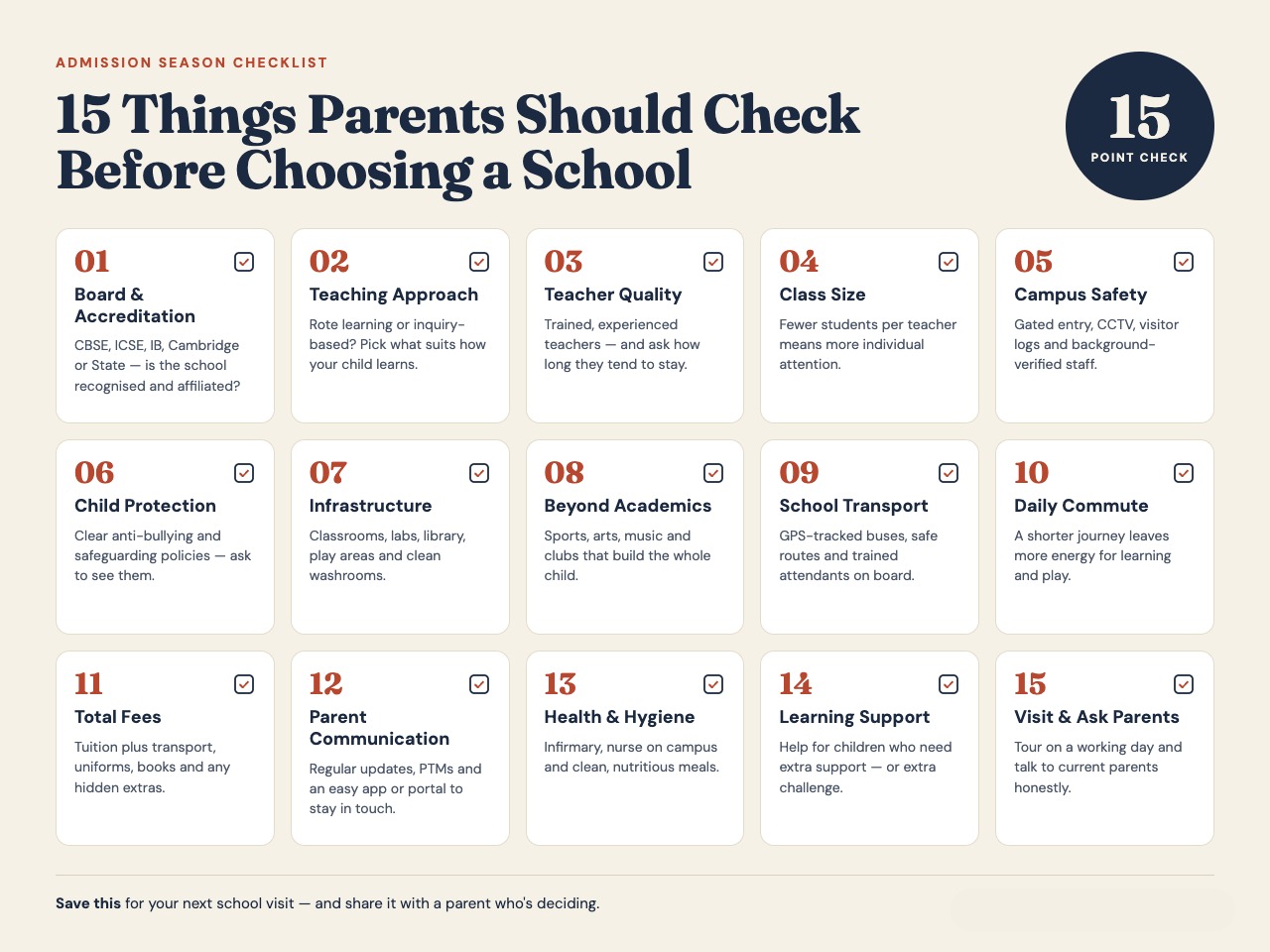
15 Things Parents Should Check Before Choosing a School
Choosing a school is one of the most important decisions you’ll make for your child. It shapes not only how they learn, but also who they become, the friendships they form, the confidence they build and the opportunities that open up for them later in life.
With so many options across Chennai, from CBSE and State Board to Cambridge IGCSE and IB schools, the choice can feel overwhelming. Glossy brochures and impressive websites only tell part of the story. To help you look beyond the surface, we’ve put together a practical checklist of 15 things every parent should check before choosing a school.
1. The Curriculum and Board
Start with the curriculum, because it shapes everything from teaching style to assessments and future pathways.
- CBSE follows a nationally standardised syllabus and aligns closely with Indian competitive examinations.
- Cambridge IGCSE offers subject flexibility and application-based learning, with qualifications recognised worldwide.
- IB (International Baccalaureate) focuses on inquiry, interdisciplinary learning and global perspectives.
Think about your child’s learning style and your family’s long-term plans. Will your child pursue higher education in India, abroad, or keep both options open?
2. Affiliation and Recognition
Confirm that the school is properly affiliated or authorised by its board. CBSE schools publish a mandatory disclosure with affiliation details, while Cambridge and IB schools should be authorised by Cambridge International or the International Baccalaureate respectively. This is a basic check, but an essential one.
3. Teacher Qualifications and Experience
Teachers make the greatest difference to your child’s learning. Ask about teacher qualifications, subject expertise, curriculum-specific training and how the school supports ongoing professional development. Low teacher turnover is often a good sign of a healthy school culture.
4. Class Size and Student-Teacher Ratio
Smaller classes allow teachers to understand each child’s strengths and challenges and give more personal attention. Ask how many students are in each class and whether there are teaching assistants in the younger grades.
5. Teaching Approach
Does the school encourage children to ask questions, work on projects and learn by doing? Or is the focus mainly on textbooks and memorisation? The best schools balance strong academic fundamentals with hands-on, experiential learning that builds critical thinking and creativity.
6. Academic Results and Alumni Outcomes
Ask about board examination results, but don’t stop there. Find out where past students have gone for higher education and what careers they’ve pursued. A school’s alumni tell you a great deal about the kind of learners it produces.
7. Safety and Security
Your child’s safety is non-negotiable. Check campus security measures, visitor management, supervision during breaks, first-aid facilities and emergency procedures. Ask about child protection policies and how the school handles bullying.
8. Infrastructure and Facilities
Look at classrooms, science and computer labs, libraries, sports facilities, and spaces for art, music and performance. Facilities don’t need to be lavish, but they should be well maintained, safe and actually used in everyday learning.
9. Co-curricular Activities and Sports
Education goes well beyond the classroom. Look for a school with a full calendar of sports, arts, clubs, competitions, cultural events and celebrations. These experiences help children discover their passions and develop teamwork, discipline and confidence.
10. Holistic Development and Values
A good school nurtures character as well as academics. Ask how the school encourages leadership, responsibility, empathy and community service. Student leadership roles, house systems and service activities are strong indicators of a well-rounded approach.
11. Student Wellbeing and Support
Every child learns differently. Ask how the school supports students who need extra help and those who need extra challenge. Is there a counsellor on campus? How does the school support children’s emotional wellbeing, especially during transitions or exam years?
12. Parent Communication and Involvement
The best schools see parents as partners. Find out how often parent-teacher meetings are held, how progress is reported and how teachers communicate day to day. A school that welcomes parent involvement creates a stronger support system for your child.
13. Location and Transport
A long daily commute can tire children out before the school day even begins. Consider the distance from your home, traffic patterns on your route and whether the school’s bus routes cover your neighbourhood. Ask about transport safety measures such as attendants on buses and GPS tracking.
14. Fee Structure and Transparency
Ask for a complete breakdown of fees, including tuition, admission, annual, activity, transport and examination fees. Check what is included and what’s charged separately, whether instalment options are available and how fees are likely to change in higher grades. A transparent fee structure is a sign of a trustworthy school.
15. Continuity and Future Pathways
Think long term. Can your child continue in the same school from kindergarten through Grade 12? Changing schools or boards midway can disrupt learning, friendships and confidence. A school that offers a clear pathway to the senior grades gives your child stability throughout their school years.
Bonus Tip: Visit the Campus in Person
No checklist can replace a campus visit. Walk through the classrooms, observe how teachers interact with students, and notice whether the children seem happy, engaged and confident. Talk to the principal, teachers and, if possible, current parents. Trust what you see and feel. Often, the right school simply feels right.
Quick Checklist for Your School Visit
Take this list with you when you visit schools:
- Curriculum and board suit my child’s learning style and future goals
- School is properly affiliated or authorised
- Teachers are qualified and experienced
- Class sizes allow personal attention
- Teaching encourages curiosity and hands-on learning
- Strong results and alumni outcomes
- Clear safety and child protection measures
- Well-maintained facilities in active use
- Wide range of sports and co-curricular activities
- Focus on values, leadership and holistic growth
- Counselling and learning support available
- Regular, open communication with parents
- Convenient location and bus routes
- Transparent fee structure
- Continuity from early years to Grade 12
Why Families Choose Gateway Group of International Schools
The Gateway Group of International Schools has been part of Chennai’s education landscape for two decades, offering families a choice of curricula across campuses along the ECR and OMR corridors.
A curriculum choice for every family. Gateway offers the IB programme at the IB World School in Padur, the Cambridge curriculum from Primary to A Levels at Gateway The Complete School in Sholinganallur, and CBSE at campuses in Padur, Neelankarai and Mahabalipuram, along with Gateway Capstone School.
Continuity from early years to Grade 12. Children can grow within one school community, from kindergarten through to university readiness.
Learning that builds real skills. Gateway follows an experiential, inquiry-driven approach that encourages hands-on learning, creativity, communication and problem-solving.
Holistic development. Sports, arts, cultural celebrations, competitions and student leadership opportunities are part of everyday school life.
Proven outcomes. Gateway alumni have gone on to institutions including VIT, IIIT Hyderabad, SRM Institute of Science and Technology, Symbiosis Law School and universities in the UK and Europe.
Wide transport coverage. School buses serve neighbourhoods across South Chennai, including Sholinganallur, Thoraipakkam, Perungudi, Velachery, Medavakkam, Perumbakkam, Navalur, Padur and Neelankarai.
Frequently Asked Questions
When should I start looking for a school for my child?
Ideally, begin your research several months before admissions open for the academic year. This gives you time to visit campuses, compare options and prepare documents.
How do I choose between CBSE, IGCSE and IB?
Consider your child’s learning style, your plans for higher education, and whether you may relocate. CBSE aligns closely with Indian competitive exams, while IGCSE and IB offer internationally recognised pathways.
What questions should I ask during a school visit?
Ask about teacher qualifications, class sizes, safety policies, co-curricular activities, parent communication, fees and alumni outcomes. Use the checklist above as a guide.
Is it better to choose a school close to home?
A shorter commute helps your child stay fresh and energetic, but it shouldn’t be the only factor. If a school further away is the right fit, check whether its bus routes cover your area.
How important is a campus visit?
Very important. A visit shows you the school’s culture, teaching style and environment in a way no website or brochure can.
Find the Right School for Your Child
The right school is one where your child feels safe, challenged, supported and inspired to grow. Use these 15 checks to look beyond first impressions and make a choice you can feel confident about.
Admissions for 2027–28 are open across Gateway campuses. Apply online, explore our admissions page, call 044-2449 3333, or email admission@gatewaytheschool.in to schedule a campus visit.