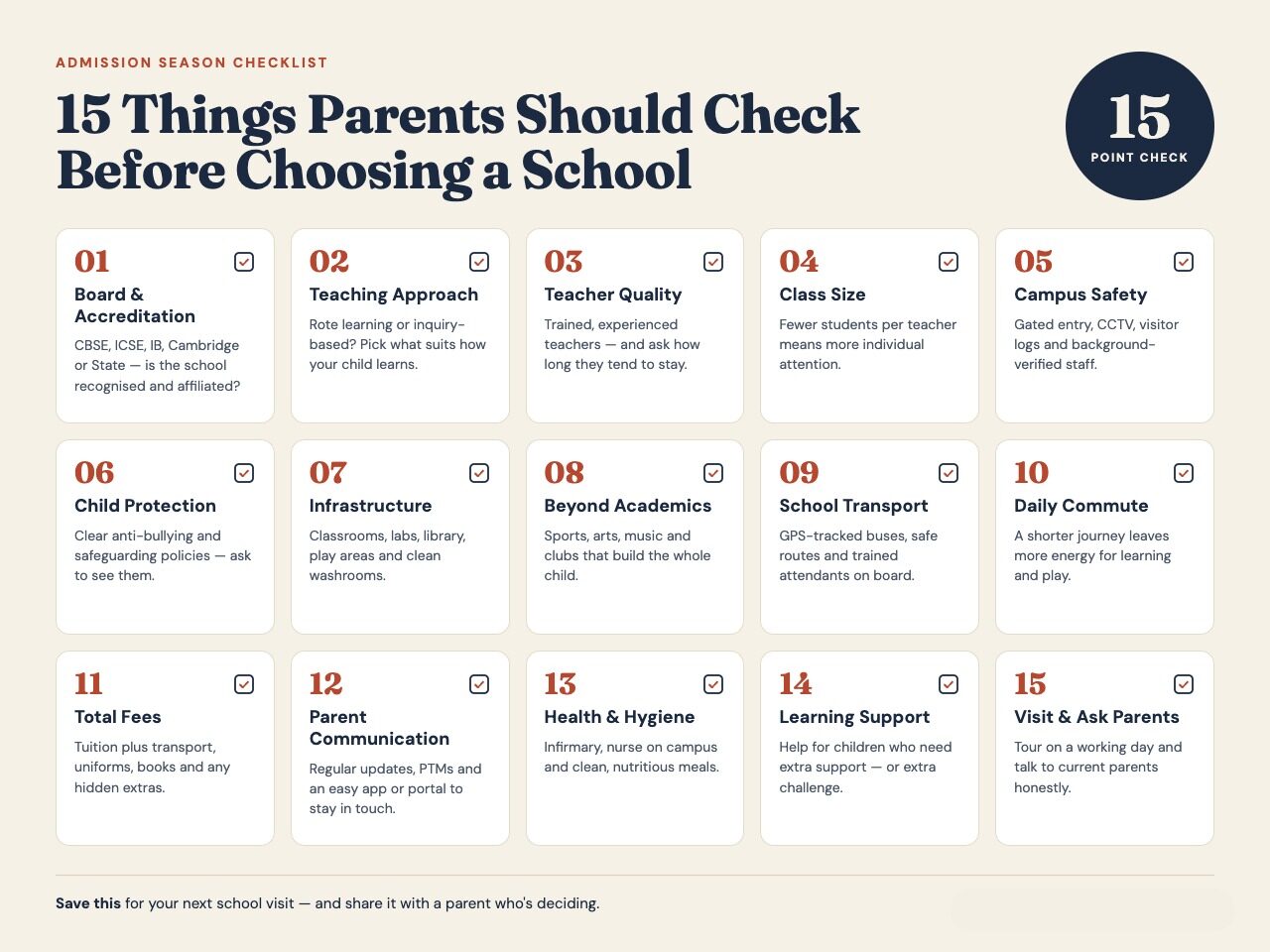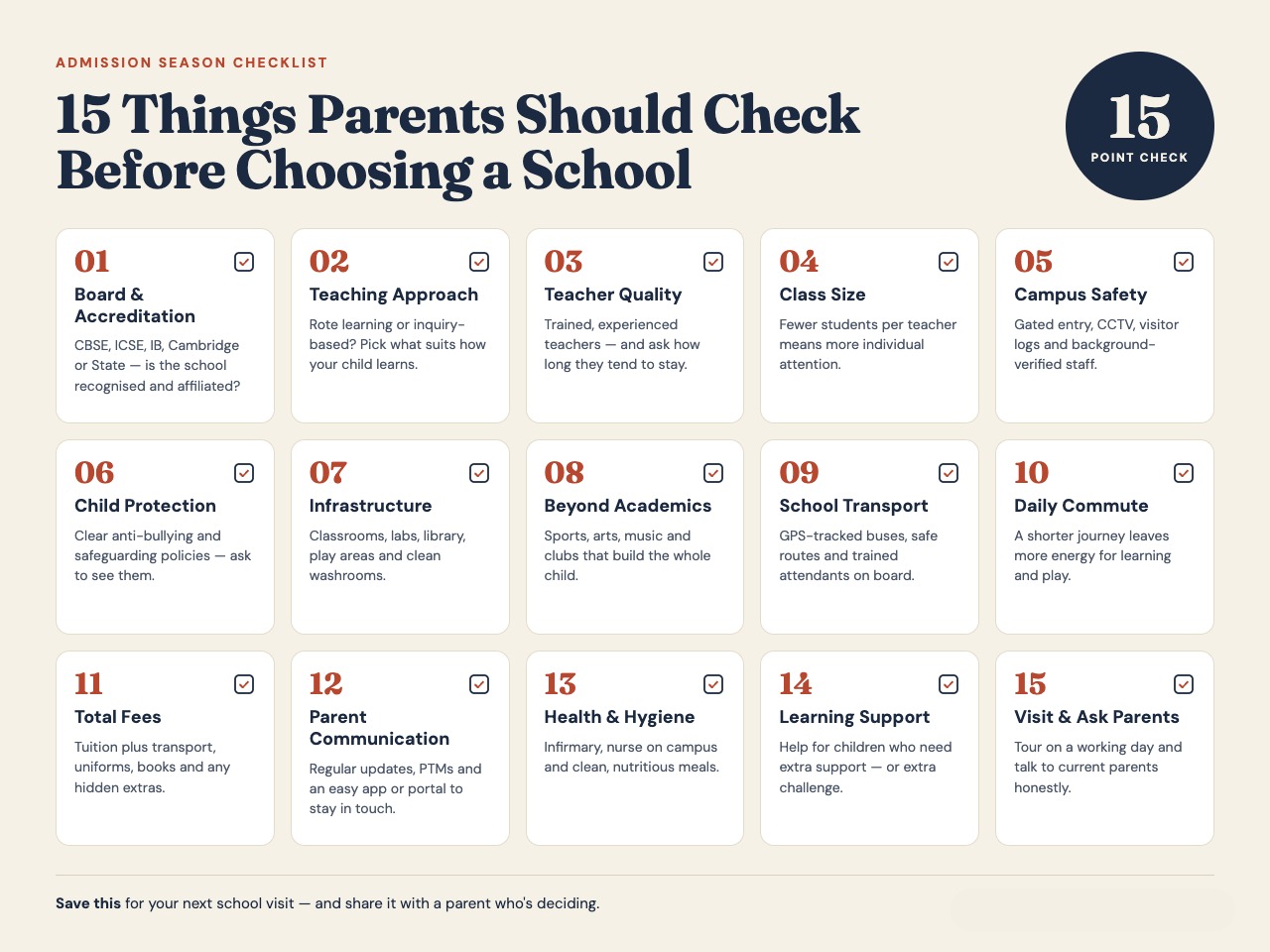


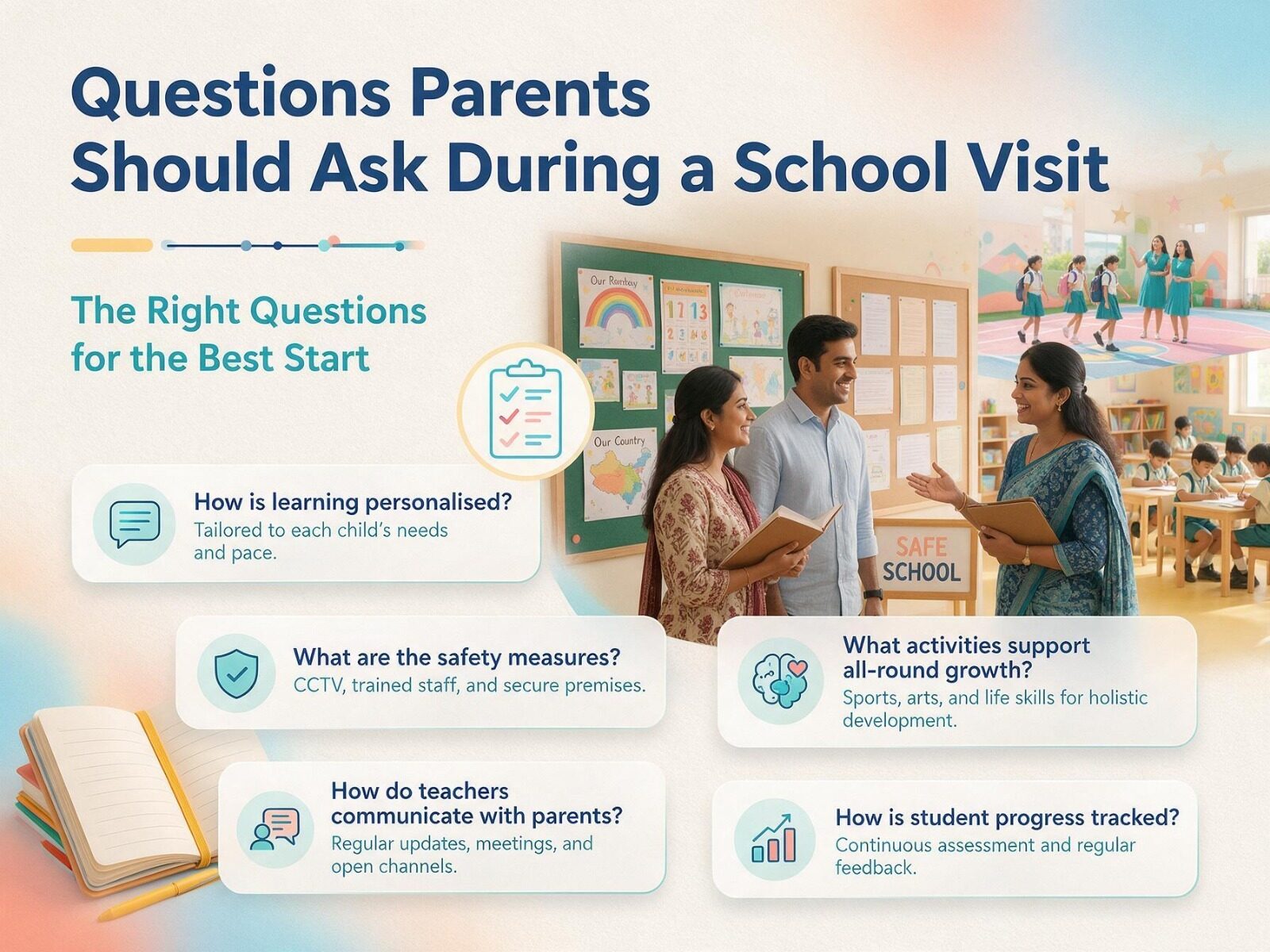
Questions Parents Should Ask During a School Visit
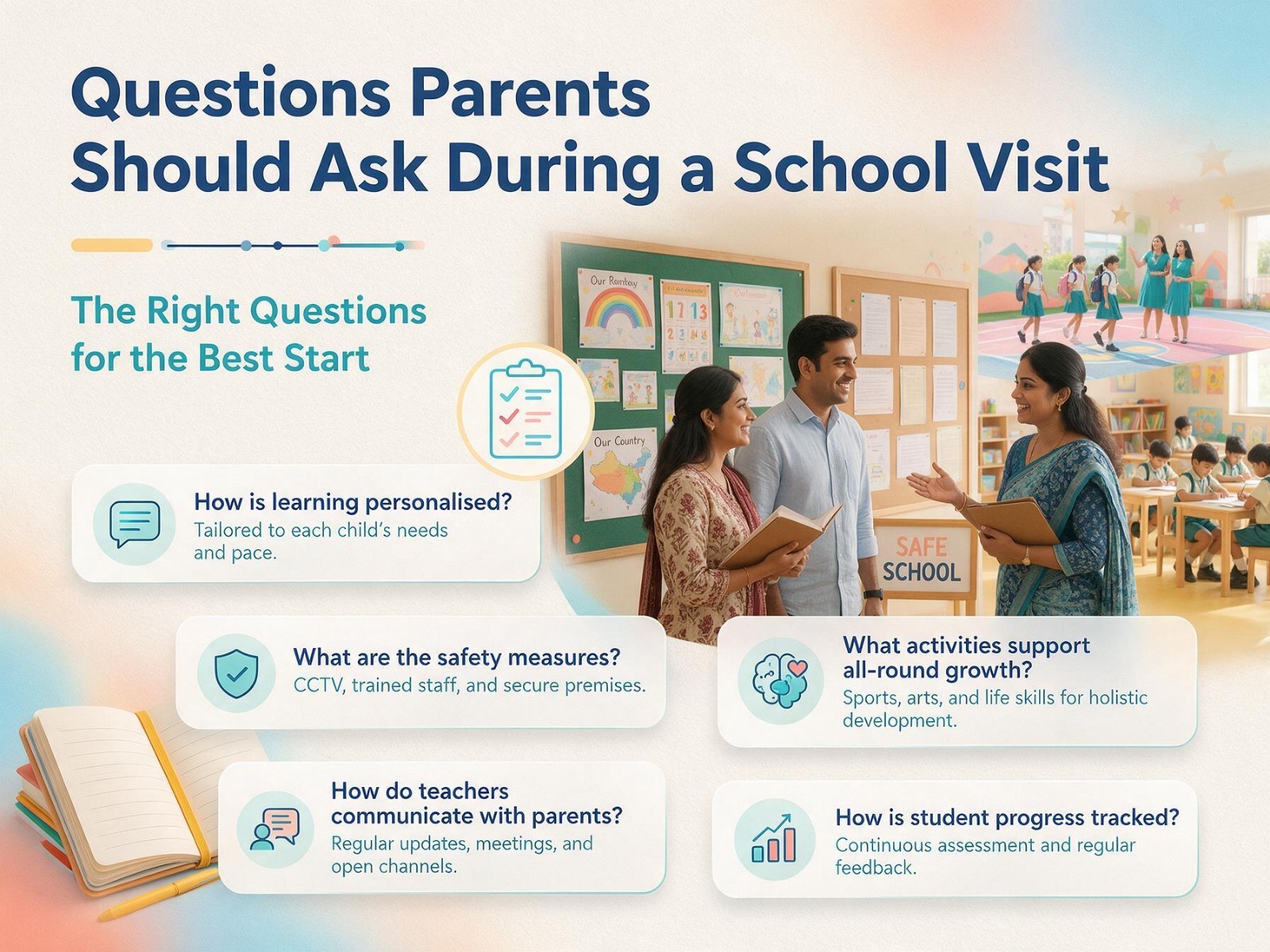
Questions Parents Should Ask During a School Visit
A school visit is your best chance to see beyond the website and brochure. It’s where you get a feel for the school’s culture, meet the people who will teach your child, and see how children actually learn every day.
But campus tours can move quickly, and it’s easy to walk away realising you forgot to ask something important. Going in with the right questions helps you gather what you really need to make a confident decision.
This guide covers the key questions to ask during a school visit, grouped by topic, along with what a good answer typically sounds like. Take it along on your next campus tour.
Before the Visit: A Little Preparation Goes a Long Way
- Book a scheduled visit. A planned tour usually gives you time with the admissions team and, often, the principal or a coordinator.
- Visit during school hours. Seeing classes in session tells you far more than an empty campus.
- Bring your child if appropriate. Their reaction to the environment can be very revealing.
- Write down your priorities. Know what matters most to your family, whether that’s curriculum, commute, sports, class size or something else.
Questions About Curriculum and Teaching
1. Which curriculum do you follow, and why did the school choose it?
A good school can explain clearly how its curriculum, whether CBSE, Cambridge IGCSE or IB, shapes teaching and learning, not just name the board.
2. How would you describe your teaching approach?
Listen for words like inquiry, projects, discussion and hands-on learning, balanced with strong fundamentals. Be cautious if the answer focuses only on textbooks and test scores.
3. How do you support children who learn at different speeds?
Look for specific examples, such as differentiated tasks, remedial sessions, enrichment activities or small-group support.
4. How is progress assessed and shared with parents?
The best answers mention a mix of assessments (projects, presentations, classwork and tests) and regular, detailed feedback.
5. How much homework do students get at this grade level?
A thoughtful school will have a clear, age-appropriate homework policy that balances learning with rest and play.
Questions About Teachers
6. What qualifications and training do your teachers have?
Ask whether teachers are trained specifically for the curriculum they teach, especially in Cambridge or IB schools.
7. How long do teachers typically stay at the school?
Low teacher turnover usually signals a positive work culture and consistency for students.
8. How does the school support teachers’ professional development?
Schools that invest in regular training tend to keep their teaching current and effective.
9. Can we meet the class teacher or coordinator?
A brief conversation will tell you a lot about their warmth, communication style and passion for teaching.
Questions About Class Size and Personal Attention
10. How many students are in each class?
Smaller classes generally allow more individual attention.
11. Are there teaching assistants in the younger grades?
Additional support in early years classrooms helps teachers give each child the care they need.
12. How well do teachers get to know each child?
A good answer will show that teachers understand students as individuals, their strengths, challenges and interests, not just their marks.
Questions About Safety and Security
13. What security measures are in place on campus?
Ask about entry and exit controls, visitor management, supervision during breaks and dispersal procedures.
14. What is your child protection policy?
The school should have a clear, written policy and trained staff who know how to respond to concerns.
15. How does the school handle bullying?
Look for a clear approach that focuses on prevention, quick action and support for all children involved.
16. What medical support is available?
Ask whether there’s a nurse or first-aid room on campus and how the school handles emergencies.
Questions About Student Wellbeing
17. Is there a counsellor on campus?
Access to counselling support is increasingly important for children’s emotional health.
18. How do you help new students settle in?
Good schools have thoughtful induction processes, buddy systems or orientation sessions for new students.
19. How do you manage exam stress in senior grades?
Listen for practical support, such as study-skills guidance, counselling and clear communication with parents.
Questions About Activities and Holistic Development
20. What sports, arts and co-curricular activities are offered?
Ask to see the activity calendar and facilities in use.
21. Are activities part of the school day or extra?
This affects both your child’s schedule and your overall costs.
22. What leadership opportunities do students have?
Student councils, house captains and prefect roles help children build confidence and responsibility.
23. How does the school encourage values and community service?
A school that nurtures character alongside academics prepares children for life, not just exams.
Questions About Results and Future Pathways
24. How have students performed in recent board examinations?
Results matter, but also ask how the school supports students of all abilities, not just top performers.
25. Where have your alumni gone for higher education?
Alumni outcomes, in India and abroad, give a clear picture of the opportunities the school opens up.
26. Can my child continue here through to Grade 12?
Continuity from early years to senior school avoids disruptive changes of school or board later.
27. How do you guide students with subject and career choices?
Look for structured guidance, such as coordinator meetings, career counselling and university application support.
Questions About Parent Communication
28. How often are parent-teacher meetings held?
Regular meetings show that the school values partnership with families.
29. How do teachers communicate with parents day to day?
Ask about diaries, apps, emails or portals, and how quickly teachers typically respond.
30. How can parents get involved in school life?
Schools that welcome parents to events, workshops and volunteering create stronger communities.
Questions About Fees and Admissions
31. What is the complete fee structure?
Ask for a clear breakdown, including admission, tuition, annual, activity, transport and examination fees.
32. What’s included and what’s charged separately?
Clarify costs for books, uniforms, trips, specialist coaching and board exams upfront.
33. Are instalment options available?
Many schools offer term-wise or split payment plans.
34. What does the admission process involve?
Ask about entrance assessments, interviews, required documents and key dates.
35. Do you offer mid-year admissions?
This is especially useful for families relocating to Chennai.
Questions About Transport and Daily Logistics
36. Do your bus routes cover our area?
Check pick-up points and approximate travel times.
37. What safety measures are in place on school buses?
Ask about attendants, tracking and driver verification.
38. What are the school timings, and is there after-school care?
This helps you plan around work schedules.
39. What are the arrangements for lunch and snacks?
Find out whether the school provides meals or children carry lunch.
Questions to Ask Yourself After the Visit
Once the tour is done, take a few minutes to reflect:
- Did the children seem happy, curious and engaged?
- Were teachers warm and approachable?
- Were your questions answered openly and clearly?
- Could you picture your child thriving here?
- Does the school fit your family’s values and long-term plans?
Often, your instinct after a visit is as valuable as any answer you received.
Visit Gateway Group of International Schools
At the Gateway Group of International Schools, we welcome parents to visit, ask questions and experience our campuses for themselves. For two decades, Gateway has offered Chennai families a choice of curricula along the ECR and OMR corridors.
A choice of curricula. Gateway offers the IB programme at the IB World School in Padur, the Cambridge pathway from Primary to A Levels at Gateway The Complete School in Sholinganallur, and CBSE at campuses in Padur, Neelankarai and Mahabalipuram, along with Gateway Capstone School.
A clear admission process. Admissions are open from LKG to Grade 12. Early years applicants don’t take an entrance exam, while older students complete an age-appropriate assessment and interview, so the school can understand each child and place them well.
Holistic learning. Experiential teaching, sports, arts, cultural celebrations and student leadership opportunities are part of everyday school life.
Support for relocating families. Mid-year admissions are available for students with valid reasons for changing schools.
Wide transport coverage. School buses serve neighbourhoods across South Chennai, including Sholinganallur, Thoraipakkam, Perungudi, Velachery, Medavakkam, Perumbakkam, Navalur, Padur and Neelankarai.
Frequently Asked Questions
How long does a typical school visit take?
Most visits take between 45 minutes and an hour and a half, including a campus tour and a conversation with the admissions team.
Should I bring my child on the school visit?
For many families, yes. Seeing how your child responds to the environment can be very helpful, especially for older children.
How many schools should I visit before deciding?
Visiting two to four shortlisted schools usually gives you enough comparison without becoming overwhelming.
Is it okay to ask about fees during the visit?
Absolutely. A transparent school will be happy to share its complete fee structure.
What documents should I carry for admission?
Documents typically include recent report cards, a transfer certificate, birth certificate, photographs, address proof and Aadhaar card. Confirm the exact list with the school.
Book Your Campus Visit
The right questions help you see a school clearly and choose with confidence. We’d love to show you around and answer every question on your list.
Admissions for 2027–28 are open across Gateway campuses. Apply online, explore our admissions page, call 044-2449 3333, or email admission@gatewaytheschool.in to schedule your visit.