

Apply for Admission

Category: Parenting / Admissions

Set Realistic Goals, Track Progress

How to Teach Children to Take Better Notes in Class: Effective Note-Taking Strategies for Students
How to Teach Children to Take Better Notes in Class: Effective Note-Taking Strategies for Students

Have you ever noticed your child returning from school with pages of handwritten notes but struggling to explain what they learned? Or perhaps they spend so much time copying information from the board that they miss important explanations from their teacher.

Taking notes is an essential academic skill, but effective note-taking involves much more than writing down everything a teacher says. It requires students to listen carefully, identify important information, organise ideas, and review what they have learned.

Good note-taking habits can help students improve concentration, understand complex subjects, prepare for examinations, and become more independent learners.

Whether your child is in primary school or preparing for secondary school examinations, developing effective note-taking skills can make classroom learning more meaningful.

In this guide, Gateway Schools explores practical strategies parents and teachers can use to help children take better notes, organise information, and develop study habits that support long-term academic success.

Why Are Note-Taking Skills Important for Students?

Note-taking helps students actively engage with classroom lessons instead of simply listening to information.

When students identify key ideas and record them in their own words, they have an opportunity to process what they are learning.

Effective note-taking can support several important academic skills.

1. Improves Classroom Attention

Taking purposeful notes encourages students to listen for important explanations, examples, and instructions.

Instead of copying every sentence, they learn to distinguish between central concepts and supporting details.

2. Strengthens Understanding

When students summarise information in their own words, they must think about what the teacher is explaining.

This process can help them recognise relationships between ideas and identify concepts they do not fully understand.

3. Supports Memory and Revision

Well-organised notes provide useful material for reviewing lessons, practising questions, and preparing for examinations.

However, writing notes alone does not guarantee better memory. Students benefit most when they review their notes, explain concepts, and practise retrieving information without looking at the answers.

4. Develops Organisational Skills

Students learn to structure information using headings, bullet points, diagrams, keywords, and summaries.

These skills become increasingly important as academic subjects grow more complex.

5. Encourages Independent Learning

Students who can create and use their own notes become less dependent on repeatedly reading entire textbook chapters or relying exclusively on teacher-provided summaries.

They also develop greater awareness of what they understand and which topics require additional attention.

When Should Children Start Learning Note-Taking Skills?

Children can begin developing basic note-taking habits during primary school, although the methods should match their age, writing ability, and developmental needs.

Younger children may benefit from drawing pictures, recording keywords, completing simple worksheets, or discussing the main ideas of a lesson.

As students grow older, they can gradually learn to write short summaries, organise notes into sections, and use structured note-taking techniques.

School stage

Suitable note-taking activities

Early primary school

Drawing pictures, recording simple words, using teacher-provided templates

Upper primary school

Writing keywords, short sentences, bullet points, and simple diagrams

Middle school

Using headings, summaries, mind maps, and structured notes

Secondary school

Cornell notes, concept maps, comparison tables, and independent revision notes

These are general suggestions rather than strict age-based expectations. Children develop writing, listening, and organisational skills at different rates.

10 Effective Ways to Teach Children to Take Better Notes in Class

1. Teach Children to Listen Before Writing

One of the most common note-taking mistakes is attempting to copy every word spoken by the teacher.

This can make it difficult for students to follow explanations or understand the overall meaning of a lesson.

Encourage children to listen for the main idea before writing.

For example, if a teacher explains how plants produce food through photosynthesis, students do not need to record every sentence.

Instead, they could write:

Photosynthesis

  • Plants use sunlight to make food.
  • Water and carbon dioxide are required.
  • Chlorophyll helps absorb light.
  • Glucose is produced, and oxygen is released.

These notes capture the essential information without reproducing the entire explanation.

Tip for parents: After your child explains something they learned at school, ask them to summarise it in three or four key points.

This helps them practise identifying important information.

2. Encourage the Use of Keywords and Short Sentences

Writing complete paragraphs during every lesson can be time-consuming.

Teach students to identify keywords and record information in concise phrases.

For example:

Instead of writing:

“The water cycle is a natural process in which water evaporates from the Earth’s surface, condenses into clouds, and returns to the ground as precipitation.”

Students can write:

Water Cycle

  • Evaporation – water changes into vapour.
  • Condensation – vapour forms droplets and clouds.
  • Precipitation – rain, snow, or hail returns water to Earth.

This format is easier to scan during revision.

Students should avoid shortening notes so much that they become difficult to understand later.

3. Use Headings and Subheadings to Organise Information

Clear headings make notes easier to follow and help students understand how ideas are connected.

For example, a history lesson could be organised as:

Topic: The Indus Valley Civilisation

Location

  • Indus River region
  • Major settlements: Harappa and Mohenjo-daro

Town Planning

  • Planned streets
  • Drainage systems
  • Brick buildings

Trade

  • Agricultural products
  • Crafts and pottery
  • Trade connections with other regions

Important Discoveries

  • Seals
  • Pottery
  • Jewellery
  • Archaeological remains

This structure helps students locate information quickly when preparing for assignments and examinations.

Parents can encourage children to use one clear heading for each major concept rather than writing everything as a continuous paragraph.

4. Introduce the Cornell Note-Taking Method

The Cornell method is a structured note-taking system that helps students organise information and review it effectively.

It divides a page into three sections:

  • Notes section: Record important information during the lesson.
  • Cue column: Add keywords, questions, or prompts after the lesson.
  • Summary section: Write a short explanation of the main ideas.

For example:

Cue or question

Notes

What is evaporation?

Water changes from liquid to vapour.

What causes condensation?

Water vapour cools and forms liquid droplets.

What is precipitation?

Water falls from clouds as rain, snow, or hail.

Summary: The water cycle describes the continuous movement of water through evaporation, condensation, and precipitation.

Students can cover the notes column and use the questions to test their memory.

The Cornell method may be particularly useful for middle and secondary school students who need to revise detailed subjects.

5. Encourage Mind Maps for Complex Topics

Mind maps help students organise information visually by connecting a central concept to related ideas.

For example, a student studying ecosystems could place “Ecosystem” at the centre of a page and create branches for:

  • Living organisms
  • Non-living components
  • Food chains
  • Energy flow
  • Environmental balance

Each branch can include keywords, examples, or short explanations.

Mind maps are useful for brainstorming, organising relationships, and reviewing topics with several connected concepts.

However, students should choose a format that suits the subject. A detailed mathematical proof or chronological sequence may be easier to record using numbered steps.

6. Teach Students to Use Abbreviations and Symbols

Abbreviations can help students record information more efficiently during fast-paced lessons.

Examples include:

Symbol or abbreviation

Meaning

e.g.

For example

i.e.

That is

→

Leads to or results in

↑

Increase

↓

Decrease

vs.

Versus or compared with

+

Addition or positive relationship

=

Equals

Students can also develop subject-specific abbreviations.

For example, in geography, they might use “temp.” for temperature or “precip.” for precipitation.

Encourage children to use abbreviations consistently and avoid symbols they may not understand when reviewing their notes later.

7. Use Diagrams, Tables, and Flowcharts

Not every concept is best explained through written sentences.

Diagrams and tables can help students organise processes, comparisons, and relationships.

For example, when learning about plant and animal cells, students could create a comparison table.

Feature

Plant cell

Animal cell

Cell wall

Present

Absent

Chloroplasts

Present in photosynthetic cells

Absent

Cell membrane

Present

Present

Nucleus

Usually present

Usually present

Vacuole

Often one large central vacuole

Usually smaller vacuoles

Similarly, flowcharts can help explain processes such as the water cycle, digestion, or the stages of a historical event.

Encourage students to select diagrams when they make information clearer, rather than adding illustrations simply to decorate their notebooks.

8. Encourage Students to Write in Their Own Words

Copying textbook definitions or classroom explanations word for word may sometimes be necessary, especially for formulas or precise terminology.

However, students should also practise explaining concepts using language they understand.

For example:

Textbook explanation:

“Friction is a force that opposes the relative motion between surfaces in contact.”

Student’s explanation:

“Friction is a force that resists movement when two surfaces touch.”

The student’s version preserves the central meaning while using simpler language.

After writing a note, encourage children to ask themselves:

“Can I explain this idea without looking at my textbook?”

If they cannot, they may need to revisit the concept or ask their teacher for clarification.

9. Review Notes After Every Important Lesson

Notes are most useful when students return to them and actively review the information.

A short review after school can help children identify missing details and strengthen their understanding.

Encourage students to:

  1. Read through their notes.
  2. Complete any unfinished explanations.
  3. Highlight a few important keywords.
  4. Add questions about confusing concepts.
  5. Close the notebook and explain what they remember.

For example, after reviewing a science lesson, a student could attempt to answer three questions without looking at their notes.

This combines note-taking with active recall, helping students practise retrieving information independently.

A brief review is often more manageable than leaving all revision until the days before an examination.

10. Help Students Develop a Personal Note-Taking System

There is no single note-taking method that works best for every student or every subject.

Different topics may require different approaches.

For example:

  • Mathematics: Formulas, worked examples, and step-by-step solutions.
  • Science: Definitions, diagrams, processes, and experiment observations.
  • History: Timelines, key events, causes, and consequences.
  • Geography: Maps, diagrams, comparisons, and important terminology.
  • Languages: Vocabulary lists, grammar rules, examples, and short summaries.

Encourage students to experiment with different formats and evaluate which ones help them understand and revise effectively.

The objective is not to produce the most colourful or attractive notebook. It is to create notes that are accurate, organised, and useful for learning.

How to Take Better Notes in Different School Subjects

Students can improve their note-taking skills by adapting their approach to the type of information being taught.

Mathematics: Focus on the Process

Mathematics notes should explain how to solve problems, not simply record the final answer.

Students can include:

  • Important formulas.
  • Definitions of mathematical terms.
  • Step-by-step worked examples.
  • Common calculation mistakes.
  • Questions they need to practise again.

For example, when learning percentages, students can write the formula, solve a sample problem, and explain why each step is necessary.

Science: Connect Concepts with Examples

Science notes often benefit from diagrams, labelled illustrations, definitions, and explanations of processes.

Students should record observations from experiments and distinguish between what they observed and what they concluded.

History: Organise Events Chronologically

Timelines can help students understand the sequence of historical events.

Notes should also explain the causes, consequences, and significance of important developments rather than focusing only on dates.

English and Other Languages: Record Vocabulary and Meaning

Students can create vocabulary tables containing new words, meanings, example sentences, and related expressions.

For literature lessons, notes may include character development, themes, plot events, and evidence from the text.

Geography: Use Maps and Comparisons

Maps, charts, tables, and diagrams can help students understand locations, natural processes, and relationships between geographical features.

Combining these resources with short explanations can make complex topics easier to review.

How Parents Can Help Children Improve Note-Taking at Home

Parents do not need to rewrite their children’s notes or supervise every classroom assignment.

Instead, they can provide simple guidance that encourages independence.

Create a Comfortable Study Environment

Provide a quiet, organised space where children can review lessons and complete assignments.

Keep notebooks, pencils, rulers, and other necessary materials accessible.

Ask Children to Explain Their Notes

Rather than checking only whether a notebook is complete, ask your child to explain what they learned.

Questions such as “What was the most important idea in today’s science lesson?” can encourage deeper thinking.

Encourage Regular Organisation

Help children organise notebooks by subject, date, and topic.

A simple system makes it easier to locate information during homework and examination preparation.

Avoid Expecting Perfect Notes

Some children may struggle to write quickly, maintain neat handwriting, or organise information while listening.

Focus first on whether the notes are understandable and useful.

If a child consistently has difficulty keeping up with classroom writing, discuss appropriate support with their teacher.

Recognise Improvement

Encourage children when they begin identifying key points, writing clearer summaries, or reviewing lessons independently.

Specific feedback is more helpful than focusing only on handwriting or presentation.

Common Note-Taking Mistakes Students Should Avoid

Even hardworking students can develop habits that make their notes less useful.

Writing everything the teacher says: Trying to copy every word can reduce attention to explanations and examples.

Using too many colours: Excessive highlighting may make it difficult to distinguish truly important information.

Copying without understanding: Notes should support learning, not become a transcription exercise.

Ignoring diagrams and examples: Visual explanations and worked examples can be essential for understanding certain subjects.

Keeping disorganised notebooks: Missing headings, dates, and topic labels can make revision unnecessarily difficult.

Never reviewing notes: Notes become more useful when students revisit them, test their understanding, and correct mistakes.

Prioritising neatness over learning: A beautifully decorated notebook is not necessarily an effective study resource.

Students should focus on clarity, accuracy, understanding, and regular revision.

A Simple Daily Note-Taking Routine for Students

Developing better note-taking habits does not require hours of additional work.

Students can begin with a short routine that fits their school schedule.

When

Activity

Purpose

Before class

Review the previous lesson’s main points

Activate prior knowledge

During class

Listen carefully and record key information

Capture important ideas

After class

Complete missing details and clarify questions

Improve accuracy

At home

Review notes and summarise key concepts

Strengthen understanding

Before exams

Use notes to answer questions and practise recall

Improve retrieval and application

This routine can be adapted to the student’s age, workload, and individual learning needs.

How Schools Can Encourage Effective Note-Taking

Schools play an important role in helping students develop strong learning and organisational skills.

Teachers can support note-taking by:

  • Providing clear lesson objectives.
  • Highlighting important concepts during explanations.
  • Demonstrating different note-taking formats.
  • Giving students time to record key information.
  • Encouraging questions and classroom discussions.
  • Providing guided notes when appropriate.
  • Teaching students how to review and use their notes for revision.

Younger students may benefit from structured worksheets or partially completed notes, while older students can gradually take greater responsibility for recording and organising information.

Students with writing, attention, language, or learning difficulties may require additional support, such as printed outlines, accessible materials, or other appropriate accommodations.

At Gateway Schools, encouraging active participation, critical thinking, and independent learning can help students develop effective study habits that support their academic growth.

Frequently Asked Questions

1. What is the best note-taking method for school students?

There is no single method that is best for every subject or student. Bullet points, Cornell notes, mind maps, and structured outlines can all be useful. Students should choose methods that help them understand, organise, and review information effectively.

2. At what age should children start taking notes?

Children can begin with simple note-taking activities during primary school, such as drawing diagrams, recording keywords, or completing guided worksheets. More structured techniques can be introduced as their writing and organisational skills develop.

3. Is handwriting better than typing notes?

Both handwritten and digital notes can support learning. The effectiveness of either method depends on how students process information, avoid distractions, and review their notes. Writing meaningful summaries is generally more important than the format alone.

4. How can students take notes faster in class?

Students can use keywords, abbreviations, bullet points, and simple diagrams. They should focus on important information rather than attempting to copy every sentence.

5. How often should students review their class notes?

Reviewing notes soon after a lesson and revisiting important concepts over several days can help students strengthen understanding and retention. The frequency should depend on the subject, difficulty, and upcoming assessments.

6. Can note-taking improve examination performance?

Effective note-taking can support understanding, organisation, and revision. However, students should combine their notes with practice questions, active recall, feedback, and spaced revision rather than relying on rereading alone.

Conclusion: Better Notes Lead to Better Learning Habits

Taking effective notes is an important skill that helps students become more attentive, organised, and independent in their learning.

By learning to identify key information, summarise concepts, use diagrams, and review lessons regularly, children can turn classroom notes into valuable learning resources.

Parents can support this process by encouraging curiosity, providing opportunities for reflection, and helping children develop consistent study routines.

Teachers can strengthen these habits by demonstrating practical note-taking strategies and gradually encouraging students to take responsibility for their own learning.

The goal of note-taking is not to fill pages with information. It is to help students understand what they learn, remember important concepts, and apply their knowledge with confidence.

At Gateway Schools, developing effective learning habits and encouraging independent thinking are important considerations in supporting students’ academic and personal development.

Explore Gateway Schools to learn more about its educational programmes and discover how a supportive learning environment can help children become confident, capable, and lifelong learners.
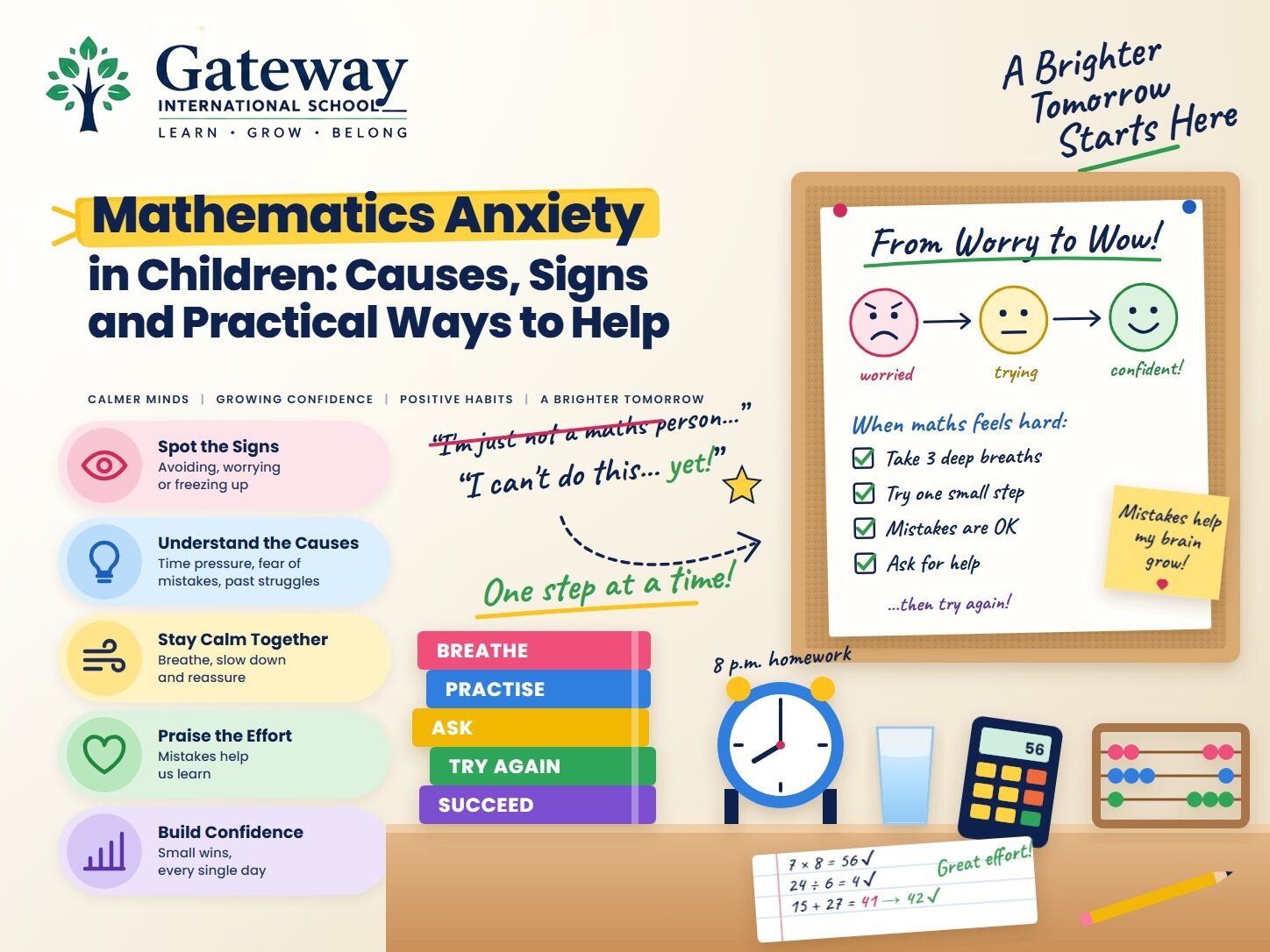
Mathematics Anxiety in Children Causes,Signs & How to Help

Mathematics Anxiety in Children: Causes, Signs and Practical Ways to Help

Mathematics Anxiety in Children: Causes, Signs and Practical Ways to Help

It’s 8 p.m. The maths homework is open on the table, and your child has suddenly developed a headache, an urgent need for water and a sudden interest in tidying their bag. Or perhaps they sit frozen, staring at a problem they solved without difficulty yesterday.

If this feels familiar, your child may be dealing with more than a dislike of the subject. For many children, maths triggers genuine worry, and that worry can get in the way of learning. This is called mathematics anxiety, and the good news is that it can be understood, addressed and overcome.

This guide explains what maths anxiety is, why it develops, how to spot the signs, and what parents and teachers can do to help children feel calmer and more confident with numbers.

What Is Mathematics Anxiety?

Mathematics anxiety is a feeling of tension, fear or dread that comes up when a child faces maths, whether that’s a test, homework, a question in class or even a casual number problem.

It is important to understand what it is not:

  • It is not the same as being “bad at maths.” Anxiety is an emotional response, and children who are perfectly capable can still be affected by it.
  • It is not laziness or lack of effort. Many anxious children care a great deal and worry precisely because they want to do well.
  • It is not the same as dyscalculia. Dyscalculia is a specific learning difficulty with number concepts. The two can occur together, but they are different issues and need different support.

Because anxiety can affect performance, parents sometimes assume a child “just can’t do maths” when the real obstacle is worry.

Why Maths Anxiety Affects Performance

Understanding the mechanism helps parents respond with patience instead of frustration.

When a child feels anxious about a maths task, the stress response can impair working memory, the mental workspace we use to hold and manipulate information while solving a problem. A child who fully understands the material may still underperform because their mental energy is going into managing the anxiety. outschooloutschool

A broad review of research confirms that working memory plays a significant role in the link between maths anxiety and maths performance. nih

This often creates a loop. Children who feel anxious about maths are more likely to perform poorly, and children who perform poorly are more likely to become anxious. Each difficult experience reinforces the worry, which makes the next experience harder. The encouraging part is that loops can be broken. thirdspacelearning

Common Causes of Maths Anxiety

Maths anxiety rarely has a single cause. It usually builds up from a combination of experiences.

1. Early Struggles and Learning Gaps

Maths builds on itself. If a child misses or only half-understands a foundation concept, such as place value, fractions or multiplication tables, later topics feel confusing. Repeated confusion can turn into fear.

2. Negative Experiences in the Classroom

Being laughed at for a wrong answer, being told off for mistakes, or feeling embarrassed in front of classmates can leave a lasting emotional mark. Children who feel unsafe making mistakes tend to avoid participating.

3. Pressure, Speed and Timed Tests

Heavy emphasis on speed, ranking and marks can make maths feel like a performance rather than a subject to understand. Timed tests in particular can set off anxiety in children who think carefully rather than quickly.

4. Messages from Adults

Children pick up attitudes quickly. Research suggests that parents with more negative attitudes towards maths tend to do fewer maths activities at home, which was linked to higher maths anxiety in their children. Casual remarks such as “I was never good at maths either” or “maths is just not for everyone” can unintentionally signal that struggling is normal and that ability is fixed. utb

Parental help with homework can matter too. One widely discussed study found that when maths-anxious parents helped frequently with homework, their children learned less maths and developed more maths anxiety over the school year. This doesn’t mean parents should stop helping. It means how we help matters, which we cover below. monstermath

5. A Fixed Mindset About Ability

Children who believe “I’m either a maths person or I’m not” tend to give up faster when things get hard. A growth mindset, the belief that ability develops through effort and good strategies, is a powerful protective factor.

6. Learning Differences

Some children may have an underlying difficulty, such as dyscalculia, attention difficulties or specific language or memory challenges, that makes maths harder and anxiety more likely. If you suspect this, a professional assessment can help.

Signs of Maths Anxiety to Watch For

Maths anxiety doesn’t always look like obvious distress. Some children cry or panic, while others show it in quieter ways. Look out for:

Emotional signs

  • Saying “I hate maths,” “I’m stupid at maths” or “I can’t do it” before even trying
  • Worry, irritability or tearfulness around homework or tests
  • Low confidence that seems specific to maths

Physical signs

  • Headaches, stomach aches or nausea before maths class or tests
  • Restlessness, sweating or a racing heart
  • Sleep problems before a maths test

Behavioural signs

  • Avoiding or delaying maths homework
  • Procrastinating, getting distracted or suddenly needing “something else” to do
  • Rushing through work to get it over with, or refusing to attempt problems
  • Frequent absence or requests to stay home on test days
  • Perfectionism, such as erasing repeatedly or being unable to move on from one mistake

Performance signs

  • Doing well in practice but poorly in tests
  • Making careless errors on questions they actually know
  • A sudden dip in marks that doesn’t match their understanding in conversation

No single sign proves anything. What matters is a pattern of worry that is specific to maths and affects your child’s wellbeing or learning.

Practical Ways Parents Can Help

1. Watch Your Own Words

Avoid saying you were bad at maths or that you dislike it. Try something like: “Maths can be tricky, but we can figure it out step by step.” Your attitude is contagious, so model curiosity and persistence.

2. Make It Safe to Make Mistakes

Treat mistakes as useful information, not failures. Ask, “What did you try? What happened? What could we try next?” Praise effort, strategy and persistence rather than only correct answers or high marks.

3. Help Without Taking Over

When helping with homework, resist the urge to grab the pencil or hand over the answer. Instead:

  • Ask your child to explain their thinking out loud
  • Offer guiding questions like “What do we know already?” and “Can you draw it?”
  • Stay calm and patient, even when it takes time
  • If you feel anxious about the topic yourself, say so honestly and look it up together, rather than hiding it

4. Keep Maths Practice Short, Regular and Calm

Twenty relaxed minutes a day does more good than a stressful two-hour session before a test. Small, frequent practice builds fluency and confidence without overwhelming working memory.

5. Fix the Foundations

If your child is struggling, go back to find the gap. Ask the teacher which concepts are shaky. Reviewing earlier topics isn’t a step backwards; it’s what makes later progress possible.

6. Make Maths Part of Everyday Life

Show children that maths is useful, not just a school subject:

  • Cooking: measuring, doubling a recipe, converting units
  • Shopping: comparing prices, calculating discounts, handling change
  • Travel: reading timetables, estimating time and distance
  • Games: board games, card games, puzzles and cricket scores

When maths connects to something enjoyable, it feels less threatening.

7. Use Visuals and Hands-On Tools

Drawing diagrams, using objects, building with blocks, folding paper for fractions and using number lines help children see what’s happening instead of memorising rules.

8. Teach Simple Calming Techniques

Before a test or tricky homework, help your child take a few slow, deep breaths. A short walk, a glass of water or a moment of quiet can help settle nerves. Some children benefit from jotting down their worries before a test, which can free up mental space.

9. Look After Sleep, Food and Routine

Tired, hungry or overscheduled children are more prone to stress. A steady routine with enough sleep makes a real difference.

10. Stay in Touch with the Teacher

Share what you’re noticing and ask what the teacher sees in class. Working together means your child gets consistent messages and support at home and at school.

How Teachers and Schools Can Help

Schools play a major role in shaping how children feel about maths. Effective approaches include:

  • Creating a classroom where mistakes are welcome. Discussing errors openly, without embarrassment, helps children see them as part of learning.
  • Building understanding before speed. Using concrete materials, visuals and real-life problems before moving to abstract methods.
  • Avoiding public comparison. Not ranking children or calling out low scores in front of peers.
  • Offering variety in assessment. Using projects, discussions, quizzes and practical tasks alongside timed tests.
  • Differentiating support. Giving extra help to children who need it, and extension tasks to those ready for more.
  • Using low-stakes practice. Frequent small quizzes without heavy marks attached can reduce the fear of “big” tests.
  • Encouraging a growth mindset. Language like “not yet” and “let’s find another way” sends a powerful message.

When to Seek Extra Support

Most children respond well to patient support at home and school. Consider speaking to the school counsellor, coordinator or a qualified professional if:

  • Your child’s distress around maths is intense or lasts for a long time
  • Anxiety is spreading to other subjects or to school in general
  • Physical symptoms such as stomach aches or sleep trouble keep recurring
  • Your child avoids school on maths days
  • You suspect a learning difficulty such as dyscalculia
  • Marks are falling despite regular effort and support

Asking for help is a sign of care, not a sign that something is wrong with your child.

Common Mistakes to Avoid

  • Saying “maths isn’t your thing.” This tells children their ability is fixed.
  • Over-emphasising marks and ranks. It raises pressure and can reduce curiosity.
  • Drilling endlessly. More worksheets don’t cure anxiety and can make it worse.
  • Comparing siblings or classmates. It damages confidence quickly.
  • Rushing in with the answer. It prevents children from building their own problem-solving skills.
  • Ignoring the problem. Anxiety rarely disappears on its own, and avoidance can deepen the gap.

Building Maths Confidence at Gateway Group of International Schools

At the Gateway Group of International Schools, we believe every child has hidden potential waiting to be discovered. Our campuses follow a multisensory, experiential approach that encourages hands-on learning, inquiry and creative expression, an approach that helps students understand concepts deeply instead of simply memorising procedures.

A caring learning environment. We aim to provide a challenging, safe and supportive environment where children feel comfortable asking questions and learning from mistakes.

Skills for the future. We focus on competencies such as problem-solving, decision-making, creativity, communication and resilience, which grow when children are encouraged to think and try.

Partnership with parents. We value collaboration between parents, facilitators and students, so concerns can be shared early and addressed together.

A choice of curricula. Families can choose from the IB programme at the IB World School in Padur, the Cambridge pathway from Primary to A Levels at Gateway The Complete School in Sholinganallur, and CBSE at campuses in Padur, Neelankarai and Mahabalipuram.

Holistic development. Sports, arts, cultural celebrations and leadership opportunities help children build the broader confidence that supports all areas of learning.

Frequently Asked Questions

1. What is maths anxiety?

It is a feeling of fear, tension or worry that arises when a child faces maths tasks such as homework, tests or classroom questions. It can reduce performance even when a child understands the material.

2. Is maths anxiety the same as being bad at maths?

No. Maths anxiety is an emotional response. Capable children can experience it, and it can make them perform below their real ability.

3. What causes maths anxiety in children?

Common causes include early learning gaps, negative classroom experiences, pressure around speed and marks, adults’ attitudes towards maths, a fixed mindset and sometimes underlying learning differences.

4. How can I tell if my child has maths anxiety or dyscalculia?

Maths anxiety is an emotional reaction to maths. Dyscalculia is a specific learning difficulty with number concepts. They can occur together, so if you’re unsure, speak to the school and consider a professional assessment.

5. Can maths anxiety be overcome?

Yes. With patient support, a calm approach, strengthened foundations and a positive attitude, most children become more confident over time.

6. Should I stop helping with maths homework if I’m anxious about maths myself?

No, but change how you help. Ask your child to explain their thinking, learn alongside them, avoid negative remarks about maths and ask the teacher for guidance when needed.

7. Does maths anxiety go away on its own?

Not always. Without support, avoidance can deepen learning gaps, so early attention is helpful.

Help Your Child Make Peace with Numbers

Maths anxiety is common, real and very treatable. When children feel safe, supported and understood, the fear begins to fade, and curiosity has room to grow. By choosing your words carefully, celebrating effort and working closely with your child’s school, you can help your child see maths not as something to dread, but as something they can do.

Admissions for 2027–28 are open across Gateway campuses. Apply online, explore our admissions page, call 044-2449 3333, or email admission@gatewaytheschool.in to schedule a campus visit.

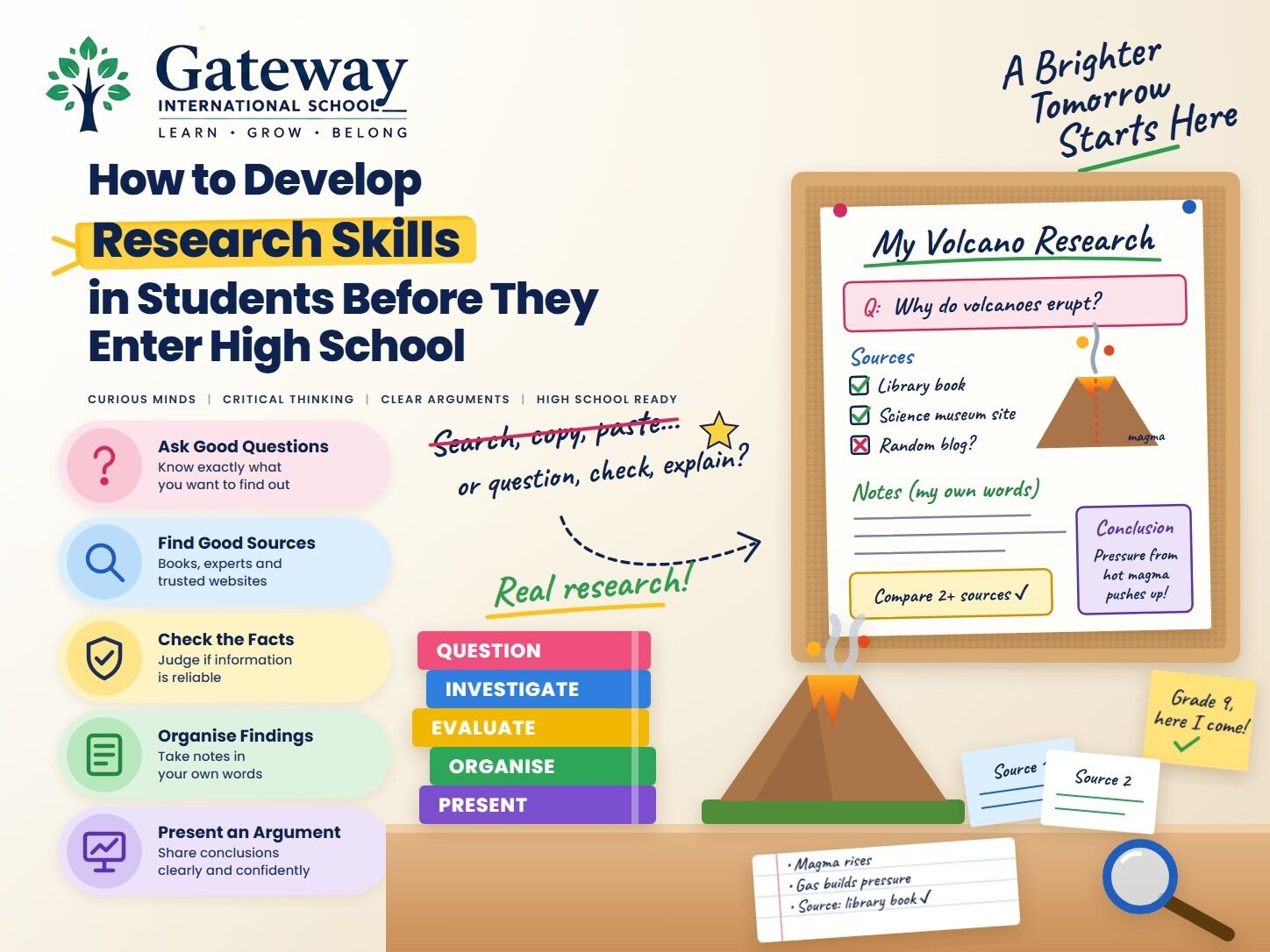
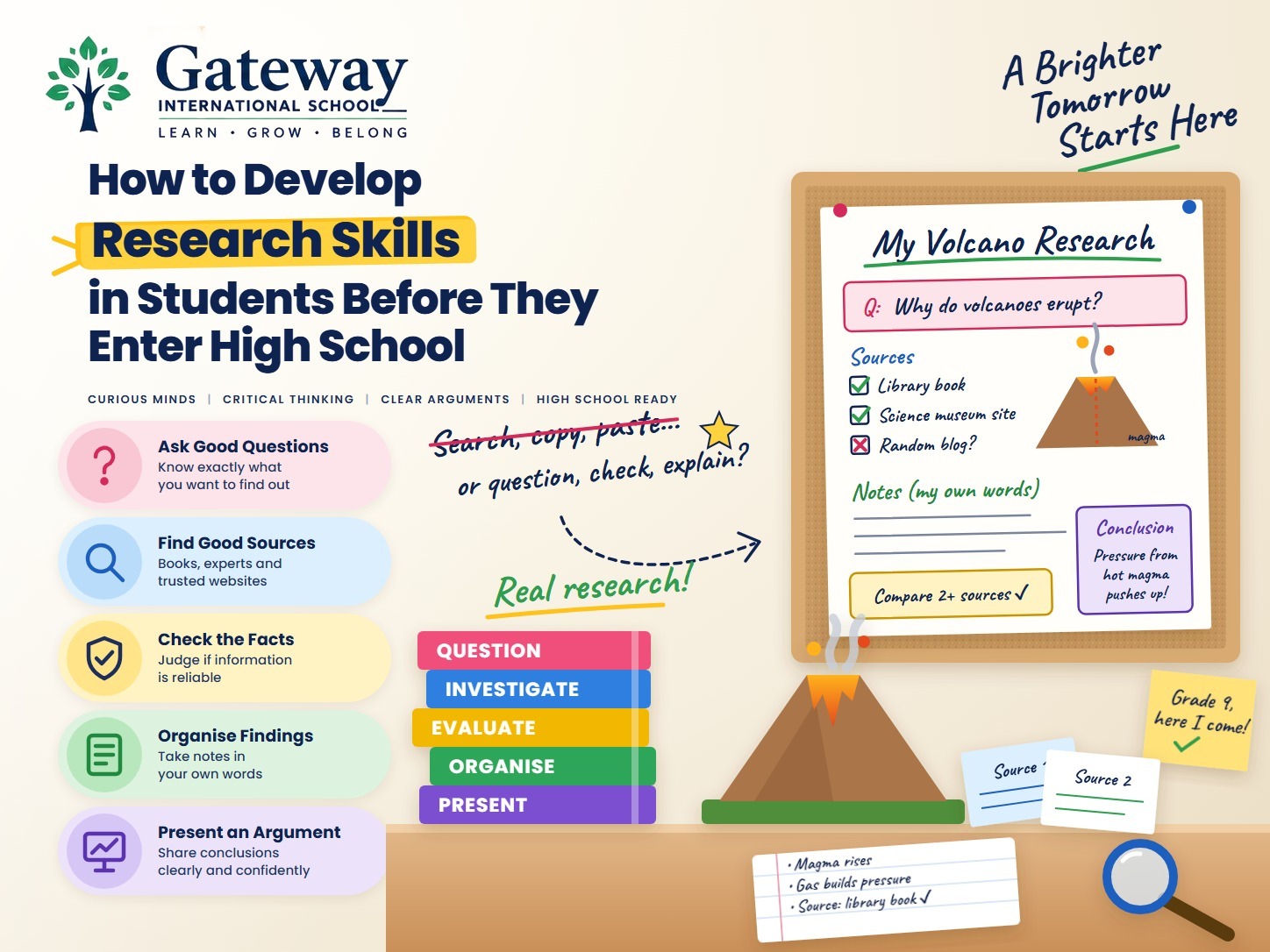
How to Develop Research Skills in Students Before High School

How to Develop Research Skills in Students Before They Enter High School

How to Develop Research Skills in Students Before They Enter High School

Ask a Grade 6 student to “find out about volcanoes” and you will often get the same result: a quick search, a few copied paragraphs and a document that looks finished but says very little. It’s not a lack of effort. Nobody ever taught them how to research.

High school changes the game. Whether your child is heading into CBSE senior classes, Cambridge IGCSE or the IB, they will be expected to investigate topics independently, judge the quality of information, organise their findings and present a clear argument. Students who have practised these skills early walk into Grade 9 with a real advantage.

This guide explains what research skills actually are, why they matter, and how parents and teachers can build them step by step during the primary and middle school years.

What Are Research Skills?

Research skills are the abilities that help a student find, evaluate, use and share information. They go well beyond searching online. A student with strong research skills can:

  • Ask a good question instead of just choosing a topic
  • Plan where and how to find answers
  • Locate information from a range of sources
  • Evaluate whether a source is trustworthy and relevant
  • Take notes in their own words
  • Organise ideas and spot patterns
  • Draw conclusions supported by evidence
  • Communicate findings clearly, giving credit to sources

These skills are useful in every subject, from a science investigation to a history essay, and they continue to matter in university and the workplace.

Why Research Skills Matter Before High School

High school demands independence. In senior grades, students handle longer assignments, internal assessments, practicals and projects with far less hand-holding.

Information is everywhere, and not all of it is reliable. Today’s students grow up surrounded by search results, videos and AI-generated answers. Knowing how to check whether something is accurate, current and unbiased is now a core life skill.

It builds deeper understanding. A student who has investigated a topic rarely forgets it. Research turns learning from memorising into understanding.

It supports board and international programmes. Cambridge and IB pathways include inquiry-based work, such as research projects and extended writing, where students must investigate and argue from evidence. Indian boards too are moving towards competency-based, application-focused learning in line with NEP 2020.

It builds confidence. Children who know how to find answers feel capable of tackling unfamiliar problems instead of waiting to be told what to do.

The Research Process, Made Simple

Even young students can learn a basic research cycle. Teach it as a loop they can repeat with growing sophistication:

  1. Wonder. Start with curiosity. What do I want to find out?
  2. Question. Turn the curiosity into a clear, focused question.
  3. Plan. Where could I look? Who could I ask?
  4. Find. Gather information from different sources.
  5. Check. Is this source reliable? Does it agree with others?
  6. Make sense. Note key points, compare ideas and look for patterns.
  7. Share. Present findings in a clear way and say where the information came from.
  8. Reflect. What did I learn? What would I do differently?

Building Research Skills by Age

Early Years and Lower Primary (Ages 4 to 8)

At this stage, research is simply structured curiosity.

  • Encourage questions. Celebrate “why” and “how” instead of silencing them.
  • Observe and describe. Watch ants in the garden, track the weather, or notice how plants grow. Ask what they see and what they think will happen next.
  • Use more than one source. Look something up in a picture book, ask a grandparent and watch a short video together.
  • Draw and label findings. Let children record discoveries through drawings, simple charts or a “discovery journal.”

Upper Primary (Ages 8 to 11)

Children can now begin to plan and record more independently.

  • Teach question types. Show the difference between a closed question (“What is the capital of Tamil Nadu?”) and an open one (“How has Chennai changed over the last fifty years?”). Open questions lead to real research.
  • Introduce note-taking. Teach them to jot down key words and rewrite ideas in their own words instead of copying.
  • Use the library. Learn how books are organised and how to use contents pages and indexes.
  • Start comparing sources. Ask: “Did both sources say the same thing? Why might they differ?”
  • Try mini-projects. A one-week investigation, such as “Where does our household water come from?”, builds stamina and organisation.

Middle School (Ages 11 to 14)

This is the most important window for preparing students for high school.

  • Teach source evaluation. Help students ask who created the information, why, when, and whether the claims are backed by evidence.
  • Explain primary and secondary sources. A survey they conduct themselves is primary data; an encyclopaedia entry is a secondary source.
  • Introduce referencing. Make “where did I get this?” a habit, and explain why giving credit matters and what plagiarism means.
  • Practise surveys, interviews and experiments. Collecting their own data makes research real, and links naturally with maths and science.
  • Develop argument and structure. Teach them to state a claim, support it with evidence and acknowledge other viewpoints.
  • Use technology wisely. Teach effective search techniques, how to spot unreliable websites and how to treat AI tools as a starting point to be verified, never as a final authority.

Practical Activities That Build Research Skills

The “Fact or Fiction?” challenge. Give students a surprising claim and ask them to verify it using at least three sources.

Family interview project. Ask your child to interview an elder about life in their youth, record the answers and write a short profile. It builds questioning, listening and organising skills, and it’s a lovely way to connect generations.

Neighbourhood survey. Students design three or four questions, survey 15 to 20 people on a topic like water use or favourite local places, then present the results as a chart.

Mini science investigation. Pose a testable question, such as “Which material keeps water warm the longest?”, then plan the test, record results and draw conclusions.

Passion project. Let students choose any topic they love, from cricket to coral reefs, research it over a few weeks and present to family or classmates.

Source detective. Give students two articles on the same topic with different viewpoints and ask them to identify differences in facts, tone and purpose.

Reading beyond the textbook. Encourage reading magazines, biographies, news articles for young readers and science journals. Wider reading builds vocabulary, background knowledge and the ability to follow an argument.

How Parents Can Support Research Skills at Home

You don’t need to be an expert. You just need to be curious alongside your child.

  • Model curiosity. Say “I don’t know, let’s find out together” often.
  • Ask guiding questions. Instead of giving the answer, ask “Where could we look?” or “How could we check that?”
  • Resist doing it for them. Let your child struggle productively with finding and organising information.
  • Teach them to question what they read. Ask “How do we know this is true?” in everyday conversations, whether about a news story or a viral message.
  • Set up a reading-friendly home. Books, magazines, a library membership and a quiet study corner all help.
  • Praise process, not just product. Appreciate the questions they asked, the sources they checked and the effort they put in.
  • Set healthy tech boundaries. Guide children on safe, responsible internet use and show them how to search with purpose.

Common Mistakes to Avoid

  • Copying and pasting. Teach note-taking in their own words from the very beginning.
  • Trusting the first search result. Encourage checking at least two or three sources.
  • Choosing topics that are too broad. “Space” is a topic; “Why do astronauts lose bone density?” is a research question.
  • Skipping the planning stage. A few minutes spent planning saves hours of confusion.
  • Treating AI answers as facts. AI tools can be useful for brainstorming, but they can also be wrong, so every claim needs checking against reliable sources.
  • Overloading the child. Keep early research tasks short, enjoyable and achievable.

Signs Your Child Is Ready for High School Research

By the end of middle school, a well-prepared student can usually:

  • Form focused, open-ended questions
  • Use several kinds of sources and tell reliable from unreliable ones
  • Take notes and summarise in their own words
  • Organise information logically
  • Support their opinions with evidence
  • Credit their sources
  • Present findings clearly, in writing or speech

If some of these are still developing, that’s perfectly normal. These skills grow with steady practice over time.

How to Tell Whether a School Builds Research Skills

When choosing a school, it’s worth asking:

  1. How are students taught to ask questions and investigate topics?
  2. Do students complete research projects before Grade 9? Can I see examples?
  3. How does the school teach referencing and academic honesty?
  4. How is technology, including AI, used responsibly in learning?
  5. Is there a library, and how often do students use it?
  6. How are projects assessed, and do they recognise process as well as final product?

Inquiry-Based Learning at Gateway Group of International Schools

At the Gateway Group of International Schools, learning is designed to go beyond the textbook. Our campuses follow a multisensory, experiential approach that encourages hands-on learning, inquiry and creative expression, so students develop the habits of questioning, investigating and explaining that prepare them for the senior years.

Skills for the future. We focus on competencies such as problem-solving, communication, creativity, decision-making, innovation and resilience.

A choice of curricula. Families can choose from the IB programme at the IB World School in Padur, the Cambridge pathway from Primary to A Levels at Gateway The Complete School in Sholinganallur, and CBSE at campuses in Padur, Neelankarai and Mahabalipuram.

Holistic development. Sports, arts, cultural celebrations, competitions and student leadership opportunities help children grow into confident, well-rounded learners.

Proven outcomes. Gateway alumni have gone on to institutions including VIT, IIIT Hyderabad, SRM Institute of Science and Technology, Symbiosis Law School and universities in the UK and Europe.

Frequently Asked Questions

1. At what age should children start learning research skills?

From the early years. Young children can practise observing, asking questions and finding answers in simple ways. The skills become more structured as they grow.

2. How can I teach my child to research without copying from the internet?

Teach note-taking in their own words from the start. Ask them to close the page and explain what they learned, then write it down. Also discuss why giving credit to sources matters.

3. Is it okay for students to use AI tools for research?

AI tools can help with brainstorming or understanding a topic, but they can make mistakes and invent information. Students should always verify claims against reliable sources and be clear about what they’ve written themselves. Follow your school’s guidelines on AI use.

4. How do I help my child tell reliable sources from unreliable ones?

Teach them to ask who wrote it, why, when it was published, what evidence is given, and whether other trustworthy sources agree.

5. Will research skills help in board exams?

Yes, indirectly. Research builds understanding, analysis and clear writing, which support performance in application-based and analytical questions across boards.

Raise a Curious, Capable Researcher

Research skills aren’t built in a single project. They grow through years of curiosity, practice and guidance. By helping your child ask better questions, check their sources and explain their thinking, you give them something far more valuable than any single answer: the ability to find out for themselves.

Admissions for 2027–28 are open across Gateway campuses. Apply online, explore our admissions page, call 044-2449 3333, or email admission@gatewaytheschool.in to schedule a campus visit.

Why Interdisciplinary Projects Help Students Learn

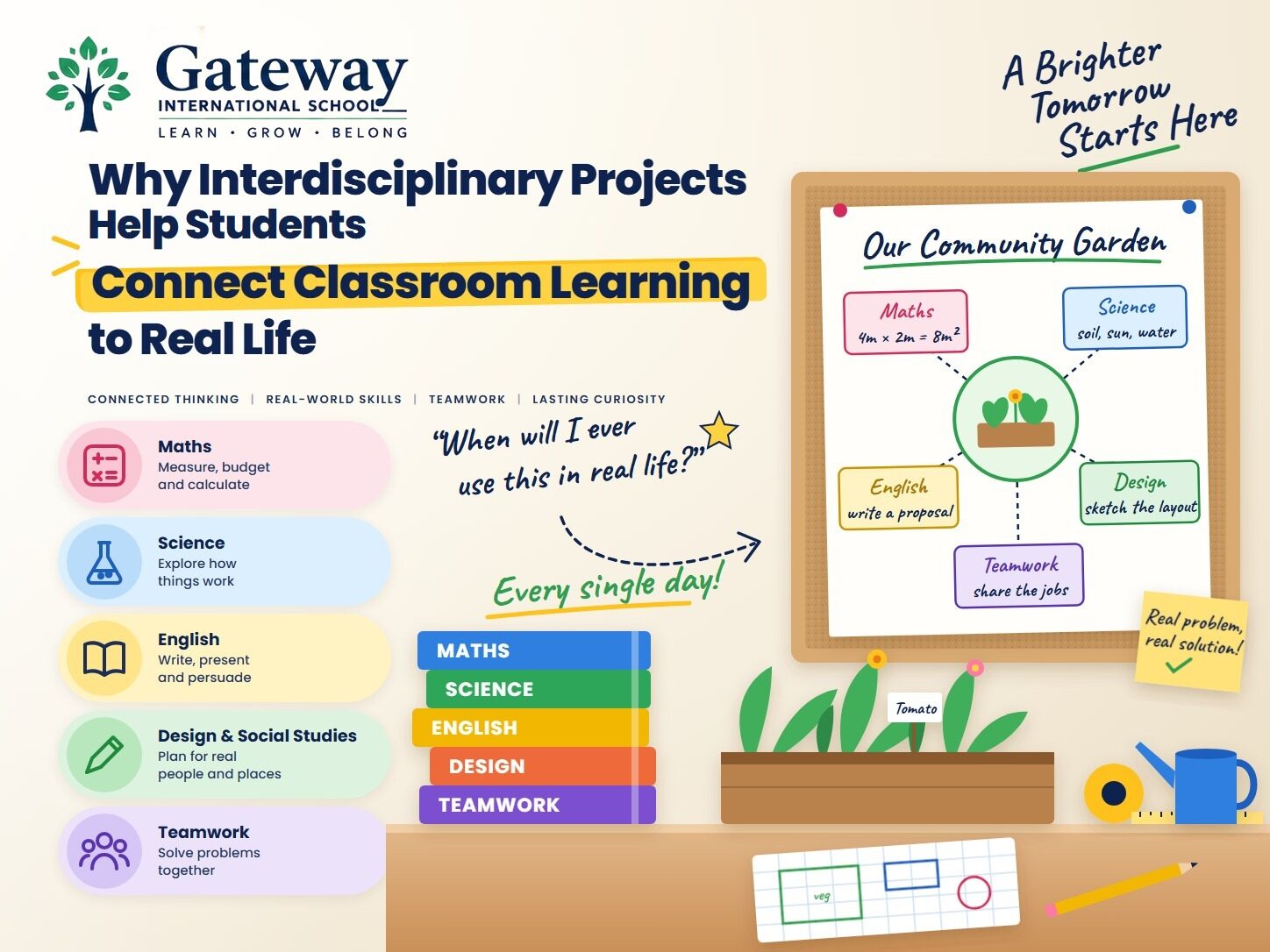
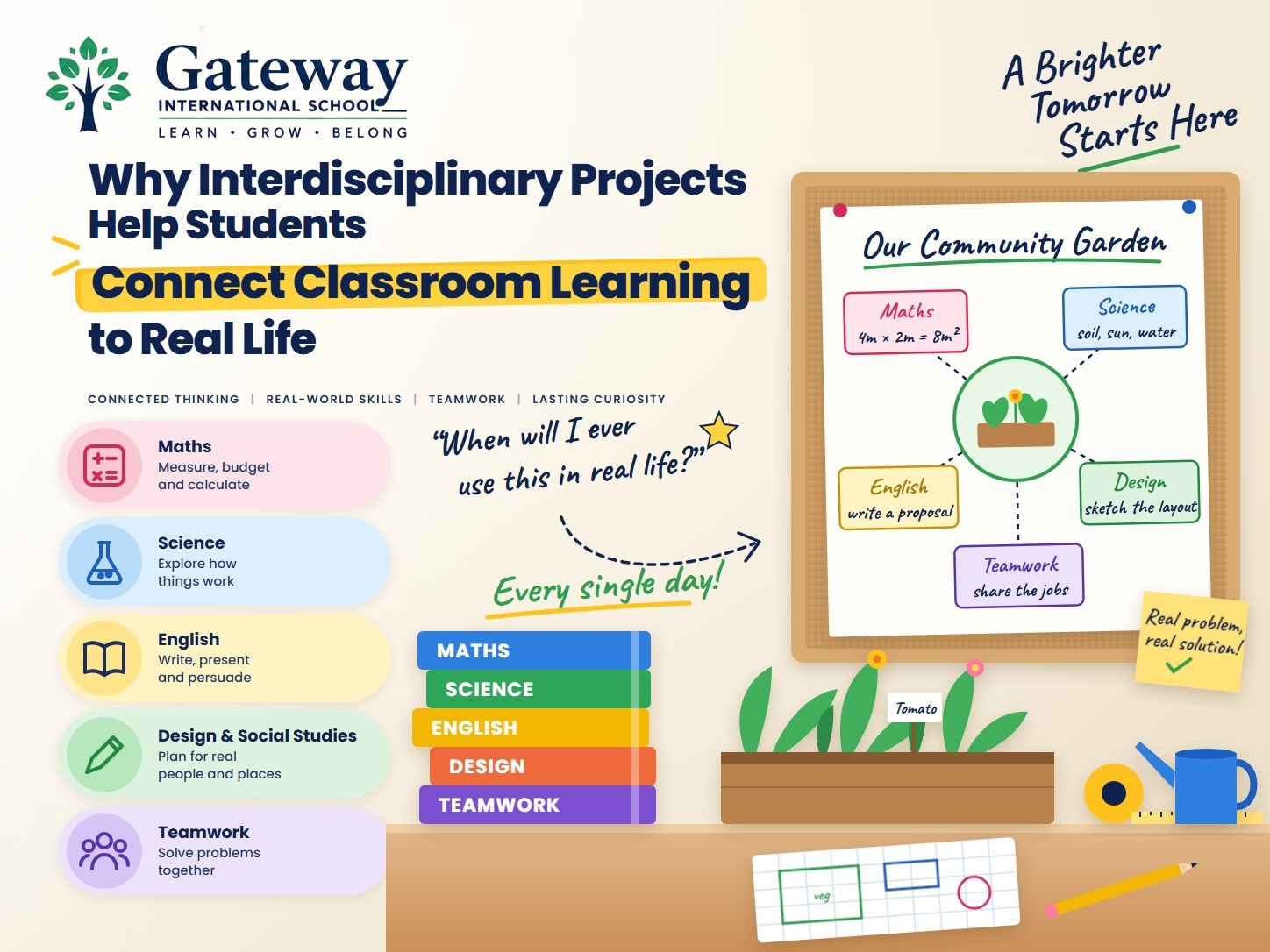
Why Interdisciplinary Projects Help Students Connect Classroom Learning to Real Life

Why Interdisciplinary Projects Help Students Connect Classroom Learning to Real Life

Every parent has heard the question at some point: “When will I ever use this in real life?”

It’s a fair question. In a traditional timetable, subjects are taught in separate 40-minute blocks. Mathematics ends, science begins, then comes English, then social studies. Children learn each subject well, but they rarely see how the subjects fit together. Yet the real world doesn’t work in subject periods. Planning a community garden involves science, maths, design, writing and teamwork all at once.

This is exactly what interdisciplinary projects are designed to do. In this guide, we explain what they are, why they work, what they look like in practice, and how parents can support them at home.

What Are Interdisciplinary Projects?

An interdisciplinary project brings knowledge and skills from two or more subjects together to explore a single question, problem or theme. Instead of studying a topic through just one subject, students approach it from several angles.

For example, a project on water scarcity might involve:

  • Science: understanding the water cycle, groundwater and water quality
  • Mathematics: collecting data, calculating usage and drawing graphs
  • Geography and social studies: exploring how water shortages affect communities
  • English: writing a report or persuasive speech
  • Art and design: creating a poster or a model of a water-saving solution

The subjects stay intact. What changes is that students see them working together on something that matters.

Why Interdisciplinary Projects Work

1. They Answer the “Why Am I Learning This?” Question

When students use a mathematical idea to solve a problem they care about, the concept stops being abstract. A graph becomes a tool for telling a story. A scientific principle becomes a way to explain something happening in their own neighbourhood. This sense of purpose makes learning more meaningful and memorable.

2. They Build Deeper Understanding

Recalling a fact for a test is one thing. Applying it in an unfamiliar situation is another. Interdisciplinary projects ask students to transfer what they know across contexts, which is one of the strongest signs of real understanding.

3. They Develop Critical Thinking and Problem-Solving

Real problems rarely have a single correct answer. Students learn to ask questions, weigh evidence, test ideas, deal with setbacks and refine their approach. These habits of mind serve them well in exams and far beyond.

4. They Strengthen Communication and Collaboration

Most projects are done in teams. Students learn to share responsibilities, listen to different views, resolve disagreements and present their ideas clearly. These are the very skills employers and universities consistently look for.

5. They Encourage Creativity

When students have room to decide how to approach a problem and present their findings, they think more creatively. A model, a short film, a debate, an experiment or a community survey can all be valid ways to show learning.

6. They Increase Engagement and Ownership

Children tend to put in more effort when they have a voice and a choice in what they’re doing. Projects give students ownership of their learning, which builds motivation, confidence and independence.

7. They Prepare Students for the Future

Today’s biggest challenges, from climate change and public health to artificial intelligence, cut across many fields. Students who can connect ideas across disciplines are better equipped to understand and respond to them.

How This Fits with Modern Education

The shift towards connected, experiential learning is part of a wider global movement in education. India’s National Education Policy (NEP) 2020 promotes multidisciplinary and holistic education, with greater emphasis on experiential learning, critical thinking and application over rote memorisation. Internationally recognised programmes such as the IB and Cambridge also place importance on inquiry, application and the ability to link learning across subjects.

Whichever curriculum a school follows, the principle is the same: knowledge becomes more powerful when students can apply it.

What Interdisciplinary Projects Look Like at Different Ages

Early Years and Primary. Learning is naturally connected at this age. A theme such as “Our Neighbourhood” can bring together language through storytelling, maths through counting and measuring, science through observing plants and animals, and art through drawing maps and models.

Middle School. Students can take on longer, more structured projects. For instance, designing a sustainable school canteen might combine nutrition science, budgeting and data handling, persuasive writing and poster design.

Senior School. Projects become more ambitious and research-driven. Students might investigate the impact of technology on local businesses, bringing together economics, statistics, ethics, communication and digital skills, or build a model for a smarter, greener city drawing on physics, geography, mathematics and design.

These are illustrative examples of the kinds of projects that work well at each stage.

Signs of a Good Interdisciplinary Project

Not every group activity is a meaningful interdisciplinary project. A strong one usually has:

  • A real, engaging question that students genuinely want to explore
  • Clear links between subjects, not just a topic with a different subject label attached
  • Student voice and choice in how they investigate and present
  • Opportunities for reflection, so students understand what they learned and how
  • Teacher guidance that supports learning without giving away every answer
  • Fair assessment that recognises both subject knowledge and skills such as collaboration and communication

Do Projects Compromise Academic Rigour?

This is a common and understandable concern, especially for parents thinking about board exams and entrance tests. The answer is no, when projects are well designed.

Strong projects don’t replace core subject learning. They reinforce it. A student who has applied a mathematical concept to a real situation will usually understand it more securely than one who has only practised it in exercises. The best schools balance both: solid subject fundamentals, supported by applied learning that deepens understanding.

How Parents Can Support Interdisciplinary Learning at Home

You don’t need special resources to support this kind of learning. A few simple habits go a long way.

  • Ask open-ended questions. Instead of “What did you learn today?”, try “What problem were you trying to solve?” or “How could you use that idea outside school?”
  • Connect learning to daily life. Cooking involves fractions and chemistry. Travel involves geography, budgeting and culture. Shopping involves percentages and decision-making.
  • Encourage curiosity. When your child asks “why”, explore the answer together rather than rushing to give one.
  • Allow for productive struggle. Resist the urge to solve every problem for them. Learning to work through difficulty is part of the process.
  • Celebrate effort and process. Praise persistence, creativity and teamwork, not just the final product.
  • Visit museums, nature spots and local events. Real experiences give children rich material to connect with what they learn in class.

Questions to Ask a School About Project-Based Learning

If you’re evaluating schools, these questions can help you understand how seriously a school takes applied learning:

  1. How often do students work on projects that connect multiple subjects?
  2. Can you share examples of recent projects at my child’s grade level?
  3. How are projects assessed?
  4. How do you make sure projects strengthen, not replace, core subject knowledge?
  5. Do students get opportunities to present their work to an audience?

Experiential Learning at Gateway Group of International Schools

At the Gateway Group of International Schools, learning is designed to go beyond the textbook. Across our campuses, we follow a multisensory, experiential approach that encourages hands-on learning, inquiry and creative expression, so students can see how ideas connect to the world around them.

Skills for the future. We focus on the competencies students need to thrive: problem-solving, communication, creativity, decision-making, innovation and resilience.

Learning that suits every child. Experiential teaching caters to diverse learning styles and helps deepen understanding and long-term retention.

A choice of curricula. Families can choose from the IB programme at the IB World School in Padur, the Cambridge pathway from Primary to A Levels at Gateway The Complete School in Sholinganallur, and CBSE at campuses in Padur, Neelankarai and Mahabalipuram.

Holistic development. Sports, arts, cultural celebrations, competitions and student leadership opportunities help children grow into confident, well-rounded individuals.

Strong outcomes. Gateway alumni have gone on to institutions including VIT, IIIT Hyderabad, SRM Institute of Science and Technology, Symbiosis Law School and universities in the UK and Europe.

Frequently Asked Questions

1. What is an interdisciplinary project?

It’s a project that combines knowledge and skills from two or more subjects to explore a single theme, question or problem, helping students see how subjects connect in real life.

2. What is the difference between interdisciplinary and project-based learning?

Project-based learning refers to learning through extended, hands-on projects. Interdisciplinary learning refers to connecting multiple subjects. Many projects are both: students work on a real-world project that draws on several subjects.

3. Do interdisciplinary projects help in board exams?

Yes, indirectly. Applying concepts in real contexts builds deeper understanding, which supports performance in application-based and analytical questions.

4. At what age should children start interdisciplinary learning?

It can begin in the early years. Young children naturally learn through connected themes, and the complexity of projects grows as students get older.

5. How can I tell if a school’s project work is meaningful?

Look for real questions, links across subjects, student choice, teacher guidance and thoughtful assessment. Ask to see examples of student work.

Help Your Child Learn for Life, Not Just for Exams

When students see how science, mathematics, language, art and technology work together, learning becomes more purposeful, and the classroom becomes connected to the world beyond it. That is the foundation of lifelong learning.

Admissions for 2027–28 are open across Gateway campuses. Apply online, explore our admissions page, call 044-2449 3333, or email admission@gatewaytheschool.in to schedule a campus visit.

Set Realistic Goals, Track Progress

The Science of Making Mistakes: How Children Learn Better Through Trial and Error

The Science of Making Mistakes: How Children Learn Better Through Trial and Error

What happens when a child gets a mathematics problem wrong, struggles to build a model, or makes an error during a classroom activity?

For many children, making a mistake can feel embarrassing or disappointing. Some may worry about receiving lower marks, being corrected by a teacher, or comparing themselves with classmates. Others may avoid challenging activities because they are afraid of getting the wrong answer.

But mistakes are not necessarily obstacles to learning. When children receive constructive feedback, reflect on what went wrong, and try a different approach, errors can become valuable opportunities for understanding and improvement.

Learning through trial and error helps children develop problem-solving skills, adaptability, critical thinking, and the confidence to approach unfamiliar challenges.

In this guide, Gateway Schools explores the science behind learning from mistakes, why trial-and-error experiences matter, and how parents and teachers can create environments where children feel comfortable exploring, experimenting, and improving.

Why Are Mistakes Important in the Learning Process?

Learning involves building knowledge, testing ideas, identifying misunderstandings, and refining what we know.

Children do not always understand a new concept immediately. They may need to explore different solutions, receive explanations, and practise repeatedly before developing confidence.

For example, a child learning fractions might initially believe that one-eighth is larger than one-fourth because eight is greater than four.

When a teacher uses a visual model to demonstrate how fractions represent parts of a whole, the child can recognise the misunderstanding and develop a more accurate understanding.

The mistake becomes useful because it reveals a gap in knowledge that can be addressed.

Mistakes can support learning by helping children:

  • Identify concepts they have misunderstood.
  • Compare different approaches to solving problems.
  • Develop persistence when facing challenges.
  • Practise evaluating evidence and reasoning.
  • Become more comfortable asking questions.
  • Recognise that learning often requires revision and practice.

However, making mistakes alone does not guarantee learning. Errors become educationally valuable when children receive appropriate guidance, feedback, and opportunities to correct their understanding.

The Science Behind Learning from Mistakes

Researchers in cognitive science, psychology, and education have studied how people respond to errors and how feedback influences learning.

Several important processes help explain why mistakes can contribute to stronger understanding.

1. The Brain Detects Differences Between Expectations and Results

When children attempt a task, they often have an expectation about what will happen.

If the result differs from what they predicted, the difference can signal that their understanding needs to be updated.

For example, a student might predict that a heavy object will always fall faster than a lighter one.

A carefully designed classroom experiment can challenge this assumption and encourage the student to reconsider the relationship between gravity, air resistance, and falling objects.

This process helps children compare their predictions with evidence and revise their explanations.

2. Feedback Helps Correct Misunderstandings

Feedback is essential when children are learning unfamiliar concepts.

A student who repeatedly practises an incorrect method without correction may strengthen the misunderstanding rather than improve.

Effective feedback explains what went wrong and provides guidance on how to approach the task differently.

For example, instead of simply marking a mathematics answer incorrect, a teacher might ask:

“Can you check how you carried the number into the next column?”

This directs attention to the relevant step and gives the student an opportunity to identify and correct the error.

3. Retrieval Practice Reveals Knowledge Gaps

When students attempt to remember information without looking at their notes, they may discover that they cannot recall certain facts or explanations.

These unsuccessful attempts can provide useful information about what needs additional study.

For example, a student revising the water cycle might remember evaporation and condensation but forget precipitation.

After checking the correct answer and practising again later, the student may develop a more complete understanding.

Research on retrieval practice suggests that attempting to recall information, followed by corrective feedback, can improve later retention.

4. Reflection Encourages Deeper Thinking

When children examine why a solution did not work, they practise analysing information rather than simply memorising answers.

Reflection can involve questions such as:

  • What was I trying to achieve?
  • Which part of my approach worked?
  • Where did I make an incorrect assumption?
  • What evidence could help me?
  • What should I try differently next time?

These questions encourage metacognition, which refers to thinking about and monitoring one’s own learning.

5. Emotional Safety Influences Learning

Children may become reluctant to participate when they fear humiliation or harsh criticism.

A supportive environment can make it easier for students to ask questions, acknowledge confusion, and attempt challenging tasks.

Teachers and parents can encourage this by responding calmly to mistakes, providing constructive guidance, and recognising thoughtful effort.

The goal is not to eliminate every uncomfortable feeling but to help children experience challenges without feeling that their worth depends on always being correct.

What Is Trial-and-Error Learning?

Trial-and-error learning is a process in which children attempt a task, observe the result, and adjust their approach based on what they discover.

It often follows a simple cycle:

Try → Observe → Reflect → Adjust → Try Again

For example, imagine a child building a bridge using blocks.

The first structure collapses because the blocks are not balanced. The child experiments with a wider base, changes the placement of the blocks, and tries again.

Through this process, the child begins exploring ideas related to balance, stability, weight, and structure.

Trial-and-error learning can occur in many everyday activities, including:

  • Solving mathematics problems.
  • Building models and structures.
  • Learning to ride a bicycle.
  • Conducting science experiments.
  • Writing and revising stories.
  • Learning musical instruments.
  • Developing coding projects.
  • Participating in sports.

The process becomes more effective when children understand what changed between attempts and why the new approach produced a different result.

8 Ways Trial-and-Error Learning Benefits Children

1. Develops Problem-Solving Skills

Trial and error encourages children to explore multiple solutions instead of assuming that every problem has one obvious approach.

When an initial attempt fails, children can analyse the situation and consider alternatives.

For example, a student solving a puzzle may try different arrangements until they identify a pattern that works.

This process helps develop flexible thinking and systematic problem-solving skills.

2. Encourages Critical Thinking

Children learn to evaluate whether their ideas are supported by evidence.

In a science experiment, students may predict an outcome, observe the results, and compare them with their original expectations.

They begin to understand the importance of questioning assumptions and using observations to reach conclusions.

3. Builds Confidence Through Improvement

Confidence can grow when children experience progress after struggling with a task.

A child who initially finds multiplication difficult may feel more capable after practising different strategies and understanding where previous errors occurred.

The important lesson is not that every attempt will succeed, but that skills can often improve through effective practice and guidance.

4. Strengthens Perseverance

Learning to continue after a setback is an important part of personal development.

Trial-and-error activities allow children to practise managing frustration, adjusting expectations, and deciding when to try again.

However, perseverance should not mean continuing indefinitely without support. Sometimes children need a break, a clearer explanation, or a different strategy.

5. Supports Creativity and Experimentation

When children are encouraged to explore different possibilities, they may discover solutions they had not initially considered.

For example, during an art activity, a child might experiment with different colours, materials, or techniques.

Even when the result differs from their original plan, the experience can encourage creative expression and exploration.

6. Promotes Independent Learning

Children gradually become more capable of identifying problems and evaluating their own work.

Instead of immediately asking an adult for the correct answer, they may begin asking themselves what they can check or change.

This develops a sense of responsibility and ownership over learning.

7. Improves Adaptability

Not every strategy works in every situation.

Children who practise adjusting their approach may become more comfortable responding to unfamiliar tasks and changing circumstances.

For example, a student who finds one method of organising an essay ineffective can experiment with a different outline or structure.

8. Develops a Healthier Attitude Towards Challenges

When mistakes are treated as information rather than personal failure, children may become more willing to attempt difficult activities.

They can begin to understand that being unable to complete a task immediately does not mean they are incapable of learning it.

This perspective can support motivation and a more constructive approach to academic challenges.

How Parents Can Help Children Learn from Mistakes

Parents play an important role in shaping how children interpret mistakes and setbacks.

The way adults respond to an incorrect answer or unsuccessful attempt can influence whether children feel encouraged to keep learning.

1. Respond Calmly to Mistakes

Avoid reacting with anger, embarrassment, or unnecessary criticism when your child makes an error.

Instead, acknowledge the difficulty and encourage reflection.

For example:

Instead of: “Why do you keep getting this wrong?”

Try: “Let’s look at the steps together and find where the answer changed.”

This approach helps children focus on solving the problem rather than worrying about being judged.

2. Ask Questions Before Providing Answers

When children encounter a challenge, avoid immediately completing the task for them.

Ask questions that guide their thinking:

  • What have you tried so far?
  • Which part is confusing?
  • What do you think might happen if you change this step?
  • Can you think of another way to solve it?

Offer additional explanation when needed. The goal is to support independent thinking, not leave children struggling without guidance.

3. Share Your Own Learning Experiences

Children benefit from seeing adults acknowledge mistakes and respond constructively.

You might explain how you made an error while cooking, learning a new skill, or completing a project.

Describe what happened, how you corrected the mistake, and what you learned.

This helps children understand that making errors is a normal part of learning throughout life.

4. Recognise Strategies and Progress

Instead of praising only correct answers, acknowledge thoughtful approaches and improvements.

For example:

“I noticed that you checked your calculation and found the mistake yourself.”

Or:

“You tried a different method after the first one didn’t work.”

Specific feedback helps children understand which learning behaviours are useful.

5. Give Children Time to Think

Some children need additional time to process information and solve problems.

Avoid rushing them towards the correct answer.

Allow reasonable thinking time, and provide hints or examples when the task becomes too difficult.

6. Encourage Reflection After Difficult Tasks

After completing an assignment, project, or activity, ask your child to identify:

  • One thing they did well.
  • One challenge they encountered.
  • One thing they learned.
  • One change they would make next time.

These simple conversations can gradually build self-awareness and independent learning skills.

Practical Trial-and-Error Activities for Children

Parents and teachers can introduce trial-and-error learning through enjoyable, age-appropriate activities.

Activity

What children can explore

Skills developed

Building a block tower

Balance, structure, and stability

Problem-solving and spatial reasoning

Growing plants

Light, water, and plant growth

Observation and scientific thinking

Solving puzzles

Patterns and alternative solutions

Logical reasoning

Paper aeroplane experiments

Shape, design, and flight distance

Prediction and experimentation

Cooking with supervision

Measurements and ingredient combinations

Following instructions and problem-solving

Coding simple animations

Sequences, commands, and debugging

Computational thinking

Creative writing

Drafting, editing, and improving stories

Communication and reflection

Sports practice

Technique, timing, and coordination

Perseverance and skill development

For example, a paper aeroplane activity can become a simple science investigation.

Ask children to create two different designs, predict which will travel farther, test both under similar conditions, and compare the results.

They can then adjust one design feature and test again.

This encourages children to connect experimentation with evidence rather than making random changes.

The Difference Between Productive Mistakes and Repeated Confusion

Although mistakes can support learning, not every unsuccessful attempt is beneficial.

Productive mistakes occur when children can use feedback, prior knowledge, or guidance to understand what went wrong and improve.

Unproductive struggle occurs when a child repeatedly attempts a task without understanding the problem or receiving enough support to make progress.

For example, a student learning long division may benefit from identifying an incorrect subtraction step.

However, if the student does not understand place value or division concepts, repeatedly attempting the same type of problem without explanation may lead to frustration.

Parents and teachers should recognise when children need:

  • A simpler example.
  • A demonstration.
  • Additional background knowledge.
  • A different explanation.
  • Guided practice.
  • A short break.
  • Individual learning support.

Effective teaching balances challenge with appropriate guidance.

How Teachers Can Create a Mistake-Friendly Classroom

Schools can encourage meaningful learning by creating environments where students feel comfortable asking questions, testing ideas, and correcting misunderstandings.

Encourage Questions and Discussion

Teachers can invite students to explain their reasoning and discuss different approaches to a problem.

This helps students understand that learning involves thinking, questioning, and evaluating ideas.

Use Constructive Feedback

Feedback should identify specific misunderstandings and suggest practical next steps.

Rather than simply marking an answer wrong, teachers can explain which part needs correction.

Demonstrate the Learning Process

Teachers can model how to solve a problem, notice an error, check the evidence, and revise an answer.

Seeing this process helps students understand how experienced learners respond to mistakes.

Encourage Collaborative Problem-Solving

Group activities allow students to compare approaches, discuss ideas, and learn from different perspectives.

Teachers can guide discussions so that students explain their reasoning respectfully.

Include Reflection in Classroom Activities

After an experiment, assignment, or project, students can reflect on what worked, what did not, and what they would change.

This makes the learning process visible and helps children recognise progress.

Celebrate Improvement, Not Just Correct Answers

Recognising thoughtful questions, improved strategies, and developing understanding can encourage students to participate more confidently.

At Gateway Schools, encouraging curiosity, critical thinking, and active participation can help create meaningful learning experiences where children develop confidence through exploration and practice.

Common Mistakes Parents and Teachers Should Avoid

Even well-intentioned adults can unintentionally discourage children from learning through experimentation.

Expecting children to get everything right immediately: New skills often require explanation, practice, and correction.

Punishing every mistake: Harsh responses can make children reluctant to ask questions or attempt challenging tasks.

Praising effort without providing guidance: Encouragement is useful, but children also need effective strategies and feedback.

Allowing misconceptions to continue: Incorrect information should be clarified before it becomes a repeated habit.

Comparing children with others: Students develop at different rates, and comparisons can distract from individual progress.

Making every task unnecessarily difficult: Learning challenges should match the child’s current knowledge and developmental abilities.

Confusing persistence with endless repetition: When an approach is not working, children may need a different strategy rather than simply more attempts.

The objective is to create a balance between exploration, support, and meaningful improvement.

Frequently Asked Questions

1. Why are mistakes important for children’s learning?

Mistakes can reveal gaps in understanding and provide opportunities for correction. When children receive useful feedback and practise improved strategies, errors can contribute to stronger learning.

2. What is trial-and-error learning?

Trial-and-error learning involves attempting a task, observing the result, identifying what did not work, and adjusting the approach. It is commonly used in problem-solving, experiments, creative activities, and practical skill development.

3. How can parents help children who are afraid of making mistakes?

Parents can acknowledge their child’s feelings, avoid harsh criticism, model constructive responses to errors, and encourage manageable challenges. Specific feedback and opportunities to improve can help build confidence.

4. Does making more mistakes always lead to better learning?

No. Mistakes are useful when learners can recognise and correct them. Repeated errors without explanation or feedback may reinforce misunderstandings or create frustration.

5. How can teachers encourage students to learn from mistakes?

Teachers can create supportive classroom environments, encourage questions, provide constructive feedback, demonstrate problem-solving strategies, and give students opportunities to revise their work.

6. What activities help children learn through trial and error?

Building projects, puzzles, science experiments, coding, creative writing, and age-appropriate practical activities can encourage children to test ideas, observe results, and refine their approaches.

Conclusion: Helping Children See Mistakes as Opportunities to Grow

Mistakes are a natural part of learning. Whether children are solving a mathematics problem, conducting an experiment, learning a new sport, or developing creative skills, they will encounter situations where their first attempt does not work.

What matters is how they respond.

When children are encouraged to reflect on errors, seek feedback, and explore alternative solutions, they can develop stronger problem-solving skills, confidence, and independence.

Parents and teachers can support this process by creating environments where children feel safe asking questions, receiving guidance, and trying again.

The goal is not to raise children who never make mistakes. It is to help them become learners who know how to understand, correct, and grow from them.

At Gateway Schools, fostering curiosity, meaningful exploration, and independent thinking can help students develop the confidence and skills needed to approach new challenges with a positive learning mindset.

Because every thoughtful attempt, useful correction, and new discovery can become another step towards lifelong learning.

Set Realistic Goals, Track Progress

How to Build Vocabulary and Confident Communication in Multilingual Children

How to Build Vocabulary and Confident Communication in Multilingual Children

In many Chennai homes, a single conversation can move between Tamil, English, Hindi, Telugu or Malayalam without anyone noticing. Grandparents speak one language, school uses another, friends switch between two, and cartoons arrive in a fourth. Children growing up in this environment are already doing something remarkable: they are learning to think and communicate in more than one language.

Yet many parents worry. Will so many languages confuse my child? Why does she know the word in Tamil but not in English? How can I help him speak up confidently in class?

This guide answers those questions. It explains how multilingual children learn, how to build vocabulary across languages, and how to nurture the confidence that turns knowing words into speaking well.

First, a Reassurance: Multilingualism Is a Strength

A common worry is that growing up with several languages causes confusion or delays. It helps to know what research actually suggests.

Mixing languages in a sentence is normal in multilingual homes and communities. It is a sign that a child is drawing on everything they know, not a sign of confusion. And children’s vocabulary is often spread across their languages: a child may know “kitchen” words in Tamil, “school” words in English and “festival” words in Hindi. That doesn’t mean the vocabulary is smaller overall, only that it is distributed differently.

Research also offers encouraging news about the school language. Studies suggest that in the majority language, multilingual children can develop vocabulary skills similar to those of their monolingual peers. What matters most is the amount and quality of language they hear and use. frontiersin

What Really Drives Vocabulary Growth

Whatever the language, children build vocabulary through the same ingredients:

  1. Rich, frequent input. Both the quantity and the quality of the language children are exposed to influence how quickly their language develops. The more varied, meaningful conversation a child hears, the more words they absorb. frontiersin
  2. Everyday interaction. One study of bilingual children found that language used during home activities such as dinner-time conversations and book reading was a significant predictor of vocabulary knowledge. Ordinary family routines are powerful learning moments. flo
  3. Books and shared reading. Another study on bilingual kindergarten and Grade 1 children found that parents’ direct teaching and the number of books at home in both languages were consistent positive factors in vocabulary development. degruyterbrill
  4. Opportunities to speak. Children learn words best when they use them, not just hear them. Speaking, explaining, asking and storytelling all turn passive understanding into active vocabulary.

Don’t Let the Home Language Fade

When children start school in English, it’s natural for the home language to take a back seat. But home languages rarely sustain themselves automatically. Researchers studying trilingual children have encouraged parents to actively support the home languages if they want those languages to be retained in the long term. frontiersin

Why does this matter?

  • Identity and belonging. Language connects children to grandparents, culture, stories and traditions.
  • Learning transfers. Concepts understood in one language, such as how stories work, how numbers behave or what “cause and effect” means, help children learn in another.
  • Family communication. Children who share a language with their elders enjoy closer relationships.

Supporting the home language does not hold back English. The two work together.

Practical Ways to Build Vocabulary at Home

1. Talk, Talk and Talk Some More

Narrate what you’re doing as you cook, travel or shop. Describe things in detail: not just “pass the bowl,” but “pass the steel bowl, the one next to the blue jar.” Ask open questions such as “What do you think will happen next?” and “Why do you think that?” Give children time to answer, even if they need to pause.

2. Read Daily, in More Than One Language

Make reading a family habit.

  • Read aloud together, even with older children
  • Keep books in all your home languages and English
  • Visit the library regularly and let your child choose
  • Discuss the story: “What would you have done?” “What does this word mean?”

Picture books, comics, folk tales, newspapers for children and magazines all build vocabulary in different ways.

3. Follow a “Language Plan” That Fits Your Family

Consistency helps children keep languages organised. Some families use “one parent, one language.” Others reserve certain languages for home and others for outside, or choose one language for mealtimes. There’s no single right system. Choose one you can sustain, and make sure your child gets plenty of rich exposure in each language.

4. Link Words Across Languages

When your child learns a new English word, connect it to the home language: “Butterfly is vandu in Tamil,” or “That’s titli in Hindi.” Noticing similarities and differences between languages deepens word knowledge and builds language awareness.

5. Play with Words

Games make vocabulary stick:

  • Word games: I-spy, rhyming, 20 Questions, word chains
  • Storytelling: Take turns adding a sentence to a story
  • Categories: Name as many fruits, animals or vehicles as you can
  • Charades and acting: Act out words and guess them
  • Board games: Scrabble, Boggle and picture-word games

6. Teach Words in Context, Not Lists

A word learned in a meaningful situation is remembered far longer than one memorised from a list. If your child learns “ripe,” let them touch and smell a ripe mango. For “enormous,” look at a picture of an elephant or a tall building together.

7. Use Screens Wisely

Quality matters more than quantity. Choose interactive, age-appropriate content in the languages you want to strengthen, and watch with your child, talking about what you see. Passive screen time rarely builds vocabulary on its own.

8. Encourage Writing

Journals, postcards, shopping lists, simple stories and letters to relatives give children a reason to use new words. Don’t worry about perfection at first. Fluency and confidence come before polish.

Building Confident Communication

Knowing words is only half the picture. Many multilingual children understand far more than they feel comfortable saying. Confidence is what turns understanding into speaking.

Create a Safe Space for Mistakes

Fear of getting it wrong is the biggest barrier to speaking. When your child makes a mistake, respond to the message first, then gently model the correct form.

Child: “Yesterday I goed to the park.”
You: “Oh, you went to the park yesterday? What did you do there?”

No correction lecture needed. They hear the right form naturally.

Give Them Real Reasons to Speak

Let children order at a restaurant, ask a shopkeeper a question, greet visitors, make a phone call to a relative or explain a game to a friend. Real communication builds courage faster than practice drills.

Listen Patiently

Resist finishing your child’s sentences or hurrying them along. Give full attention, make eye contact and show you value what they say. Children speak more when they feel heard.

Encourage Storytelling and Show-and-Tell

Ask your child to describe their day, retell a story or explain how something works. Structuring ideas into beginnings, middles and ends builds clear communication.

Build Presentation Skills Early

Short talks, family “shows,” role-play and school assemblies help children practise speaking before an audience. Start small, with two or three sentences, and build gradually.

Celebrate Every Language

Never make a child feel their home language is “lesser” or something to hide. Children who are proud of all their languages tend to communicate with more confidence in each.

Age-by-Age Guide

Early Years (ages 2 to 5). Focus on rich talk, songs, rhymes, picture books and play. Name things, ask simple questions and encourage pretend play. Mixing languages is normal.

Primary (ages 6 to 10). Build reading habits and wider vocabulary. Introduce storytelling, journaling, word games and short presentations. Encourage reading across genres.

Middle School (ages 11 to 14). Support more academic language, such as describing, comparing, explaining and arguing a point. Encourage debates, discussions, longer reading and structured writing. Teach strategies for working out unfamiliar words.

Common Mistakes to Avoid

  • Stopping the home language because “English is more important.” Both matter, and the languages support each other.
  • Correcting every error. Constant correction silences children. Model rather than interrupt.
  • Comparing with other children. Every multilingual child’s profile is different.
  • Relying only on school for language growth. Daily conversation and reading at home make a large difference.
  • Pushing too hard too soon. Keep language learning enjoyable.
  • Ignoring persistent difficulties. If you have ongoing concerns about speech, understanding or reading in all of your child’s languages, speak to the school and consider a professional assessment. Mixed-language use alone isn’t a cause for concern.

What to Look for in a School for Multilingual Learners

When choosing a school, ask:

  1. How does the school support children who are not yet fluent in English?
  2. Is there an assessment or placement process for English language learners?
  3. How does the school encourage reading, speaking and writing across the grades?
  4. Are students given regular chances to speak, present and take part in discussions?
  5. How does the school value children’s home languages and cultures?
  6. How does the school communicate with parents about language progress?

Building Language and Confidence at Gateway Group of International Schools

The Gateway Group of International Schools values a culturally diverse learning community, where children from different backgrounds learn together. Our campuses follow a multisensory, experiential approach that encourages hands-on learning, inquiry and creative expression, an approach that gives children many natural opportunities to listen, speak and explain their thinking.

English immersion and communication. At Gateway The Complete School in Sholinganallur, English immersion is one of the school’s stated focus areas, alongside quality education, holistic development, leadership skills and community service. Cambridge programmes include dedicated frameworks for English and English as a second language, giving a clear structure for language development.

Thoughtful admissions and placement. For students joining Grades 6 to 12 at Gateway The Complete School, the admission process includes an English and maths assessment, along with ESL placement where needed, so that each child is supported at the right level.

A diverse community. Children learn alongside classmates from different parts of the country and the world, which builds communication, collaboration and cultural understanding.

Skills for the future. Communication, creativity, problem-solving and leadership are central to our approach, and student leadership roles, assemblies, competitions and cultural events give children regular chances to speak with confidence.

A choice of curricula. Families can choose from the IB programme at the IB World School in Padur, the Cambridge pathway from Primary to A Levels at Gateway The Complete School in Sholinganallur, and CBSE at campuses in Padur, Neelankarai and Mahabalipuram.

Frequently Asked Questions

Will learning several languages confuse my child?
No. Multilingual children can keep languages apart and draw on all of them. Mixing languages within a sentence is a normal feature of multilingual speech.

Should we speak English at home to help my child at school?
Not at the cost of your home language. Rich conversation, reading and everyday use are what build vocabulary, and a strong home language supports learning in English. Many families do well with a mix: the home language for family conversation and English through books, games and activities.

My child knows a word in one language but not the other. Is that a problem?
Not necessarily. Multilingual children’s vocabulary is spread across languages depending on where and with whom they use each one. Helping them link words across languages builds a stronger overall vocabulary.

How can I help a shy child speak more confidently?
Create low-pressure opportunities to talk, listen patiently, avoid correcting every error and praise effort. Start with small audiences, such as family or one friend, before larger groups.

How many books should we have at home?
There’s no magic number. What matters is that books are available, enjoyed and discussed in the languages you want your child to develop.

When should I seek help for my child’s language development?
If your child shows ongoing difficulty understanding or using language in all their languages, or if you notice problems with speech sounds, reading or social communication, speak to the school or a qualified speech-language professional.

Raise Confident Communicators in Every Language

Multilingual children have a remarkable advantage: access to more than one way of seeing and expressing the world. With rich conversation, shared reading, respect for every language and a safe space to speak, vocabulary grows and confidence follows. The best thing you can give your child is not a perfect accent or a longer word list, but the belief that their voice matters.

Admissions for 2027–28 are open across Gateway campuses. Apply online, explore our admissions page, call 044-2449 3333, or email admission@gatewaytheschool.in to schedule a campus visit.

Set Realistic Goals, Track Progress

How to Help Students Set Realistic Goals and Track Progress

How to Help Students Set Realistic Goals and Track Their Own Progress

Every student wants to do well in school, whether that means improving grades, becoming more confident in mathematics, reading more books, participating in classroom discussions, or learning a new skill. However, knowing what they want to achieve is only the first step. Students also need to understand how to set realistic goals, take consistent action, and recognise their progress along the way.

Without a clear plan, even motivated students can feel overwhelmed by large expectations. They may begin studying enthusiastically but lose momentum when results take longer than expected. Others may focus entirely on marks and rankings without noticing the smaller improvements that lead to long-term success.

Teaching students to set realistic goals and track their own progress helps them develop responsibility, motivation, self-awareness, and independent learning skills.

In this guide, Gateway Schools explores practical goal-setting strategies, progress-tracking methods, and ways parents and teachers can help students turn their ambitions into achievable actions.

Why Is Goal Setting Important for Students?

Goal setting gives students a clear direction for their learning. Instead of simply hoping to improve, they can identify what they want to achieve and decide how to work towards it.

When used thoughtfully, goal setting can help students:

  • Improve focus: Clear goals help students prioritise important tasks.
  • Build self-confidence: Recognising progress can help students see what they are capable of achieving.
  • Develop responsibility: Students learn to take ownership of their learning and decisions.
  • Manage time effectively: Breaking larger goals into smaller tasks makes it easier to plan study sessions and activities.
  • Build perseverance: Students can learn to continue working towards a goal when progress is slow.
  • Reflect on learning: Reviewing results helps students understand which strategies work and what needs to change.

Goal setting is not about putting children under pressure to achieve more. It is about helping them understand their abilities, make informed choices, and develop habits that support continued growth.

What Makes a Student Goal Realistic?

A realistic goal is one that challenges a student while remaining achievable given their current skills, available time, resources, and other responsibilities.

For example, a student who struggles with fractions may set a goal to practise five problems each day and improve their understanding over the next two weeks.

By contrast, deciding to master an entire mathematics syllabus in two days may create unnecessary pressure and lead to frustration.

A useful goal should be:

Specific: The student knows exactly what they want to accomplish.

Measurable: They can identify evidence of progress.

Achievable: The goal matches their current abilities and available resources while allowing room for growth.

Relevant: It matters to the student and supports their learning or personal development.

Time-bound: There is a reasonable timeframe for reviewing progress.

These principles are commonly known as the SMART goal framework. They can help students turn broad ambitions into practical plans.

8 Steps to Help Students Set Realistic Goals

1. Start with What the Student Wants to Improve

Effective goals begin with understanding what matters to the student.

Instead of immediately setting targets for grades or examination results, ask questions such as:

  • Which subject would you like to understand better?
  • What skill would you like to develop?
  • Which part of studying feels difficult at the moment?
  • What would you like to feel more confident doing?
  • Is there something you would like to learn outside the classroom?

A student might want to read more confidently, participate in class, improve handwriting, understand science concepts, or become more organised.

Allowing students to contribute to their own goals helps them understand why the goal matters and encourages a greater sense of ownership.

2. Turn Broad Ambitions into Specific Goals

Many students begin with goals that are too general.

For example, “I want to become better at English” does not explain what the student needs to do.

Help them identify a more specific objective.

Broad ambition

More specific goal

Improve English

Read one age-appropriate story each week and summarise it in my own words

Get better at mathematics

Practise five problems on the topic I find difficult, four days a week

Become more organised

Prepare my school bag and check my timetable every evening

Participate more in class

Prepare one question or observation before each science lesson

Improve writing

Write one short paragraph three times a week and review it with feedback

The goal should describe an action the student can take, not simply an outcome they hope will happen.

3. Make Sure the Goal Is Appropriate for Their Current Level

A goal should provide a meaningful challenge without becoming unrealistic.

Before setting a target, help the student consider:

  • What can I do independently right now?
  • Which skills do I still need to practise?
  • How much time can I reasonably dedicate to this goal?
  • What support or resources might I need?
  • What other schoolwork or activities do I need to manage?

For instance, a student who currently reads one book a month might begin by aiming to finish two manageable books over the next month rather than setting an arbitrary target of ten books.

As their confidence and skills develop, they can adjust the goal.

Remember that progress varies from student to student. Goals should reflect individual needs rather than comparisons with classmates.

4. Break Large Goals into Smaller Milestones

Large goals can feel overwhelming when students do not know where to begin.

Breaking a goal into smaller milestones makes it easier to take action and recognise progress.

Consider a student who wants to improve their performance in mathematics over eight weeks.

Their milestones might include:

  • Week 1: Identify the topics they find most difficult.
  • Weeks 2–3: Review key concepts and practise basic questions.
  • Weeks 4–5: Attempt more challenging problems and review mistakes.
  • Weeks 6–7: Complete practice exercises under timed conditions where appropriate.
  • Week 8: Review progress and identify topics that still need attention.

Each milestone creates a manageable next step.

Smaller goals also help students recover from setbacks. If they miss one study session, they can resume the plan instead of feeling that the entire goal has failed.

5. Focus on Actions Students Can Control

Some outcomes depend on factors beyond a student’s control. Examination marks, competition rankings, and selection decisions can be influenced by several circumstances.

Students can still set outcome goals, but they should also establish process goals that focus on actions within their control.

For example:

Outcome goal: Improve my science examination score.

Process goals:

  • Review one topic each evening according to my study plan.
  • Answer practice questions after revising each topic.
  • Ask my teacher for help with concepts I do not understand.
  • Review mistakes and practise similar questions.

The outcome provides direction, while the process goals give the student a practical route towards improvement.

6. Set a Realistic Timeline

Goals need enough time for students to practise, receive feedback, and improve.

A short-term goal might involve completing a reading assignment over a week. A longer-term goal could involve improving writing skills over a school term.

When choosing a timeline, consider the difficulty of the task, the student’s existing workload, and opportunities for practice.

Avoid filling every available hour with academic targets. Children also need time for sleep, recreation, relationships, physical activity, and unstructured play.

A balanced plan is more sustainable than an intensive schedule that is difficult to maintain.

7. Anticipate Challenges Before They Happen

Students are more likely to maintain their efforts when they have a plan for common obstacles.

Ask them to consider:

  • What might make this goal difficult?
  • What will I do if I miss a planned session?
  • Who can help if I do not understand something?
  • How can I reduce distractions?
  • What can I do when I feel discouraged?

For example, a student who finds it difficult to concentrate at home might decide to complete a short study session before using entertainment apps.

Another student might arrange to ask their teacher a question whenever a concept remains unclear after independent practice.

Planning for obstacles teaches students that challenges are normal and can often be managed with adjustments.

8. Let Students Take Ownership of Their Goals

Parents and teachers can provide guidance, but students should gradually learn to make decisions about their own learning.

Allow them to choose suitable goals, select tracking methods, and suggest changes when a plan is not working.

For younger children, this may involve choosing a book to read or marking completed activities on a chart.

Older students can manage weekly planners, review practice-test results, and decide which topics require more attention.

The aim is to develop independence rather than make students dependent on constant reminders or adult supervision.

How Can Students Track Their Own Progress?

Setting a goal is only part of the process. Students also need ways to recognise whether their actions are helping them improve.

Progress tracking should be simple, consistent, and focused on useful information rather than constant monitoring.

1. Use a Weekly Progress Tracker

A weekly tracker helps students record whether they completed planned activities.

For example, a student working towards better reading comprehension might use this table:

Day

Planned activity

Completed?

Reflection

Monday

Read a short story

Yes

Understood the main idea

Tuesday

Summarise a passage

Yes

Needed help with vocabulary

Wednesday

Answer comprehension questions

No

Had another school assignment

Thursday

Review unfamiliar words

Yes

Remembered several new words

Friday

Retell the story

Yes

Explained the events more clearly

The purpose is not to achieve a perfect record. It is to help the student notice patterns and decide what to do next.

2. Maintain a Learning Journal

A learning journal gives students space to reflect on their experiences.

At the end of a study session or week, they can answer three simple questions:

  • What did I learn?
  • What did I find difficult?
  • What will I try next?

For younger students, these reflections can be spoken aloud or represented through drawings.

Older students may write short entries describing how their understanding has changed, which strategies helped, and what they still need to practise.

Over time, a journal can help students recognise improvement that might otherwise go unnoticed.

3. Use Checklists for Daily Habits

Checklists are useful for goals involving routines and repeated actions.

For example, a student working on organisation might use a daily checklist:

  • Check the school timetable.
  • Complete planned homework.
  • Pack books and learning materials.
  • Prepare clothes or sports equipment for the next day.
  • Review tomorrow’s priorities.

Keep the checklist short enough to be manageable. If every small action becomes a tracked task, the process can feel burdensome rather than helpful.

4. Compare Work Samples Over Time

Some improvements are easier to see by comparing work completed at different stages.

Students can keep samples of essays, drawings, mathematics exercises, presentations, or reading summaries.

For example, comparing an early essay with a later one may reveal improvements in sentence structure, organisation, vocabulary, and clarity.

Encourage students to identify specific changes rather than simply deciding that one piece of work is better than another.

This helps them understand what progress looks like in practical terms.

5. Use Practice Tests and Feedback

Practice tests can help students understand what they know and identify areas that need further attention.

However, a single score should not be treated as a complete measure of ability.

After completing a practice test, encourage students to review:

  • Which questions they answered correctly.
  • Which mistakes resulted from misunderstanding.
  • Which errors involved calculation, reading, or time management.
  • Which topics need additional practice.
  • Whether their preparation strategy was effective.

Teacher feedback can help students understand why an answer was incorrect and how to improve it.

6. Review Progress at Regular Intervals

Students should revisit their goals periodically rather than waiting until the final deadline.

A short weekly review can help them identify what is working and what needs to change.

Ask:

  • Am I making progress?
  • Which actions have helped me most?
  • Is the goal still realistic?
  • Do I need additional support?
  • What should I focus on next week?

If progress is slower than expected, adjust the strategy or timeline. Changing a goal when circumstances change is a useful skill, not a sign of failure.

How Parents Can Support Goal Setting Without Creating Pressure

Parents play an important role in helping children develop realistic expectations and sustainable habits.

Encourage Effort and Strategy

Instead of focusing exclusively on grades, recognise actions that support improvement.

For example, praise a child for identifying mistakes, asking questions, practising consistently, or trying a different approach to a difficult problem.

Specific feedback helps children understand which behaviours are useful.

Avoid Comparing Children

Every child has different strengths, interests, developmental needs, and learning circumstances.

Comparing siblings or classmates may create unnecessary pressure and distract children from their own progress.

Help your child compare their current skills with their previous work instead.

Allow Room for Mistakes

Students may miss deadlines, forget tasks, or struggle to achieve a target.

Respond by helping them understand what happened and plan a practical adjustment.

For example, if a student repeatedly struggles to complete homework, explore whether the schedule is realistic or whether they need help understanding the assignments.

Make Time for Conversations

A brief conversation about a child’s goals can be more useful than repeatedly asking whether they have completed their work.

Ask what they are learning, which challenges they are facing, and what support they need.

This encourages children to share concerns and develop problem-solving skills.

Protect Time for Rest and Play

A healthy goal-setting routine should support a child’s overall development, not turn every activity into a performance target.

Ensure that academic goals leave adequate time for sleep, hobbies, friendships, physical activity, and relaxation.

How Teachers Can Build Goal-Setting Skills in the Classroom

Schools can help students develop goal-setting and self-monitoring skills through regular classroom practices.

Collaborative goal setting: Teachers can work with students to identify learning objectives and choose appropriate next steps.

Clear success criteria: Explaining what successful work looks like helps students understand how to evaluate their progress.

Self-assessment opportunities: Reflection questions, checklists, and learning journals help students monitor their understanding.

Constructive feedback: Specific feedback helps students identify what they did well and what they can improve.

Celebrating meaningful progress: Recognising improved understanding, perseverance, collaboration, and independent problem-solving reinforces positive learning habits.

Age-appropriate responsibility: Younger children may use visual charts, while older students can maintain planners, portfolios, and longer-term academic goals.

At Gateway Schools, a supportive educational environment can help students develop the confidence, reflection skills, and responsibility needed to take an active role in their learning.

A Practical Student Goal-Setting Worksheet

Students can use the following framework to create a simple plan.

Planning question

Example

What do I want to improve?

My understanding of fractions

Why is this important to me?

I want to solve mathematics problems more confidently

What will I do?

Practise five problems four days a week

What support might I need?

Ask my teacher about mistakes I cannot understand

How will I track progress?

Record completed practice and review errors

When will I review my goal?

At the end of each week

What will I do if I struggle?

Revisit examples and ask for help

How will I recognise progress?

Explain concepts more clearly and solve more problems independently

Students should be encouraged to adapt this framework to their age, interests, and learning needs.

A goal does not need to be complicated to be useful. The most important elements are a clear purpose, manageable actions, and regular reflection.

Common Goal-Setting Mistakes Students Should Avoid

Even motivated students can find it difficult to maintain their goals when the planning process becomes unrealistic.

Setting too many goals at once: Start with one or two priorities so students can focus their efforts.

Choosing goals based only on marks: Include learning habits, confidence, organisation, and skill development.

Making goals too vague: Replace “study harder” with a specific activity that can be completed and reviewed.

Ignoring setbacks: Missing a session is an opportunity to adjust the plan, not abandon the goal.

Tracking activity without checking learning: Completing many study hours does not necessarily mean a student understands the material. Include practice, feedback, and evidence of progress.

Expecting immediate results: Skills develop at different rates. Regular practice and thoughtful adjustments are often more useful than rushing towards a deadline.

Treating the tracker as a punishment: Progress records should help students learn, not become a source of shame when targets are missed.

Frequently Asked Questions

1. At what age should children start setting goals?

Children can begin with simple goals in early childhood, such as putting toys away or finishing a short activity. As they grow older, they can take on more complex academic, personal, and long-term goals.

2. What is an example of a SMART goal for a student?

A student might set the goal: “For the next four weeks, I will practise five mathematics problems on fractions four days each week and review my mistakes every Friday.” This goal specifies the action, provides a way to track completion, and establishes a timeframe.

3. How often should students review their goals?

A brief weekly review works well for many short-term learning goals. Longer-term goals can also be reviewed monthly or at the end of a school term, depending on their complexity.

4. What should students do if they fail to achieve a goal?

They should review what happened, identify obstacles, and decide whether to change the strategy, reduce the workload, seek help, or extend the timeline. An unmet goal can provide useful information about what needs to change.

5. How can parents motivate students who lack interest in goal setting?

Begin with a goal connected to the child’s own interests and keep the first steps manageable. Offer choices, recognise progress, and avoid turning every goal into a demand. If motivation difficulties persist across many areas of life, consider discussing the concern with the child’s teacher.

6. Should students focus on academic goals or personal goals?

Both can be valuable. Academic goals support subject knowledge and study habits, while personal goals can develop organisation, communication, teamwork, confidence, and independence. A balanced selection should reflect the student’s age, interests, and current priorities.

Conclusion: Helping Students Become Independent Learners

Teaching students to set realistic goals and track their own progress is about more than improving grades. It helps them understand their strengths, recognise challenges, take responsibility for their actions, and make informed decisions about their learning.

When students break large ambitions into manageable steps, monitor meaningful progress, and adjust their strategies when necessary, they develop skills that can support them throughout their education and beyond.

Parents and teachers can encourage this development by providing guidance without taking control, celebrating progress without demanding perfection, and creating opportunities for students to reflect on their experiences.

The ultimate goal is to help every student move from simply completing tasks to understanding how they learn, how they improve, and how they can take ownership of their future.

At Gateway Schools, a learning environment that encourages reflection, responsibility, and continuous development can help students build the habits and confidence needed for lifelong learning.

Growing Through Disappointment

Teaching Children to Manage Disappointment After Losing a Competition

Teaching Children to Manage Disappointment After Losing a Competition

Winning a competition can bring excitement, pride, and a sense of achievement. But what happens when a child prepares for weeks, gives their best effort, and still does not win?

For some children, losing a competition may lead to tears, frustration, anger, or a feeling that they are not good enough. Whether it is a sports match, a drawing contest, a dance performance, a spelling bee, or an academic competition, disappointment can be difficult for young minds to process.

As parents and educators, our natural instinct may be to comfort children immediately or remind them that winning is not everything. While these responses are well-intentioned, children also need opportunities to understand their emotions, recover from setbacks, and develop the confidence to try again.

Learning how to handle disappointment is an important life skill that helps children develop emotional resilience, self-confidence, and a healthier attitude towards success and failure.

In this guide, Gateway Schools explores practical ways parents and teachers can help children manage disappointment after losing a competition and turn challenging experiences into opportunities for growth.

Why Is Losing a Competition So Difficult for Children?

Children may experience disappointment more intensely than adults expect. Their understanding of competition, achievement, and self-worth continues to develop throughout childhood.

Several factors can influence how a child responds to losing.

1. They Connect Winning with Self-Worth

Some children begin to believe that winning proves they are talented, intelligent, or valuable. When they lose, they may interpret the result as evidence that they are not good enough.

For example, a child who does not win a mathematics competition may say, “I am bad at maths,” even though the result reflects only one performance.

Children need reassurance that their worth is not determined by trophies, rankings, grades, or awards.

2. They Fear Disappointing Others

Children may worry about how parents, teachers, friends, or teammates will react when they lose.

If they believe that adults expect them to win, they may experience additional pressure or feel ashamed of the result.

Creating an environment where effort and learning matter more than winning can help reduce this fear.

3. They Struggle to Regulate Strong Emotions

A disappointing result can trigger frustration, sadness, embarrassment, or anger. Younger children may not yet have the language or emotional regulation skills needed to express these feelings constructively.

They may cry, withdraw, argue, or refuse to participate in another competition.

These reactions do not automatically indicate poor behaviour. They may reflect a child who needs support to understand and manage an overwhelming emotion.

4. They Compare Themselves with Other Children

Children often compare their performance with that of friends, classmates, siblings, or teammates.

Seeing another child receive a medal or praise may make losing feel even more painful.

Helping children recognise their own progress can shift their attention away from constant comparison and towards personal development.

5. They Have Invested Time and Effort

A child who has practised every day may expect their hard work to result in a win.

When that does not happen, they may wonder whether practising was worthwhile.

Parents can help children understand that effort builds skills and experience, even when the immediate outcome is not what they hoped for.

10 Ways to Teach Children to Handle Disappointment After Losing

1. Acknowledge Their Feelings Instead of Dismissing Them

When a child loses, avoid immediately saying, “It is only a competition,” or “You should not cry.”

Although adults may see the event as a small setback, it can feel significant to the child.

Instead, acknowledge the emotion.

You could say:

  • “I can see that you are disappointed.”
  • “You worked hard for this, and I understand why losing feels upsetting.”
  • “It is okay to feel sad when something does not go the way you hoped.”

Acknowledging feelings does not mean agreeing with every reaction. It means helping children recognise their emotions before deciding how to respond.

Once the child feels heard, they may become more willing to discuss the experience.

2. Teach Children That Losing Does Not Define Them

Children need to understand that one result does not determine their abilities, potential, or personal worth.

A child who loses a drawing competition is not necessarily a poor artist. A student who does not win a quiz may still have strong academic skills.

Help children separate their identity from the outcome.

Instead of saying, “You are the best, so you should have won,” try saying, “This result does not change the fact that you practised, learned new skills, and had the courage to participate.”

Avoid exaggerated praise that makes children feel they must always be exceptional. Genuine encouragement helps them develop a more realistic and stable sense of self-confidence.

3. Focus on Effort, Improvement, and Learning

Winning depends on several factors, including preparation, performance on the day, competition rules, and the abilities of other participants.

Children can control some aspects of their performance, but they cannot control every outcome.

Ask questions such as:

  • What did you enjoy about preparing for the competition?
  • What is one thing you did well?
  • What did you learn from participating?
  • What would you like to practise before your next competition?

For example, a child who loses a swimming race may realise that their starting technique has improved or that they maintained a steady pace throughout the race.

Recognising progress helps children see competition as an opportunity to develop skills rather than simply a test of their ability.

4. Help Children Understand That Emotions Take Time to Settle

Children may not be ready to analyse what happened immediately after losing.

A child who is crying or angry may first need comfort, quiet time, water, or a little space to process the experience.

Encourage simple emotional regulation strategies, such as:

  • Taking slow, comfortable breaths.
  • Sitting quietly with a trusted adult.
  • Naming the emotion they are experiencing.
  • Taking a short walk or having a calm break.
  • Talking about the event when they feel ready.

Avoid forcing a child to smile, congratulate the winner, or discuss lessons learned while their emotions are still intense.

The aim is to help children learn that feelings are temporary and can be managed without hurting themselves or others.

5. Teach Good Sportsmanship and Respect for Others

Competition offers opportunities to learn about fairness, respect, and consideration for other people.

Children can practise congratulating winners, acknowledging teammates, thanking organisers, and accepting results appropriately.

However, good sportsmanship should be taught without shaming children for feeling disappointed.

You might explain, “You can feel sad that you did not win and still be kind to the person who did.”

Role-playing different situations can help children practise what to say when:

  • A friend wins an award they wanted.
  • Their team loses a match.
  • Another participant performs better.
  • They disagree with a result.

These experiences teach children that disappointment and respect can exist together.

6. Encourage a Growth Mindset

A growth mindset involves understanding that abilities can develop through practice, feedback, effective strategies, and learning from mistakes.

When a child says, “I will never win,” help them focus on what they can learn or improve.

For example:

Instead of: “I am terrible at public speaking.”

Try: “I felt nervous during my speech. I can practise speaking slowly and making eye contact next time.”

Instead of: “I will never be good at football.”

Try: “I need more practice with passing and ball control.”

Avoid suggesting that effort guarantees a win. Hard work does not always produce the desired result, but it can help children improve their skills and understand what to try next.

7. Share Age-Appropriate Stories About Setbacks

Stories can help children understand that disappointment is a normal part of learning.

Parents and teachers can share examples of athletes, artists, scientists, or other individuals who encountered setbacks and learned from them.

It can also help to share ordinary experiences from your own life, such as making a mistake at work, struggling to learn a skill, or feeling disappointed when a plan did not work out.

Explain what you felt, what helped you recover, and what you learned.

Avoid presenting setbacks as stories in which everyone eventually becomes famous or successful. Children also need to understand that growth and fulfilment can happen without winning a major award.

8. Help Children Set Personal Goals

When children focus only on winning, they may feel that any other result is a failure.

Personal goals give them additional ways to measure progress.

Before a competition, help your child choose one or two goals within their control.

Examples include:

  • Completing a dance routine with confidence.
  • Speaking clearly during a presentation.
  • Applying a newly learned technique.
  • Completing a race without giving up.
  • Staying calm when making a mistake.
  • Working cooperatively with teammates.

After the event, discuss what went well and what they might try differently next time.

These goals help children recognise achievements that are not reflected in medals or rankings.

9. Model a Healthy Response to Losing

Children learn how to respond to setbacks by observing adults.

If parents react angrily to losing a board game, criticise referees after every defeat, or compare children with winners, they may unintentionally reinforce unhealthy attitudes towards competition.

Try to model calm, respectful responses.

For example, when you lose a game, you might say, “I really wanted to win, but I enjoyed playing. I will try a different strategy next time.”

You can also acknowledge your feelings without blaming others or pretending you are not disappointed.

Children do not need perfect role models. They benefit from seeing adults recognise mistakes, take responsibility, and recover constructively.

10. Encourage Children to Try Again Without Pressuring Them

After a disappointing experience, some children may not want to participate in another competition.

Give them time to recover and discuss what they would like to do next.

You might ask:

  • Would you like to try this activity again?
  • Is there something you would like to practise first?
  • Would you prefer to participate for enjoyment rather than compete?
  • What would make the next experience more comfortable?

Encourage perseverance, but do not force children into repeated competitions simply to prove that they are resilient.

Sometimes the best next step is more practice. At other times, a break or a different activity may be appropriate.

Resilience includes learning when to persist, when to adjust a strategy, and when to choose a new direction.

What Should Parents Say When Their Child Loses?

The words adults use can influence how children interpret disappointing experiences.

Here are some practical examples.

What your child says

A supportive response

“I am a loser.”

“You lost this competition, but that does not make you a loser. One result does not define who you are.”

“Everyone is better than me.”

“It can feel that way when you are disappointed. Let’s look at what you have learned and where you have improved.”

“I will never try again.”

“You do not have to decide right now. Let’s take some time, and we can talk about it when you feel ready.”

“It is not fair. I should have won.”

“You really wanted to win. Let’s talk about what happened and what we know about the result.”

“My friend won, and I hate it.”

“It is hard when someone else gets the result you wanted. You can feel disappointed and still treat your friend respectfully.”

“I practised so much for nothing.”

“I understand why it feels that way. What skills did you build while practising, even though the result was not what you hoped for?”

The goal is not to make disappointment disappear immediately. It is to help children understand their feelings, think about the experience, and respond in healthier ways.

How Schools Can Help Children Develop Emotional Resilience

Schools provide valuable opportunities for children to practise handling success, setbacks, teamwork, and differences in ability.

A supportive school environment can help students understand that learning involves progress, mistakes, feedback, and continued effort.

Create a Culture That Values Participation and Growth

Schools can recognise improvement, teamwork, perseverance, creativity, and responsible participation alongside competitive achievements.

This helps children understand that success can take different forms.

Teach Emotional Awareness

Classroom discussions, stories, and age-appropriate activities can help students identify emotions and learn constructive ways to respond to frustration and disappointment.

Encourage Healthy Competition

Competitions can be designed to promote fair play, collaboration, and personal development rather than creating unnecessary pressure to win.

Teachers can also help students reflect on what they learned after an event.

Provide Constructive Feedback

Feedback should identify specific strengths and areas for improvement rather than labelling a child as talented or untalented.

For example, a teacher might explain how a student improved their presentation structure and suggest one skill to practise next.

Support Students Who Need More Help

Some children experience intense distress around competition or become extremely fearful of making mistakes.

Teachers and parents can work together to understand the child’s concerns and identify appropriate support.

At Gateway Schools, opportunities for learning, participation, and personal development can help children build confidence and develop the interpersonal and emotional skills they need to navigate challenges.

Common Mistakes Parents Should Avoid

Even supportive parents can unintentionally make losing more difficult for children.

Comparing children with siblings or classmates: Statements such as “Your friend won, so why couldn’t you?” can create shame and reduce confidence.

Offering rewards only for winning: When prizes and praise are tied exclusively to results, children may become more afraid of failure.

Dismissing disappointment: Telling children to stop crying or insisting that the competition does not matter may discourage them from expressing their feelings.

Blaming judges or opponents without evidence: This can prevent children from reflecting constructively on their own performance and understanding the rules.

Immediately trying to fix the situation: Children may need empathy and time before they are ready for advice or solutions.

Pushing them to compete again too quickly: Children need opportunities to recover and make choices about their next steps.

Praising effort without acknowledging the actual experience: It is helpful to recognise effort while also listening to genuine concerns and offering specific feedback.

The most effective approach combines emotional support, realistic encouragement, and opportunities for learning.

When Should Parents Seek Additional Support?

Feeling upset after losing is a normal experience. However, consider speaking with your child’s teacher, paediatrician, or a qualified child mental health professional if you notice persistent patterns such as:

  • Extreme distress after minor mistakes or setbacks.
  • Repeated statements that they are worthless or incapable.
  • Avoiding activities they previously enjoyed because they fear failure.
  • Frequent aggressive reactions that are difficult to manage.
  • Significant anxiety about schoolwork, sports, or other performance situations.
  • Disappointment that repeatedly interferes with sleep, relationships, or everyday activities.

These behaviours do not automatically indicate a disorder, but they may suggest that the child needs additional help understanding and managing their emotions.

Early support can help children develop healthier coping strategies and rebuild confidence.

Frequently Asked Questions

1. Is it normal for children to cry after losing a competition?

Yes. Crying can be a normal response to disappointment, particularly when a child has invested time and effort in an activity. Offer comfort, acknowledge the feeling, and give the child time to recover.

2. At what age should children learn to handle losing?

Children begin developing these skills in early childhood, but emotional regulation and perspective-taking continue to develop over many years. Expectations should be appropriate to the child’s developmental stage, and younger children will generally need more adult support.

3. Should parents let children win games to protect their confidence?

Occasionally adjusting a game to make it accessible or enjoyable for a child can be appropriate, but consistently allowing them to win is not necessary. Children can gradually learn to handle both winning and losing through fair, age-appropriate play and supportive guidance.

4. How can I help a child who refuses to participate after losing?

First, acknowledge the disappointment without forcing an immediate decision. Later, discuss what made the experience difficult and explore whether the child would like more practice, a different approach, or another opportunity when ready.

5. How can teachers help students who are poor losers?

Teachers can model respectful behaviour, establish clear expectations, teach emotional regulation, and encourage reflection after competitions. They should address harmful behaviour calmly while recognising that disappointment itself is a normal emotion.

6. Is losing good for a child’s development?

Losing can provide opportunities to practise emotional regulation, perseverance, perspective-taking, and problem-solving. However, the experience is most beneficial when children receive appropriate support and can reflect on what happened without excessive shame or pressure.

Conclusion: Raising Children Who Can Learn from Every Outcome

Winning can be exciting, but learning how to respond to disappointment is equally valuable.

When children lose a competition, they have an opportunity to practise recognising emotions, accepting outcomes, respecting others, and deciding what they want to do next. These skills can help them navigate challenges in school, relationships, sports, and everyday life.

Parents and educators can support this development by listening without judgement, celebrating progress, modelling healthy responses to setbacks, and creating environments where mistakes are treated as opportunities to learn.

The goal is not to raise children who never feel disappointed. It is to help them develop the confidence and resilience to face disappointment without losing faith in themselves.

At Gateway Schools, a supportive learning environment that values personal growth, collaboration, and meaningful participation can help students develop the life skills they need to approach challenges with confidence and compassion.

Because, in the long run, a child’s ability to learn, recover, and keep growing can matter far more than any single competition result.

Gateway School Reading Guide

How to Improve Reading Comprehension in School Students: A Practical Guide for Parents

How to Improve Reading Comprehension in School Students: A Practical Guide for Parents

Reading is one of the most important skills children develop during their school years. However, being able to read words aloud does not always mean a child understands what they are reading.

Some students can finish an entire chapter but struggle to explain its main idea, identify important details, understand unfamiliar vocabulary, or answer questions about the text. These challenges can affect their performance across subjects, from English and science to mathematics and social studies.

The good news is that reading comprehension can be strengthened through regular practice, meaningful conversations, and simple strategies at home and school.

In this guide, Gateway Schools explores what reading comprehension means, why it matters, and how parents and educators can help students become confident, thoughtful readers.

What Is Reading Comprehension?

Reading comprehension is the ability to understand, interpret, and make meaning from written information.

It involves more than recognising words. Students must connect ideas, understand vocabulary, identify important information, draw conclusions, and relate what they read to their existing knowledge.

For example, a student reading a story about a child who shares an umbrella with a classmate should be able to explain not only what happened but also why the character acted that way and what the story might teach the reader.

Strong reading comprehension helps students:

  • Understand textbooks and classroom instructions.
  • Identify main ideas and supporting details.
  • Interpret information and make logical inferences.
  • Develop vocabulary and language skills.
  • Think critically about what they read.
  • Express their understanding clearly in speaking and writing.

These skills support learning throughout school and beyond.

Why Do Some Students Struggle with Reading Comprehension?

Reading difficulties can have several causes, and not every student experiences the same challenges.

1. Limited Vocabulary

Students may understand the basic structure of a sentence but struggle when it contains unfamiliar words or expressions.

For example, a student who does not understand words such as evaporation, migration, or consequence may find a textbook passage difficult to follow.

2. Reading Without Thinking

Some children focus on finishing a page rather than understanding the information. They may move quickly through paragraphs without pausing to consider what the text means.

3. Difficulty Identifying Main Ideas

Students sometimes remember individual facts but struggle to explain the central message of a paragraph or chapter.

4. Limited Background Knowledge

Understanding a passage often requires some familiarity with its subject. A text about the solar system, ancient civilisations, or ecosystems may be harder to understand when the student has little prior knowledge.

5. Difficulty Making Inferences

Not every detail is explained directly in a text. Readers often need to combine clues with what they already know.

For example, if a story describes dark clouds, strong winds, and people rushing indoors, students may infer that a storm is approaching.

6. Reading Fluency Challenges

When children struggle to recognise words accurately or read smoothly, much of their attention may be devoted to decoding. This can leave fewer mental resources available for understanding the passage.

7. Distractions and Limited Practice

Frequent interruptions, unsuitable reading materials, or limited opportunities to read and discuss texts may make it harder for students to develop comprehension skills.

Identifying the specific challenge is important because the most effective support depends on what is making reading difficult.

10 Effective Ways to Improve Reading Comprehension in School Students

1. Encourage Daily Reading

One of the simplest ways to strengthen comprehension is to make reading a regular part of a child’s day.

Encourage students to read books, short stories, biographies, articles, and age-appropriate informational texts. A varied reading routine exposes them to different writing styles, vocabulary, and ideas.

How parents can help:

  • Set aside 15–20 minutes for reading, adjusting the time to the child’s age and attention.
  • Let children choose books that interest them.
  • Visit a library or create a small reading corner at home.
  • Discuss interesting ideas rather than focusing only on how many pages they finish.

Consistency is more valuable than forcing children to complete long reading sessions.

2. Ask Questions Before, During, and After Reading

Reading comprehension improves when students actively engage with a text instead of passively moving through it.

Questions encourage them to think about what they are reading, connect ideas, and check their understanding.

Before reading:

  • What do you think this story or article will be about?
  • What do you already know about this topic?
  • What would you like to find out?

During reading:

  • What is happening in this paragraph?
  • Why do you think the character made that decision?
  • What might happen next?

After reading:

  • What is the main idea?
  • Which details support it?
  • What did you learn from this text?
  • Can you explain the passage in your own words?

For younger children, use simple questions and picture-based discussions. Older students can explore more complex ideas, evidence, and alternative interpretations.

3. Teach Children to Identify the Main Idea

The main idea is the central point that a passage communicates. Supporting details provide explanations, examples, or evidence.

Students who can distinguish between the main idea and minor details are better equipped to summarise information and prepare for examinations.

Try this activity:

Give your child a short paragraph and ask them to identify:

  1. What is the paragraph mainly about?
  2. What is the most important point?
  3. Which two details support that point?
  4. Can you explain the paragraph in one sentence?

For example, a passage describing how trees provide shade, absorb carbon dioxide, and support wildlife may have the main idea that trees are essential to healthy ecosystems.

Practise with short passages before moving to longer chapters.

4. Build Vocabulary Through Context

Understanding vocabulary is essential for making sense of written information. However, children do not need to stop and look up every unfamiliar word immediately.

Encourage them to use the surrounding sentences, examples, and explanations to work out possible meanings.

Practical activities include:

  • Keeping a notebook of unfamiliar words.
  • Discussing new words encountered in stories.
  • Finding synonyms and antonyms.
  • Creating sentences using newly learned vocabulary.
  • Using a dictionary to confirm meanings.

For example, in the sentence, “The exhausted runner collapsed onto the bench after the race,” a child might infer that exhausted means extremely tired.

Over time, vocabulary discussions help children understand more complex texts independently.

5. Encourage Summarising in Their Own Words

Summarising requires students to identify essential information and explain it clearly without copying the entire passage.

After reading a story or chapter, ask your child to describe what they learned in three to five sentences, depending on their age and the text.

A useful summary usually includes:

  • The main topic or central idea.
  • The most important events or points.
  • Relevant supporting details.
  • The overall conclusion, where appropriate.

Younger children can retell a story verbally or arrange picture cards in the correct sequence. Older students can write summaries of textbook chapters.

Avoid correcting every sentence immediately. First check whether the child has understood the overall meaning.

6. Use Visual Organisers and Mind Maps

Some students find it easier to understand information when they can see how ideas relate to one another.

Visual organisers can help children organise details, compare concepts, and remember sequences.

Useful examples include:

  • Story maps: Identify characters, setting, problem, events, and resolution.
  • Venn diagrams: Compare similarities and differences between two subjects.
  • Flowcharts: Show the sequence of events or steps in a process.
  • Mind maps: Connect a central topic to supporting ideas.
  • Cause-and-effect charts: Explain why something happened and what followed.

For example, after reading a chapter about the water cycle, students can create a flowchart connecting evaporation, condensation, and precipitation.

Visual organisers should support understanding rather than become an extra task that distracts from the reading itself.

7. Help Students Make Predictions and Inferences

Good readers do more than collect information. They use evidence to interpret what is happening and anticipate what may come next.

A prediction is an informed guess about what might happen. An inference is a conclusion drawn from clues and background knowledge.

Try asking:

  • What do you think will happen next?
  • Which details helped you reach that conclusion?
  • What can you infer about the character’s feelings?
  • What does the author suggest without stating it directly?

For example, if a character packs a suitcase, checks a train ticket, and says goodbye to friends, students might infer that the character is preparing to travel.

Encourage children to explain the clues behind their answers. This develops reasoning skills and helps them distinguish evidence-based interpretations from guesses.

8. Connect Reading to Real-Life Experiences

Children often understand unfamiliar ideas more easily when they can connect them to something they have experienced.

Before reading a text about plants, discuss a garden or a plant growing at home. Before reading about maps, look at a neighbourhood map together. Before exploring a historical event, discuss what students already know about the period.

Parents can also encourage children to read everyday materials such as:

  • Recipes and cooking instructions.
  • Maps and directions.
  • Age-appropriate news articles.
  • Product labels and simple manuals.
  • Museum information and educational signs.

These activities show children that reading is not limited to textbooks and examinations. It is a skill they can use to understand the world around them.

9. Teach Students to Recognise Different Text Types

Different texts serve different purposes, and students benefit from understanding how to approach each one.

A story, a scientific explanation, a newspaper article, and a set of instructions are not read in exactly the same way.

Help children recognise whether a text is intended to inform, explain, persuade, entertain, or instruct.

For example:

  • In a story, look for characters, setting, conflict, and resolution.
  • In a science passage, identify concepts, processes, and evidence.
  • In an opinion article, distinguish the author’s claim from supporting reasons.
  • In instructions, identify the sequence of steps and any warnings.

This approach is especially useful as students progress to more complex academic texts across different subjects.

10. Practise Active Reading and Self-Monitoring

Active readers regularly check whether they understand what they are reading. If a passage becomes confusing, they pause and use strategies to clarify it.

Teach students to ask themselves:

  • Do I understand this paragraph?
  • Can I explain the main point?
  • Is there a word or sentence I need to revisit?
  • Should I reread the passage or look for another explanation?

Encourage students to slow down when necessary, reread difficult sentences, break long paragraphs into smaller sections, and use headings or diagrams to clarify meaning.

The objective is not to make children stop after every sentence. It is to help them recognise when their understanding is unclear and know what to do next.

Reading Comprehension Activities by Age Group

Children need different kinds of reading support as they grow. The following activities offer a starting point.

Age or stage

Activities to try

Skills supported

Preschool and early readers

Picture walks, storytelling, naming objects, discussing illustrations

Oral language, sequencing, listening

Early primary school

Short stories, simple retelling, main-character questions, word games

Basic understanding, vocabulary, recall

Upper primary school

Chapter summaries, mind maps, predictions, cause-and-effect charts

Main ideas, inference, organising information

Middle and secondary school

Comparing texts, evaluating evidence, analysing arguments, summarising textbook chapters

Critical thinking, interpretation, academic reading

These are flexible suggestions rather than strict age-based rules. Select activities according to the student’s current reading ability, interests, and developmental needs.

How Teachers Can Improve Reading Comprehension in the Classroom

Teachers play an essential role in helping students develop effective reading strategies across the curriculum.

Model How Good Readers Think

Teachers can demonstrate how to identify a main idea, interpret an unfamiliar word, make an inference, and check understanding while reading.

This makes otherwise invisible thinking processes easier for students to learn.

Provide Guided Reading Opportunities

Students benefit from reading texts with appropriate support, discussing their meaning, and gradually applying strategies independently.

Texts should provide a useful level of challenge without being so difficult that students cannot follow the central ideas.

Integrate Reading Across Subjects

Reading comprehension should not be limited to language lessons. Science, mathematics, geography, and history all require students to interpret written information.

For example, a science teacher can ask students to explain a process from a textbook, while a mathematics teacher can help them identify what a word problem is asking before attempting to solve it.

Offer Specific Feedback

Instead of simply marking an answer incorrect, teachers can help students understand whether they missed the main idea, misunderstood a word, overlooked a clue, or used insufficient evidence.

Targeted feedback helps students develop more effective strategies.

Monitor Progress and Provide Support

Short comprehension exercises, oral retellings, discussions, and written responses can help teachers identify strengths and areas requiring additional attention.

Students who consistently struggle may benefit from more targeted instruction in decoding, fluency, vocabulary, oral language, or comprehension strategies, depending on their needs.

Common Mistakes to Avoid When Teaching Reading Comprehension

Even well-intentioned reading routines can become less effective when the focus is misplaced.

Focusing only on reading speed: Reading quickly does not guarantee understanding. Accuracy, fluency, and comprehension all matter.

Asking only factual questions: Questions about names and dates are useful, but students should also explain reasons, draw inferences, and connect ideas.

Choosing texts that are too difficult: Excessively challenging material can frustrate children and make it harder to practise comprehension strategies successfully.

Correcting every mistake immediately: Give students time to think, explain their reasoning, and attempt to solve problems independently.

Treating reading as an examination task: Stories, discussions, and personal interests can make reading more enjoyable and encourage sustained practice.

Ignoring persistent difficulties: If a child struggles despite consistent support, consider whether additional assessment or targeted instruction may be needed.

When Should Parents Seek Additional Support?

Occasional difficulty understanding a passage is normal, particularly when children encounter new vocabulary or unfamiliar subjects.

However, consider discussing your concerns with your child’s teacher if they consistently:

  • Struggle to explain what they have just read.
  • Have difficulty understanding age-appropriate instructions or texts.
  • Read words accurately but cannot explain their meaning.
  • Find reading increasingly frustrating despite regular practice.
  • Show persistent difficulties with word recognition, reading fluency, or language comprehension.

Teachers can help identify the specific difficulty and recommend appropriate next steps. Depending on the child’s needs, further assessment by a qualified educational or developmental professional may be helpful.

Early support can make it easier for children to develop the skills and confidence needed for independent learning.

Frequently Asked Questions

1. How can I improve my child’s reading comprehension at home?

Encourage regular reading, ask questions about the text, discuss unfamiliar vocabulary, and invite your child to summarise what they have learned. Short, consistent activities are often easier to maintain than lengthy practice sessions.

2. What is the difference between reading fluency and reading comprehension?

Reading fluency involves reading accurately, at an appropriate pace, and with suitable expression. Reading comprehension involves understanding and interpreting the meaning of the text. Both skills contribute to successful reading.

3. Does reading more books automatically improve comprehension?

Regular reading provides valuable exposure to vocabulary, language, and ideas. However, comprehension also benefits from discussion, explicit instruction, background knowledge, and opportunities to practise explaining and interpreting texts.

4. How can I help a child who reads well but does not understand what they read?

Pause after short passages and ask the child to explain the main idea in their own words. Discuss vocabulary, clarify unfamiliar concepts, and ask questions that require them to connect details and draw conclusions. If the difficulty persists, consult the child’s teacher.

5. Which books are best for improving reading comprehension?

Choose age-appropriate books that match your child’s reading ability and interests. Include a mixture of fiction, nonfiction, biographies, informational texts, and stories from different cultures. Gradually introduce more complex texts as the child’s skills develop.

6. How long should children read each day?

The appropriate duration depends on the child’s age, reading level, and concentration. Begin with a manageable period and increase it gradually as reading becomes a comfortable routine. Quality of engagement matters alongside time spent reading.

Conclusion: Building Confident Readers for Lifelong Learning

Reading comprehension is a foundational skill that helps students learn independently, think critically, and communicate their understanding across subjects.

By encouraging daily reading, discussing ideas, developing vocabulary, practising summarisation, and helping children ask thoughtful questions, parents and teachers can make reading more meaningful.

Every child develops at a different pace. With consistent practice, appropriate instruction, and encouragement, students can gradually become more confident in understanding and interpreting the information they encounter.

At Gateway Schools, fostering curiosity, independent thinking, and meaningful engagement with learning can help students build the reading skills they need to succeed academically and throughout life.

Explore Gateway Schools to learn more about its educational programmes and approach to supporting students’ learning and development.

Active Recall vs. Rereading Study Guide

Active Recall vs. Rereading: Which Study Method Helps Students Remember More?

Active Recall vs. Rereading: Which Study Method Helps Students Remember More?

Have you ever noticed your child spending hours reading a textbook, highlighting important sentences, and reviewing notes, only to struggle to remember the same information during an exam?

Many students believe that repeatedly reading their notes is the best way to prepare for examinations. While rereading can help students become familiar with a topic, it does not always mean they can recall or apply what they have learned.

An alternative approach is active recall, a study technique that encourages students to retrieve information from memory rather than simply review it.

So, which method works better: active recall or rereading? In this guide, we explore how both techniques work, their benefits, practical examples, and how students can combine them to improve learning outcomes.

What Is Rereading?

Rereading is the process of reviewing information by reading textbooks, class notes, study guides, or previously completed materials more than once.

It is one of the most common study methods because it feels familiar and is easy to practise.

For example, a student preparing for a science examination might read a chapter about the human digestive system three times, highlighting the important terms and definitions.

Benefits of Rereading

Rereading can be useful when students are encountering a topic for the first time or need to refresh their understanding.

Its benefits include:

  • Building familiarity: Repeated exposure helps students become more comfortable with new terminology and concepts.
  • Clarifying difficult topics: Reviewing an explanation can help students understand information they initially found confusing.
  • Supporting initial learning: Students can use textbooks and notes to establish a foundation before practising recall.
  • Identifying important information: Reviewing a chapter can help students recognise key concepts, definitions, and examples.

Limitations of Rereading

Although rereading has a role in learning, relying on it alone can create a false sense of confidence.

When students read the same information repeatedly, the material may begin to look familiar. However, familiarity does not necessarily mean they can reproduce the information without looking at their notes.

Students may also spend too much time reviewing material they already recognise instead of identifying concepts they have not fully understood.

The key takeaway: Rereading is useful for learning and clarification, but it should not be the only strategy students use to prepare for examinations.

What Is Active Recall?

Active recall is a learning technique in which students deliberately try to retrieve information from memory without immediately looking at the answer.

Instead of reading a paragraph repeatedly, students close their books and attempt to explain the main ideas, answer questions, solve problems, or write down what they remember.

For example, after studying the human digestive system, a student might close the textbook and answer these questions:

  • What are the main organs involved in digestion?
  • What role does the stomach play?
  • Where does most nutrient absorption take place?
  • Can I explain the journey of food through the digestive system?

The student then checks the answers against their notes and corrects any mistakes.

Benefits of Active Recall

Active recall encourages students to practise the same skill they need during examinations: retrieving information independently.

Its benefits include:

  • Strengthening memory: Retrieving information helps reinforce learning and makes it easier to access later.
  • Identifying knowledge gaps: Students discover which concepts they remember and which need further study.
  • Improving exam preparation: Practice questions help students become more comfortable answering without relying on notes.
  • Encouraging independent learning: Students learn to assess their understanding instead of assuming they know a topic because it looks familiar.
  • Supporting long-term retention: When combined with spaced practice, active recall can help students retain information over longer periods.

Limitations of Active Recall

Active recall works best when students have first developed a reasonable understanding of the material.

If a student attempts to recall a topic they have never understood, they may repeatedly practise incorrect answers or become frustrated.

It is also important to check answers and correct mistakes. Simply attempting to remember something without feedback may leave misunderstandings unresolved.

The key takeaway: Active recall is particularly valuable for strengthening memory, assessing understanding, and preparing to use knowledge independently.

Active Recall vs. Rereading: What Is the Difference?

FeatureRereadingActive recall
Main activityReviewing informationRetrieving information from memory
Study approachReading notes or textbooks againAnswering questions without looking at notes
Identifying knowledge gapsMay be less obviousMakes gaps easier to recognise
Initial learningHelpful for understanding new materialMost useful after initial exposure to the material
Exam preparationBuilds familiarity with contentPractises independent retrieval
Long-term retentionCan help, especially when used purposefullyOften more effective when combined with spaced practice
ExamplesReviewing a chapter or highlighted notesFlashcards, practice tests, closed-book summaries

Research on learning techniques, including a widely cited review by Dunlosky and colleagues, identifies practice testing and distributed practice as particularly effective approaches. Retrieval practice has also been shown to improve long-term retention compared with repeated study in many experimental settings.

The best approach is not necessarily to eliminate rereading. Instead, students can use rereading to understand a topic and active recall to check and strengthen what they have learned.

Why Does Active Recall Help Students Remember More?

Active recall supports learning through several important processes.

1. It Encourages Retrieval Practice

Remembering information requires the brain to retrieve it rather than simply recognise it.

When students answer questions without looking at their notes, they practise accessing stored knowledge. Repeating this process over time can improve their ability to recall the information later.

2. It Makes Learning Gaps Visible

A textbook may appear easy to understand when the answers are already in front of the student.

But when the book is closed, students may discover that they cannot explain a concept or remember an important detail.

This is useful feedback. It shows students where they should focus their next study session.

3. It Encourages Deeper Engagement

Answering questions requires students to think about what they know and how different concepts connect.

For example, instead of memorising the definition of photosynthesis, a student could explain why plants need sunlight and predict what might happen if a plant receives very little light.

These questions encourage students to move beyond memorising definitions towards understanding and applying ideas.

4. It Works Well with Spaced Practice

Spacing study sessions over several days can improve long-term retention compared with completing all revision in one sitting.

Students can combine active recall with a simple schedule: practise a topic on the day it is learned, revisit it the next day, review it several days later, and test themselves again after a week.

The exact schedule can vary according to the subject, difficulty, and time available before an examination.

How to Use Active Recall: A Practical Study Example

Imagine your child is preparing for a biology test on photosynthesis.

Here is a simple five-step method to try.

Step 1: Read to Understand

Spend 10–15 minutes reading the relevant textbook section or reviewing classroom notes. Focus on understanding the main concepts rather than memorising every sentence.

Step 2: Close the Book

Put the textbook and notes aside. This removes the immediate source of answers and encourages independent retrieval.

Step 3: Write Down What You Remember

Ask your child to explain photosynthesis in their own words, list the materials plants need, and describe the role of sunlight.

They could write a short summary, draw a labelled diagram from memory, or explain the process aloud.

Step 4: Check the Answers

Open the textbook and compare the explanation with the correct information. Identify missing details, inaccurate statements, or concepts that need further clarification.

Step 5: Repeat After a Gap

Return to the topic the following day and try the questions again without looking at the answers first.

Revisit the material over the following days or weeks, depending on when the information will be needed.

This process combines understanding, retrieval, feedback, and spaced practice.

Five Active Recall Techniques Students Can Try

1. Flashcards

Write a question on one side of a card and its answer on the other.

For example:

Question: What is the function of red blood cells?

Answer: They transport oxygen around the body using haemoglobin.

Students should attempt to answer before turning the card over. Digital flashcard tools can also help organise questions for repeated practice.

2. The Blank Page Method

After studying a topic, take a blank sheet of paper and write everything you can remember.

Organise the information into headings, diagrams, formulas, or key points. Then compare your work with the textbook to identify gaps.

This method is especially useful for subjects that require students to connect several related concepts.

3. Practice Questions and Quizzes

Answer questions from textbooks, worksheets, revision guides, or previous examination papers.

Begin with basic questions to check understanding and progress to more challenging questions that require reasoning or application.

Students should review both incorrect answers and correct answers they guessed.

4. Teach Someone Else

Ask your child to explain a concept as if teaching a friend, sibling, or parent.

For example, they might explain how fractions work using a pizza diagram or describe the causes of a historical event.

Teaching encourages students to organise their knowledge and identify areas they cannot yet explain clearly.

5. Draw Diagrams from Memory

Students can recreate labelled diagrams, timelines, flowcharts, or concept maps without looking at the original.

This technique can be particularly helpful for biology, geography, history, and other subjects involving connected processes or relationships.

After completing the diagram, students should check the details against reliable study materials.

How Parents Can Help Children Use Active Recall at Home

Parents do not need to become subject experts to support effective study habits. A few simple changes can help children practise retrieval without adding unnecessary pressure.

Ask questions instead of immediately giving answers. When your child finishes studying, ask them to explain the main idea in their own words.

Encourage short study sessions. Ten or fifteen minutes of focused retrieval practice can be a useful starting point, depending on the child’s age and the task.

Make mistakes part of learning. If your child forgets an answer, encourage them to review it and try again rather than treating the mistake as a failure.

Use questions suited to the child’s age. Younger students may benefit from simple oral questions and picture cards, while older students can practise written answers, complex problems, and examination questions.

Focus on understanding rather than speed. Give your child enough time to think, retrieve information, and explain their reasoning.

Celebrate progress. Recognise improvements in understanding, consistency, and independent study habits rather than focusing only on examination marks.

The aim is to help children become confident, independent learners who understand how to assess their own progress.

Common Active Recall Mistakes to Avoid

Active recall is most effective when students use it thoughtfully. Avoid these common mistakes:

  • Testing before understanding: Read and clarify the material before attempting demanding recall questions.
  • Skipping feedback: Always check answers and correct misunderstandings.
  • Only practising easy questions: Include questions that require explanation, reasoning, and application.
  • Studying everything in one sitting: Revisit important topics over multiple sessions.
  • Memorising without understanding: Encourage students to explain why an answer is correct, not just repeat a definition.
  • Ignoring difficult topics: Spend additional time on concepts that remain unclear instead of repeatedly testing only familiar material.

A balanced study routine combines reading, explanation, practice, feedback, and revision over time.

Frequently Asked Questions

1. Is active recall better than rereading?

For long-term retention, active recall is often more effective than repeated rereading alone. However, rereading remains useful for understanding unfamiliar topics, clarifying difficult concepts, and correcting mistakes.

2. How long should students practise active recall?

The ideal duration depends on the student’s age, the difficulty of the material, and their concentration. Students can begin with short sessions of 10–15 minutes and adjust according to their needs.

3. Is active recall suitable for all subjects?

Active recall can be used across most subjects. Students can retrieve vocabulary in languages, formulas in mathematics, processes in science, dates and causes in history, and arguments in literature. Practical subjects may also require demonstrations and hands-on practice.

4. Can students use active recall for mathematics?

Yes. Students can recall formulas, explain mathematical rules, solve problems without referring to worked examples, and check their solutions afterwards. Understanding the reasoning behind a formula is more useful than memorising it alone.

5. What is the difference between active recall and spaced repetition?

Active recall is the process of retrieving information from memory. Spaced repetition involves revisiting information at intervals over time. Combining both techniques can help students strengthen learning and improve long-term retention.

6. Should students stop highlighting and making notes?

No. Highlighting and note-taking can help students organise information and identify important ideas. However, these activities should support active learning rather than replace independent practice and retrieval.

Conclusion: Study Smarter, Not Just Longer

Effective learning is not simply about the number of hours a student spends with a textbook. It is also about how actively they engage with information, test their understanding, and revisit concepts over time.

Rereading helps students become familiar with information and clarify difficult topics. Active recall encourages them to retrieve that information independently, identify gaps, and strengthen their ability to remember it later.

By combining both methods with spaced practice, constructive feedback, and regular problem-solving, students can build more effective study habits.

At Gateway Schools, learning goes beyond memorising information. Encouraging curiosity, independent thinking, and meaningful engagement with concepts helps students develop the skills they need for continued academic growth.

Parents can support this journey by encouraging children to ask questions, explain what they learn, practise independently, and view mistakes as opportunities to improve.

The goal is not merely to study more, but to develop learning strategies that help students understand, remember, and apply knowledge with confidence.